
Composite bonding and veneers are the two most popular methods for correcting the aesthetics of the smile. Bonding involves applying composite resin directly to the tooth surface and sculpting it by hand, while veneers are thin shells fabricated in a laboratory (porcelain) or applied directly (composite). Both methods can transform a smile, but they differ in durability, cost, reversibility and ideal indications.
Below we present a detailed comparison of both methods — indicating the specific situations in which each performs best. The article is based on current systematic reviews and clinical studies, with full source references at the end.

What is dental bonding?
Bonding is a procedure involving the direct application and sculpting of composite material onto the tooth surface. The clinician applies the resin layer by layer directly at chairside without the need for laboratory fabrication. Each layer is light-cured with a polymerisation lamp, and the final shape is achieved by hand sculpting and polishing.
Bonding is most commonly used for closing small diastemas (gaps between teeth), correcting tooth shape, masking discolouration, rebuilding minor chips and levelling uneven incisal edges.
What are veneers?
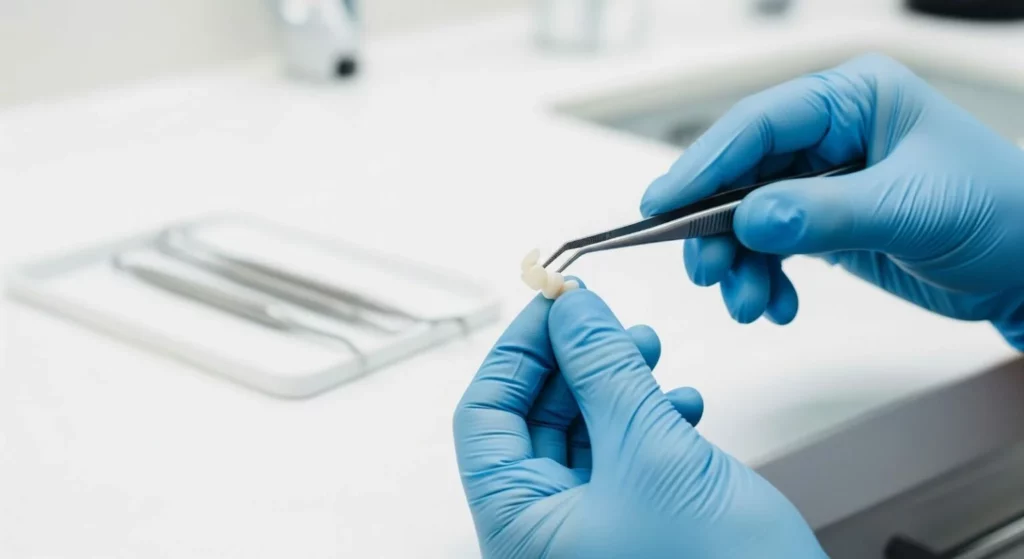
Veneers are thin shells (approximately 0.3–0.7 mm thick) bonded to the front surface of the tooth. They may be made from porcelain (ceramic) or composite resin. Porcelain veneers are laboratory-fabricated, while composite veneers may be created directly at chairside.
Porcelain veneers are indicated for more extensive aesthetic changes: deep discolouration (e.g. tetracycline staining), significant correction of shape, colour and alignment of several teeth simultaneously. They offer the highest level of aesthetics and durability.
Bonding vs veneers — comparison table
The table below sets out the key differences between composite bonding and porcelain veneers to help patients make an informed decision.
| Criterion | Composite bonding | Porcelain veneers |
| Material | Composite resin applied directly | Thin ceramic shell (e.g. e.max) |
| Number of visits | Usually 1 visit | 2–3 visits (+lab work) |
| Tooth preparation | None or minimal | Minimal (0.3–0.5 mm) or none (no-prep) |
| Durability | Circa 5–7 years | Circa 10–15+ years |
| Stain resistance | Moderate — may discolour | High — porcelain does not change colour |
| Aesthetics | Very good (depends on the clinician's skill) | Excellent, stable over time |
| Reversibility | Fully reversible | Partially irreversible (with preparation) |
| Reparability | Easy repair in the clinic | Minor chips can be repaired with composite; major damage requires replacement of the entire veneer |
Durability — which lasts longer?
Porcelain veneers are significantly more durable. A study by Mazzetti et al. (2022) published in Dental Materials compared the survival of ceramic and composite veneers — ceramic restorations demonstrated a substantially longer lifespan.
Composite bonding is less durable — it typically functions for 5–7 years, although with good hygiene and regular follow-up visits, some bonding restorations can last even longer. The most common causes of failure are chipping and discolouration.
When to choose bonding and when to choose veneers?
The choice of method depends on several factors: the scale of the aesthetic problem, expectations regarding durability, the budget and readiness for tooth preparation. Below are specific guidelines.
Bonding is best suited when:
- You want to close a small diastema (gap) between the teeth.
- You need a shape correction on one or a few teeth (e.g. a too-short tooth, a slightly uneven incisal edge).
- You have a limited budget and want a quick result — bonding is completed in a single visit.
- You value full reversibility — the composite can be removed without damaging the tooth.
- You are a young patient (e.g. under 20) whose tooth tissues may still be maturing, or you want to assess the aesthetic result before committing to a more permanent solution.
Porcelain veneers are the better choice when:
- You are planning a comprehensive smile makeover involving 6–10 teeth.
- You have deep discolouration that cannot be masked by whitening or bonding.
- You expect a long-lasting result (10–15+ years) without the need for frequent repairs.
- You want maximum stain resistance — porcelain does not change colour under the influence of coffee, tea or wine.
- You need simultaneous correction of shape, size and colour with a precision that composite cannot achieve.
The Modern Dental & Orthodontics (Klinika MDO) team emphasises that there is no single universal solution. We often recommend a combined approach — porcelain veneers on the most visible teeth and composite bonding on the less prominent ones — to optimise aesthetics and cost.
Can bonding and veneers be combined?
Yes, and this is a common clinical practice. Within a single treatment plan the clinician may use porcelain veneers on the teeth requiring the greatest correction (e.g. the central incisors) and composite bonding on the teeth needing only minor adjustments (e.g. the canines).
The key is to plan the entire result in advance using smile design technology, which allows the final outcome to be viewed on screen and precisely determines which tooth receives which type of restoration.
How much does bonding cost, and how much do veneers cost?
Composite bonding is significantly less expensive — the cost per tooth is approximately PLN 600–1,000, depending on the complexity of the case. Porcelain veneers represent a larger investment — the price per tooth is approximately PLN 2,000–4,500, depending on the ceramic system used.
It is worth considering the long-term costs, however. Bonding requires more frequent polishing and may need replacement every 5–7 years, whereas porcelain veneers, with proper care, can last 10–15+ years without replacement. raty PayU, co czyni licówki porcelanowe bardziej dostępnymi finansowo.
Tooth preparation — which method is more invasive?
Composite bonding is considered a non-invasive method. In most cases the clinician does not grind the enamel — the composite is applied directly to the existing tooth surface. This makes the procedure fully reversible.
Porcelain veneers classically require minimal preparation — removal of 0.3–0.5 mm of enamel from the front surface of the tooth. This is necessary for the veneer to sit flush with the tooth and have adequate thickness for durability and aesthetics.
Aesthetic result — what to expect?
Bonding in the hands of an experienced clinician gives a very natural result; however, composite may lose its lustre over time and become prone to discolouration. This means that periodic polishing (every 6–12 months) is needed to maintain optimal aesthetics.
Porcelain veneers offer the highest aesthetic quality, stable over time. Porcelain reproduces the natural translucency of enamel, does not change colour, and retains its lustre for many years. They are the gold standard in smile design.
The Modern Dental & Orthodontics (Klinika MDO) team advises patients to maintain realistic expectations. Bonding gives excellent results for minor corrections; porcelain veneers are preferred for a comprehensive smile transformation.
FAQ — frequently asked questions
Is bonding painful?
No. Composite bonding is a painless procedure that in most cases does not require anaesthesia. The clinician applies the composite to the tooth surface without drilling or invading the tooth structure.
Do veneers damage teeth?
Porcelain veneers require the removal of a thin layer of enamel (0.3–0.5 mm), which is an irreversible change but does not "destroy" the tooth. No-prep veneers do not require grinding at all.
How long does bonding last?
Composite bonding lasts on average 5 to 7 years, although with good hygiene and regular check-ups it can serve for longer. The main causes of failure are chipping, discolouration and wear.
Can bonding be replaced with veneers later?
Yes. Because bonding is reversible, it can be removed at any time and replaced with porcelain veneers. Many patients treat bonding as a "trial" of their new smile before investing in veneers.
Do bonding and veneers require special care?
Both methods require standard hygiene — brushing, flossing and regular check-ups. Bonding additionally requires periodic polishing (every 6–12 months) to maintain its lustre. For veneers it is important to avoid biting very hard objects.
How much does bonding for a diastema cost?
Closing a diastema with bonding is one of the most common aesthetic procedures. The cost depends on the width of the gap and the number of teeth involved. A precise estimate is provided at the consultation.
Does bonding look natural?
Yes, provided the procedure is performed by an experienced clinician. Modern composites are available in many shades and degrees of translucency, allowing an ideal match with the adjacent teeth.
Read more on Modern Dental & Orthodontics
▶ Veneers and Bonding → klinikamdo.pl/en/offer/aesthetic-and-restorative-dentistry/veneers-and-bonding/
▶ Dental Bonding — A Quick Smile Makeover → klinikamdo.pl/en/blog/dental-bonding-quick-smile-makeover/
▶ Porcelain vs Composite Veneers → klinikamdo.pl/en/blog/porcelain-vs-composite-veneers/
Sources
1. https://pubmed.ncbi.nlm.nih.gov/35379471
Mazzetti T., Collares K., Rodolfo B., da Rosa Rodolpho P.A., van de Sande F.H., Cenci M.S. „10-year practice-based evaluation of ceramic and direct composite veneers.” Dent Mater. 2022;38(5):898–906.
2. https://doi.org/10.3390/jcm10051074
Alenezi A, Alsweed M, Alsidrani S, Chrcanovic BR. „Long-Term Survival and Complication Rates of Porcelain Laminate Veneers in Clinical Studies: A Systematic Review.” J Clin Med. 2021;10(5):1074.
3. https://www.sciencedirect.com/science/article/abs/pii/S1532338223001033?via%3Dihub
Lim T.W., Tan S.K., Li K.Y., Burrow M.F. „Survival and complication rates of resin composite laminate veneers: A systematic review and meta-analysis.” J Evid Based Dent Pract. 2023;23(4):101911.
4. https://www.mdpi.com/2306-5354/10/2/168
Zarow M., Hardan L., Szczeklik K. et al. „Porcelain Veneers in Vital vs. Non-Vital Teeth: A Retrospective Clinical Evaluation.” Bioengineering (Basel). 2023;10(2):168.
5. https://pmc.ncbi.nlm.nih.gov/articles/PMC8989165
Shah Y.R., Shiraguppi V.L., Deosarkar B.A., Shelke U.R. „Long-term survival and reasons for failure in direct anterior composite restorations: A systematic review.” J Conserv Dent. 2021;24(5):415–420.
Information on content and responsibility
This article is intended solely for informational and educational purposes and does not constitute medical advice, a diagnosis or a treatment recommendation. It does not replace a consultation with a dentist or other qualified specialist. Despite every effort to ensure accuracy, the authors accept no liability for decisions made by readers on the basis of the information contained herein.