
The first visit to the orthodontist raises many questions: what exactly happens? What examinations will be carried out? Will braces be fitted straight away?Is a referral needed? This article describes the course of the first consultation step by step.

Is a referral needed for an orthodontist?
No. You can see an orthodontist without a referral. At private clinics such as Modern Dental & Orthodontics (Klinika MDO), you simply need to book an appointment by telephone or online.
What to bring to the first orthodontist appointment?
| What to bring? | Why it matters? |
| Identity document / student card | Data for the patient card and medical records. |
| Radiographs (if available) | Panoramic, cephalometric or CBCT. If you do not have them — they will be taken on site. |
| Previous documentation | If you have already seen an orthodontist or worn braces — bring the records, photographs and treatment description. |
| List of questions | Write down everything you want to ask: treatment options, duration, cost, instalment plans. The consultation is the best moment. |
| Information about medications and medical condition | Certain medications (e.g. bisphosphonates) may affect tooth movement. The orthodontist needs to know. |
Dr Prażmo, specialist orthodontist, Medical Director of Modern Dental & Orthodontics (Klinika MDO), emphasises: Do not stress about the preparation. Everything we need for diagnostics, we can do on site. If you have previous radiographs — bring them; if not — we will take them.
What does the first visit to the orthodontist look like? The course step by step
The first orthodontic appointment at Klinika MDO lasts approximately 30–60 minutes. It consists of several stages, each with a specific diagnostic purpose.
Stage 1: Medical and Dental Interview (up to 10 mins)
The orthodontist talks to the patient (or parent) about the reasons for the visit, expectations and medical history. Questions cover previous orthodontic treatment, medications taken, general health and habits (mouth breathing, bruxism).
Stage 2: Clinical examination of the oral cavity (up to 10–15 min)
The orthodontist carries out a detailed clinical examination, assessing:
- Tooth condition — caries, restorations, missing teeth, impacted teeth
- Bite — the intermaxillary relationship, overjet, crowding, gaps
- Temporomandibular joints — clicking, limited range of movement, pain
- Soft tissues — gum condition, frenum, tongue
- Facial profile — proportions, symmetry, smile line
Stage 3: Imaging diagnostics (up to 10–15 min)
On the basis of the clinical examination the orthodontist requests the appropriate images. At Klinika MDO all necessary imaging is available on site:
| Investigation | What does it show? | When is it needed? |
| Pantomogram | All the teeth, the maxillary and mandibular bones, the joints, the sinuses. A single 2D image of the entire dentition. | Always — the baseline investigation at every orthodontic consultation. |
| Cephalometry | The skeletal profile of the face, intermaxillary angles, tooth position relative to bone. | In many cases — for cephalometric analysis. Not routinely required in all types of malocclusion (Rischen 2013). |
| CBCT (3D tomography) | A three-dimensional image of the bones, roots and impacted teeth. The highest accuracy. | In complex cases: impacted teeth, resorption, surgical planning. |
| Intraoral photographs | Individual teeth, periapical areas, interdental contacts. | As needed — suspected resorption, periapical condition. |
A systematic review by Rischen et al. (2013) analysed the role of different diagnostic investigations in orthodontics. The review indicated that in practice a panoramic radiograph and a cephalogram are most commonly required; CBCT is reserved for complex cases.
Stage 4: Photographs and digital scans
The orthodontist takes a series of photographs (face from the front, in profile, smile, bite from the front, from the side, from above and below). In addition, an intraoral scanner is increasingly used to create a precise 3D model of the teeth.
Stage 5: Preliminary discussion of the diagnosis and treatment options (up to 10–15 min)
At the end of the first visit the orthodontist discusses the preliminary diagnosis and presents the possible treatment options. In the case of simple malocclusions the plan may be outlined on the same day; in complex cases a full plan is prepared for a second appointment.
Typical topics discussed on a first visit:
- Type and severity of the malocclusion
- Treatment options: fixed braces, aligners (Invisalign), removable appliance
- Expected treatment duration
- Indicative cost and financing options (PayU instalments)
- The need for possible extractions or preliminary treatment (caries, hygiene)
- Interdisciplinary collaboration (periodontist, surgeon, prosthodontist)
- Planned retention after treatment (bonded retainer and removable retainer)
The first orthodontic appointment — adults vs children
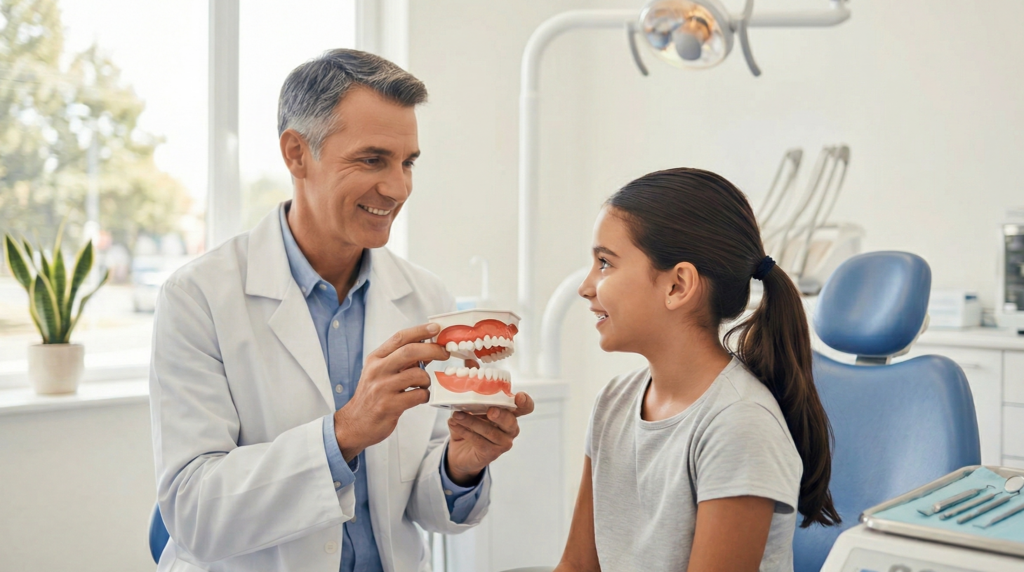
The course of the consultation is similar regardless of age, but there are important differences in diagnostics and approach.
| Aspect | Children (7–12 years) | Adults |
| Main purpose of visit | Assessment of jaw development, tooth transition, early intervention | Full diagnostics and treatment plan |
| Additional investigation | Assessment of skeletal maturity (e.g. using the CVM method — cervical vertebral assessment on the cephalogram) | Assessment of the periodontal condition, joints, possible CBCT |
| Common diagnoses | Class II, Class III, impacted teeth, habits | Advanced malocclusions, missing teeth, relapse |
| Possible treatment | Palatal expander (hyrax), facemask (for Class III correction), observation | Fixed braces, Invisalign, orthognathic surgery |
| Parent's presence | Required — the parent signs the consent | Not required |
What is NOT done at the first orthodontic appointment?
It is worth knowing what not to expect, to avoid disappointment:
- Braces are not fitted — the first visit is solely for diagnostics and planning
- Teeth are not extracted — any extractions are planned later
- You do not need to fast — this is a clinical examination, not a surgical procedure
- It will not hurt — the examination is painless
Is it worth seeing an orthodontist? What does the evidence say?
A survey by Bradley et al. (2020) of 203 orthodontic patients in the United Kingdom found that 96% of patients are satisfied with the outcome of their treatment.
FAQ – Frequently Asked Questions
1. Does the first visit to the orthodontist hurt?
No. The first visit is a clinical examination and imaging diagnostics — none of these is painful. The orthodontist examines the teeth, takes photographs and radiographs — there is no drilling, cutting or anaesthesia.
2. How long does the first orthodontist appointment last?
The first orthodontic consultation usually lasts 30–60 minutes. During this time the orthodontist takes a history, performs a clinical examination, carries out imaging diagnostics and presents a preliminary treatment plan.
3. Will braces be fitted at the first appointment?
No. The first visit is essentially diagnostics. Fitting of the braces takes place at a subsequent appointment, after full analysis and acceptance of the plan by the patient.
4. From what age should a child see an orthodontist?
According to the guidelines of the American Association of Orthodontists (AAO), the first visit is recommended at around the age of 7, when the first permanent teeth appear. This allows any developmental abnormalities to be detected early.
5. Is a referral from a dentist needed to see an orthodontist?
No. You can see an orthodontist without a referral — simply book an appointment by telephone or online. You do not need to bring ready-made results — the clinic will carry out all the necessary diagnostics on site.
6. Can adults wear braces?
Yes. There is no upper age limit for orthodontic treatment. An increasing number of adults are choosing to straighten their teeth — for both aesthetic and health reasons. Options include fixed braces, Invisalign and lingual appliances.

Read more on Modern Dental & Orthodontics
▶ Orthodontics → https://klinikamdo.pl/en/offer/orthodontist/
▶ Clear aligners (Invisalign) — an alternative to traditional braces → https://klinikamdo.pl/en/blog/invisalign-clear-aligners-alternative/
▶ How long do adults wear braces? → https://klinikamdo.pl/en/blog/how-long-do-adults-wear-braces/
Sources
Source 1
Links https://doi.org/10.1179/146531205225021753 | https://pubmed.ncbi.nlm.nih.gov/17142332/
Description Sayers MS, Newton JT. „Patients’ expectations of orthodontic treatment: part 1 – development of a questionnaire.” J Orthod. 2006;33(4):258–269.
Source 2
Links https://doi.org/10.1179/146531207225021888 | https://pubmed.ncbi.nlm.nih.gov/17347295/
Description Sayers MS, Newton JT. „Patients’ expectations of orthodontic treatment: part 2 – findings from a questionnaire survey.” J Orthod. 2007;34(1):25–35.
Source 3
Links https://doi.org/10.1371/journal.pone.0074186 | https://pubmed.ncbi.nlm.nih.gov/24265669/ | https://pmc.ncbi.nlm.nih.gov/articles/PMC3827061/
Description Rischen RJ, Breuning KH, Bronkhorst EM, Kuijpers-Jagtman AM. „Records needed for orthodontic diagnosis and treatment planning: a systematic review.” PLoS One. 2013;8(11):e74186.
Source 4
Links https://doi.org/10.1177/1465312520904377 | https://pubmed.ncbi.nlm.nih.gov/32116083/
Description Bradley E., Shelton A., Hodge T., Morris D., Bekker H., Fletcher S., Barber S. „Patient-reported experience and outcomes from orthodontic treatment.” J Orthod. 2020;47(2):107–115.
Source 5
Links https://doi.org/10.1186/s12903-016-0182-3 | https://pubmed.ncbi.nlm.nih.gov/26884053/ | https://pmc.ncbi.nlm.nih.gov/articles/PMC4756524/
Description Yao J, Li DD, Yang YQ, McGrath CPJ, Mattheos N. „What are patients’ expectations of orthodontic treatment: a systematic review.” BMC Oral Health. 2016;16:19.
Information on content and responsibility
This article is for informational and educational purposes only and does not constitute medical advice, diagnosis, or treatment recommendation. It does not replace a consultation with a doctor. The course of an orthodontic visit may vary depending on the individual case and clinic. Make all health decisions only after an individual consultation with a qualified doctor. The content was prepared using AI tools and then verified under the substantive supervision of the Modern Dental & Orthodontics team. We strive to ensure that the information is reliable and consistent with current medical knowledge, but we do not guarantee its accuracy, completeness, and up-to-dateness. Modern Dental & Orthodontics is not responsible for the consequences of decisions made based on this article without medical consultation.