
Losing a tooth is a problem that goes far beyond the aesthetics of a smile. It can lead to difficulty chewing or shifting of the remaining teeth and even bone loss. Fortunately, modern dentistry offers a solution that is considered the standard for restoring missing teeth, namely implant treatment.
In this article, we will take you through all the stages of implant tooth treatment and restoration so that you know exactly what to expect and can make an informed decision.

What is a tooth implant and how is it constructed?
In the simplest terms, a dental implant is a small titanium screw that replaces a lost tooth root. Titanium is a fully biocompatible material, meaning that the body treats it as its own tissue and does not cause allergic reactions.
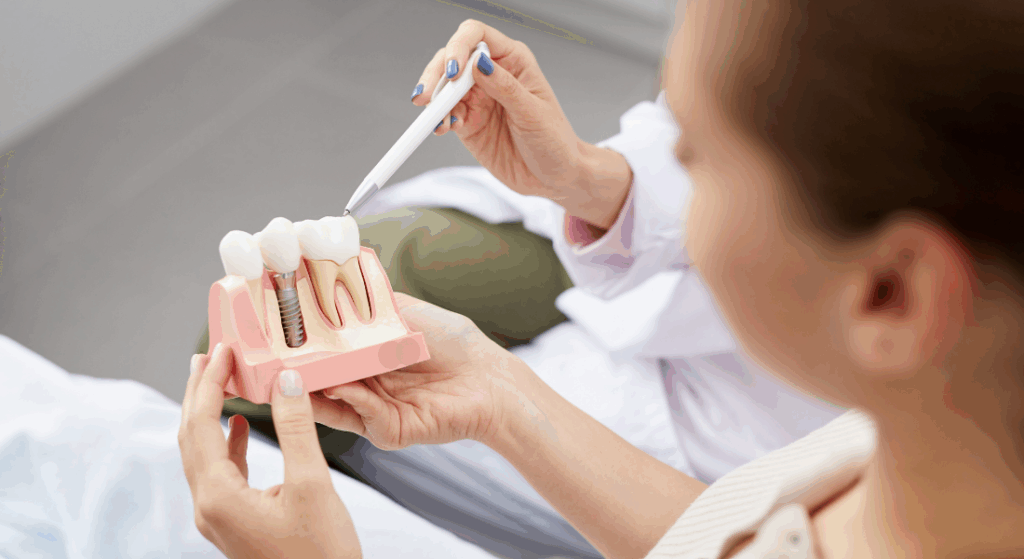
The complete implant consists of three key parts:
- Implant (implant): This is the titanium screw mentioned above, which the dentist inserts into the jawbone. It provides a stable foundation for the entire restoration.
- Prosthetic connector: A small component that attaches to the implant. It acts as a pillar on which the crown will be set.
- Prosthetic crown: The visible part that perfectly mimics the appearance, shape and colour of a natural tooth. It is responsible for a beautiful smile and the restoration of chewing function.
Step-by-step implant treatment - how does the whole process work?
The implant treatment process is staggered to ensure the highest safety and longevity. Each stage is carefully planned and implemented by an experienced team of specialists. Below is what this looks like at our clinic in Warsaw.
Step 1: Implant consultation and precise diagnosis
It all starts with the first visit. This is a key moment when the doctor takes a detailed medical history and assesses the general condition of your mouth. The most important element, however, is advanced diagnostics. In our clinic we perform cone beam computed tomography (CBCT). It is an examination that allows us to accurately assess the quantity and quality of the bone at the planned implant site, as well as to locate important anatomical structures. Based on this information, we create your individual treatment plan, schedule and cost estimate.
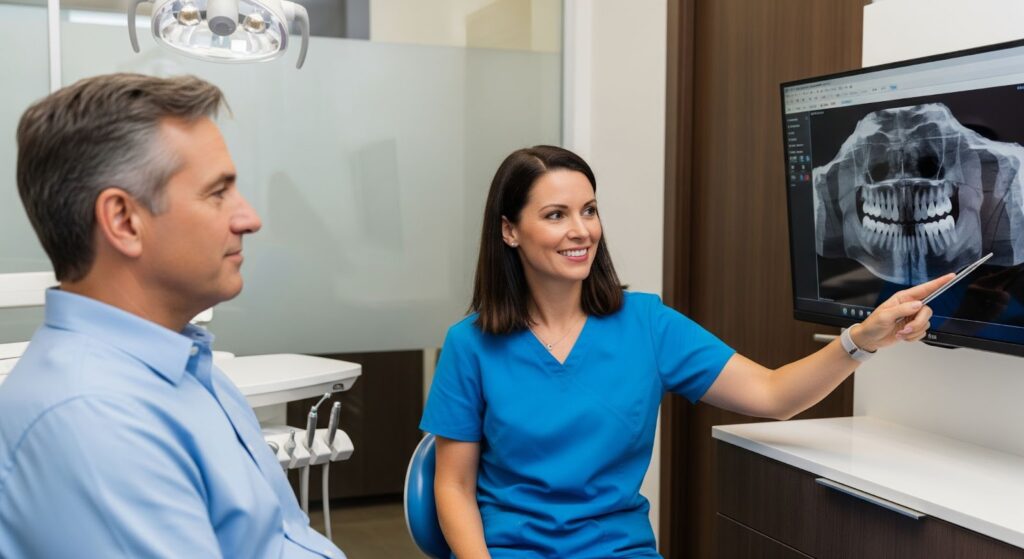
Stage 2: Surgical procedure - implant placement
The implant procedure itself is carried out in comfort and under local anaesthetic, making it completely painless for the patient. The surgeon precisely drills a small hole in the bone and then inserts a titanium implant. After the procedure, the gum is gently sutured. You will be given detailed instructions on how to care for your mouth in the first few days after the implant.
Stage 3: Healing time
Once the implant has been placed in the bone, the most important biological stage takes place, namely osteointegration. This is the process during which the surface of the implant permanently fuses with the surrounding bone tissue, creating an extremely strong and stable connection. This process usually lasts between three and six months and is crucial for the long-term success of the treatment. During this time, the implant is invisible as it is hidden under the gums.
Step 4: Exposure of the implant and installation of the healing screw
Once the osteointegration is complete, you will be invited for a short and simple procedure. This involves making a gentle incision in the gum and exposing the implant, into which a so-called healing screw is screwed. Its function is to mould the gum in such a way that the future crown looks natural and aesthetically pleasing. It takes approximately two weeks for the gum to heal around the screw.
Step 5: Prosthetic restoration - implant-supported crown placement
Once the gum has healed, impressions are taken (traditional or with an intraoral scanner), which are sent to the prosthetic laboratory. There, a dental technician prepares a perfectly fitting prosthetic crown for you. During the final visit, the finished crown is precisely fixed to the implant.
How much does a tooth implant cost? What does the final price depend on?
Price of implant treatment is one of the factors that patients are most interested in. It is important to understand that the total cost of a tooth implant is made up of several components. The main components of the price are:
- Consultation and full diagnostics, including CBCT scans.
- Cost of the implant itself, a titanium implant.
- The cost of carrying out the surgical procedure.
- Cost of prosthetic abutment and healing screw.
- The cost of making and fitting a prosthetic crown.
- Cost of any additional treatments, if necessary.
You will always learn the exact cost estimate during the consultation visit, after we have discussed your individual needs.
Frequently Asked Questions (FAQ)
Does an implant hurt?
The procedure is performed under local anaesthesia, ensuring complete comfort and no pain during the procedure. After the anaesthetic has worn off, discomfort or swelling may occur, which can be controlled with prescribed analgesics and cold compresses.
What are the main contraindications to implants?
The main contraindications include unstabilised diabetes, active cancer treatment, certain bone diseases, pregnancy and very poor oral hygiene. The final qualification for the procedure is always carried out by the doctor on the basis of a detailed history and examination.
How should dental implants be cared for?
Implants should be cared for in exactly the same way as natural teeth. The basis is daily brushing, flossing of the interdental spaces and regular check-ups and professional hygiene at the dental surgery. Proper hygiene is a guarantee that the implant will last for many years.

Bottom line - why opt for implants?
Choosing an implant is an investment in health, comfort and confidence. It is the most durable solution that not only perfectly mimics natural teeth in terms of aesthetics and function, but also prevents bone atrophy and protects neighbouring teeth from displacement. With implants, you can eat freely again, laugh and enjoy life to the full without compromise.
Contact us today to make an appointment for a consultation At the Modern Dental & Orthodontics clinic in Warsaw's Wola district. Our experts will answer all your questions and provide a personalised treatment plan.