
A smile is our calling card, and healthy teeth are the foundation of self-confidence. Unfortunately, trauma, advanced caries and root canal treatment can lead to situations in which a tooth requires comprehensive reconstruction. A prosthetic crown is one of the most effective methods.
What exactly is a crown, and when is it used? It is a fixed prosthetic restoration that is permanently cemented onto a prepared tooth or an implant. It covers the entire visible portion of the tooth, restoring its shape, strength and natural appearance.

When is a prosthetic crown worth considering?
The dentist makes decisions of making a dental crown when the natural tissues of the tooth are so damaged that a traditional filling (filling) cannot provide adequate strength and protection.
The most common indications include:
- Significant damage to teeth via caries.
- Reconstruction of a tooth after endodontic treatment.
- Fracture or breakage of the crown natural tooth.
- Improving aesthetics, i.e. the shape, colour or size of the tooth.
- As a pillar in a prosthetic bridge.
- As the culmination of implant treatment. A crown is the final stage of restoring a missing tooth to an implant (learn more from our guide to the stages of implant treatment).

Types of dental crowns - detailed comparison of materials
The choice of the right material is crucial to the durability and aesthetics of the final restoration. Modern dentistry offers several proven options.
Porcelain-fused-to-metal (PFM) crown
This is a classic and very durable solution that has been successfully used in prosthetics for years. It consists of an internal „skeleton” made of a metal alloy (usually chromium and cobalt), which is covered externally with a layer of porcelain in the colour of the patient's teeth. The metal core provides it with great resistance, making it a great choice for the restoration of lateral teeth (molars and premolars).
The main disadvantage of this solution is aesthetics, because, as the gums recede over time, a metallic, bluish line can become visible at the border of the crown. For this reason, they are used less frequently on anterior teeth.
Patients often ask: how many years will a porcelain crown on metal last? Its lifespan, like that of any other restoration, depends on hygienic care and can be as long as 10 to 20 years, and sometimes even longer.
All-ceramic crown
As the name suggests, an all-ceramic crown is made entirely of porcelain, without a metal core.
Its biggest advantage is aesthetics. Ceramic perfectly mimics natural enamel, making the restoration virtually indistinguishable from your own teeth. It is also a fully biocompatible material, meaning that it does not cause allergic reactions and is perfectly tolerated by the gums.
Due to the slightly lower mechanical strength compared to crowns on metal, is the ideal choice especially for restoring anterior teeth, where appearance counts most.
Zirconia crown
The zirconia crown is a state-of-the-art solution that combines the advantages of both of the above methods, i.e. the mechanical strength of metal and the excellent aesthetics of porcelain. Zirconium oxide, from which it is made, is a material of great hardness and biocompatibility, sometimes referred to as the „white gold” of dentistry.
The zirconia crown has no metal, so there will never be a problem of blue gums, and its colour is stable and natural. It is a versatile solution that can be successfully applied to both front and side teeth.
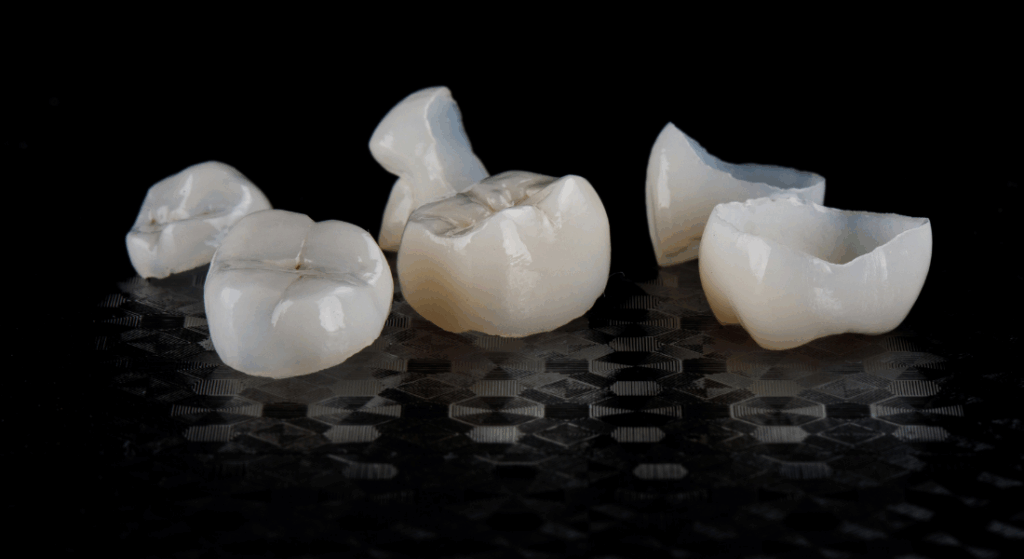
Modern alternatives: Inlay, Onlay and Endocorona
A tooth does not always need to be ground down for a full crown. If the cavity is extensive but some healthy tissue still remains, the dentist can suggest other modern solutions.
Composite inlay / onlay
Both inlays and onlays are intracoronal inlays, which are an excellent alternative to composite fillings (fillings)., when the cavity is too extensive, but at the same time there is no need to grind the entire tooth for a traditional crown. These are solutions that spare the healthy tissues of the tooth.
The main difference between the two is the extent of the reconstruction.
- Inlay: It is a precision filling that recreates the chewing surface of the tooth inside its crown, without covering the tops of the cusps. It can be compared to a very durable and perfectly fitting „filling” made in a prosthetic laboratory.
- Onlay: This is a more extensive restoration. In addition to filling the inside of the crown, the onlay also covers and restores one or more cusps of the tooth. It thus strengthens the entire structure of the weakened tooth, protecting it from fracture.
Endocorona
This is a special type of restoration used in dead teeth, which combines an inlay and a crown. It is an excellent solution to strengthen the tooth after root canal treatment (read more about it, what root canal treatment looks like in our guide).
Composite crown
A composite crown is a type of prosthetic restoration made of composite material. Due to its properties, it has specific applications and is most often used as a temporary crown.
How does the process of fitting a crown work?
The prosthetic treatment process is spread over several visits. First, the prosthodontist carries out a detailed diagnosis and consultation, during which he plans the treatment. The tooth is then precision ground under anaesthesia to create space for the future crown.
The next step is to take an impression or an intraoral scan, which is sent to the prosthetic laboratory. While waiting for the finished work, the ground tooth is secured with a temporary crown. At the final appointment, the finished, perfectly fitting dental crown is permanently cemented onto the tooth.

Frequently Asked Questions (FAQ)
1. Does it hurt to place a dental crown?
No. The entire process of preparing the tooth, i.e. grinding it, takes place under local anaesthesia, making it completely painless for the patient.
2. How long does the prosthetic treatment process take?
It usually takes 1-2 weeks from the first visit to cementing the finished crown. This time is needed for the prosthetic laboratory to produce a customised restoration.
3. How to care for a dental crown?
The crown should be cared for in exactly the same way as natural teeth. Regular brushing, flossing of the interdental spaces and regular dental check-ups and hygiene visits are key.
4 What is the price of a crown on a tooth?
The cost depends on the type of crowny and selected material. Metal-framed crowns are the most economical solution, while all-ceramic and zirconia crowns, due to their advanced technology, are more expensive. An exact cost estimate can be obtained during the consultation appointment.
Summary
Whether the aim is to strengthen a weakened tooth or to comprehensively improve aesthetics, modern prosthetics offers effective and durable solutions. The choice between a metal-on-metal, all-ceramic or zirconia crown depends on the location of the tooth and aesthetic expectations, as well as the budget.
Do you have questions about prosthetic crowns? Please visit consultation to the Modern Dental & Orthodontics Clinic in Warsaw's Wola district. During your visit, an experienced prosthodontist will help you choose the best treatment method to suit your needs. Make an appointment!