
Wisdom teeth, colloquially known as "eights", are a topic that raises many questions and, not infrequently, concerns. Does everyone need to have them removed? When is extraction of a wisdom tooth absolutely necessary?
This article will dispel your doubts and guide you through the entire process — from the first symptoms, through diagnostics and the procedure, to post-operative recommendations.
When must a wisdom tooth be removed? The main indications
The decision to remove a wisdom tooth is never taken hastily. There is, however, a range of specific medical indications that qualify a tooth for extraction. The most common are:
Pain and recurrent inflammation
This is the most common reason for visiting the clinic. Wisdom tooth pain, often described as throbbing and difficult to localise, may radiate towards the ear, temple or throat.
Another problem is a painful, swollen gum around the wisdom tooth, which makes chewing difficult. These symptoms indicate an inflammatory process that, without intervention, will recur.
Insufficient space in the dental arch
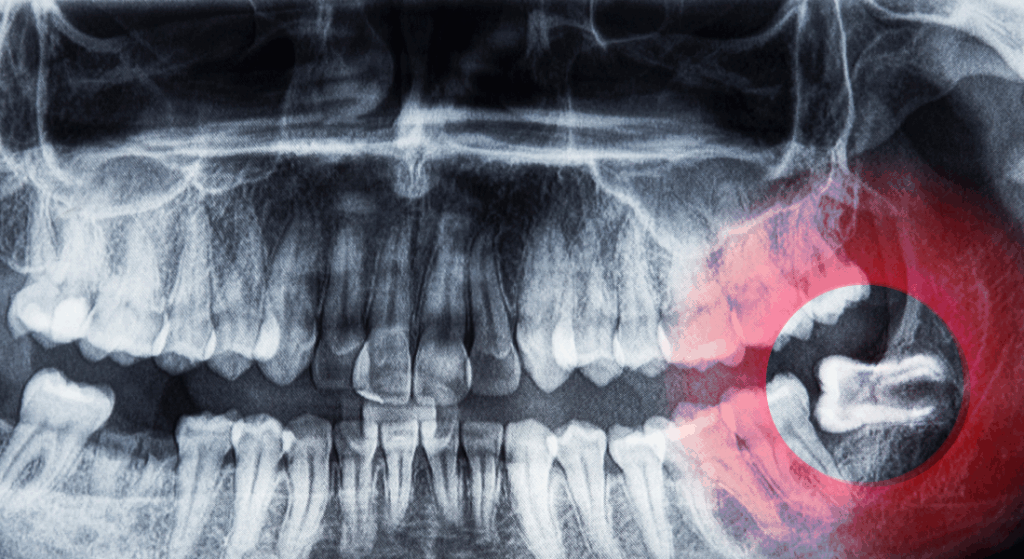
An erupting wisdom tooth often does not have enough room to position itself correctly in the arch. It is common for the wisdom tooth to be blocked (impacted) — lying horizontally, at an angle or being covered entirely by the gum.
Orthodontic reasons and damage to adjacent teeth
Removal of wisdom teeth before starting fixed braces is often indicated. The presence of third molars can prevent changes in tooth position and compromise the stability of the orthodontic result.
Furthermore, an abnormally positioned wisdom tooth can press against the root of the adjacent tooth (the second molar), leading to its damage and even loss through resorption.

What does wisdom tooth extraction look like? A step-by-step guide
Modern dental surgery allows the procedure to be carried out safely and comfortably for the patient.
1. Consultation and diagnostics — the key to precision
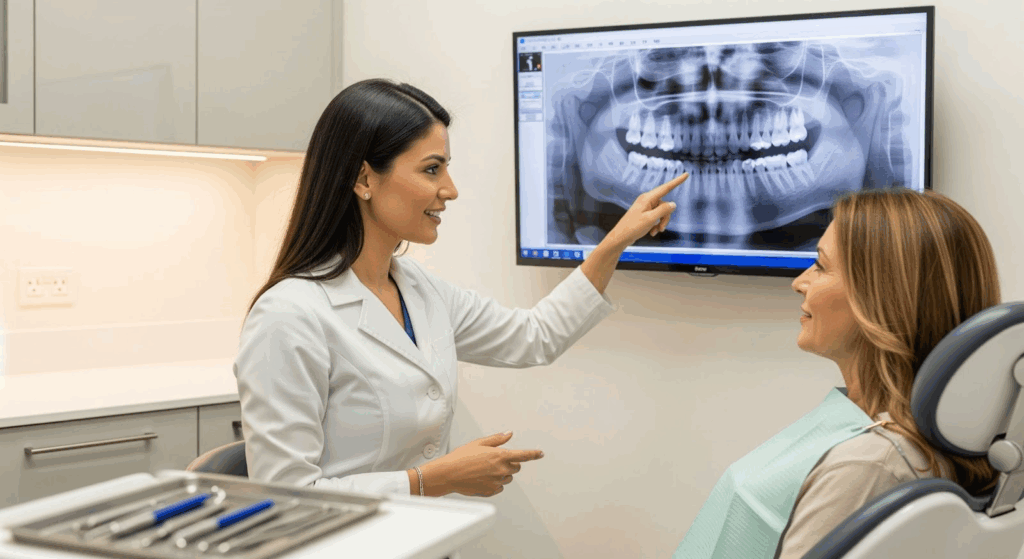
The first step is always a consultation appointment. The clinician takes a history and carries out the necessary diagnostics. Most commonly this is a panoramic radiograph, but in more complex cases a CBCT (cone-beam computed tomography) scan is necessary.
At our clinic in Wola, Warsaw, we use a modern CS 8200 3D scanner, which allows the position of the tooth and its relationship to critical anatomical structures (the inferior alveolar nerve, the maxillary sinus) to be assessed with absolute precision.
2. Anaesthesia — does wisdom tooth extraction hurt?
The procedure is performed under local anaesthesia, which completely eliminates pain. The patient feels only touch and gentle pressure, but no pain. For patients with severe dental anxiety, we also offer inhalation sedation (laughing gas).
3. The procedure — simple extraction or surgical removal?
The method of removal depends on the position of the tooth.
- Simple extraction applies to teeth that are fully visible in the oral cavity.
- Surgical removal of wisdom teeth is necessary when the tooth is impacted. The surgeon then gently incises the gum to gain access to the tooth, and sometimes divides the tooth into smaller pieces to minimise surgical trauma.
Post-extraction recommendations — what to do and what to avoid
Your behaviour after the procedure has a major impact on the speed of healing. To minimise the risk of complications and reduce swelling after wisdom tooth extraction, follow the recommendations below:
What to do:
- Apply cold compresses to the cheek for the first 2 days (e.g. 15 minutes on, 15 minutes off).
- Bite on a sterile gauze pad for approximately 30 minutes after the procedure to control bleeding.
- Rest and avoid physical exertion for several days.
- Eat soft, cool foods (yoghurts, cream soups).
- Take the prescribed analgesics as directed by the clinician.
What NOT to do after wisdom tooth extraction:
- Do not smoke or drink alcohol for at least 48 hours (they slow healing).
- Do not eat or drink hot foods and beverages for the first 24 hours.
- Do not rinse the mouth vigorously for 24 hours, so as not to dislodge the blood clot (this carries a risk of so-called dry socket).

FAQ – Frequently Asked Questions
Does every wisdom tooth need to be removed?
No. If the wisdom teeth are correctly positioned in the arch, healthy and cause no symptoms, and the patient is able to maintain their hygiene, they can remain. A decision is always made individually after a thorough examination.
How long does wisdom tooth extraction take?
The duration varies. A simple extraction may take as little as 15–20 minutes. More complex surgical removals, especially of deeply impacted teeth, may last 30–60 minutes.
When can I return to normal activities?
Most patients return to calm, everyday activities the following day. Swelling after wisdom tooth extraction is greatest on day 2 and 3, and usually subsides by day 7.
Have doubts? Book a consultation!
If you are experiencing wisdom tooth pain or simply want to check the condition of your teeth, do not delay. We invite you for a consultation at our clinic.
Professional wisdom tooth extraction is a guarantee of safety and comfort. Our team of specialists at Klinika Modern Dental & Orthodontics in Wola, Warsaw, will look after you at every stage.