
At our clinic in Wola, Warsaw, we believe that the key to success is not only experience but also continuous development and following the latest scientific discoveries.
The Medical Director & co-owner of our clinic, dr n. med. Prażmo, is the author of a scientific article on photodynamic therapy, published in collaboration with prof. dr hab. n. med. Mielczarek in the journal Protetyka Stomatologiczna.
One of the problems faced by patients wearing removable dentures is denture stomatitis. It is an infection of the oral mucosa caused by a yeast-like fungus (most commonly Candida albicans), manifesting as painful redness and erosions beneath the denture.
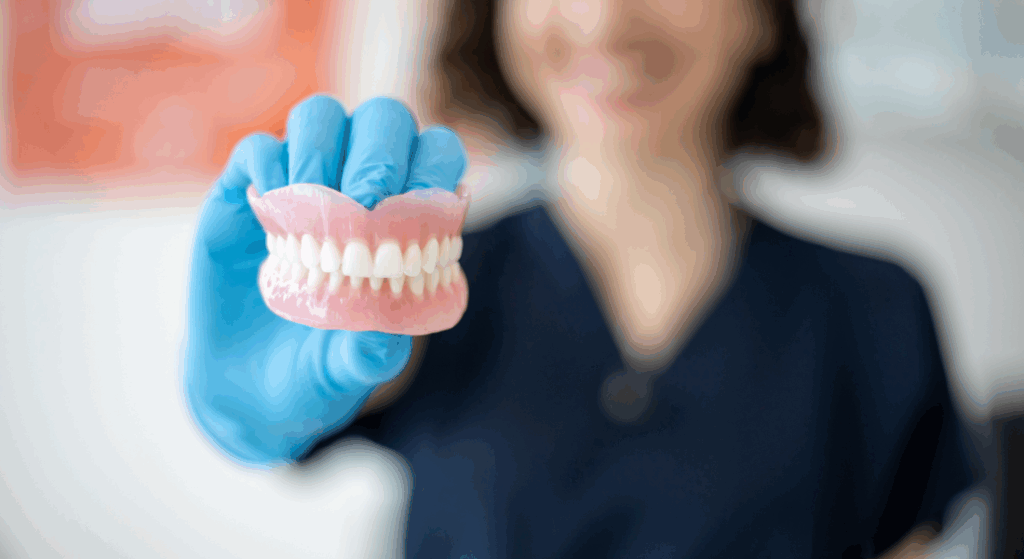
The problem with standard treatment of denture infection
Conventional methods, such as topically or systemically administered antifungal agents (e.g. nystatin), are effective. Unfortunately, their main drawback is a high rate of relapse — the infection returns after treatment is discontinued. This is because many patients have difficulty maintaining adequate hygiene of the denture and the oral mucosa, and the fungus is adept at surviving on the porous surface of the acrylic.
Photodynamic therapy (PDT)
A promising direction is photodynamic therapy (PDT).
How does it work in simple terms? The therapy relies on the interaction of three elements:
- Light of a specific wavelength.
- A photosensitiser (a special substance, e.g. in gel form).
- Oxygen present in the tissues.
This method has a broad spectrum of activity and is successfully used to eliminate bacteria, viruses and also fungi. Importantly, the risk of developing microbial resistance to this therapy is very low — a major advantage over traditional antifungal agents.
What does the scientific evidence say?
The publication by dr n. med. Prażmo and prof. dr hab. n. med. Mielczarek analyses the available clinical studies comparing the efficacy of PDT with conventional antifungal treatment.
The results of clinical studies show that the efficacy of photodynamic therapy is comparable to that of commonly used antifungal medications.
Unfortunately, the analysis also shows that the problem of infection relapse affects both methods. In one of the cited clinical studies, after 60 days both the PDT group and the nystatin group showed similar relapse rates.
Conclusions for our patients
Photodynamic therapy (PDT) is undoubtedly a promising and novel treatment method. However, as rigorous scientific analysis shows, it still requires optimisation — particularly with regard to treatment protocols, doses and long-term outcomes.
At our clinic we follow the advances in this field. Our aim is to implement only those procedures whose efficacy and long-term effects are confirmed by the highest level of scientific evidence.
For those interested in exploring the subject further, we make available the full text of the article prepared by dr n. med. Ewa Prażmo, in collaboration with prof. dr hab. n. med. Mielczarek.
Prażmo, E., Mielczarek, A. (2017). Application of photodynamic therapy in the treatment of prosthetic stomatopathies. Protetyka Stomatologiczna, 67(4), s. 355–363.