
What sets pain from a tooth apart from the other three
- Toothache or sinus pain is one of the most common confusions in this part of the face. A tooth usually hurts in response to a stimulus that will reproduce the pain: cold, sweet, biting.
- Pain covering several upper back teeth on one side points first to the maxillary sinus, not to any one of those teeth.
- Inflammation of one sinus with a lesion visible on computed tomography at an upper tooth on the same side had a dental cause, in one study, in roughly four cases out of five.
- A tooth that has caused inflammation of the sinus often does not hurt. Inflammation of the tissues around the root apex can run painlessly for years.
- Pain from the masticatory muscles and the temporomandibular joint radiates into the teeth, but it usually does not respond to cold and rarely wakes you at night.
- No single test settles whether the pulp inside the tooth is diseased. The diagnosis is made from several examinations at once - and a good clinician will say so plainly.
A patient over 50 presents with pain in the upper teeth on the right side, lasting seven weeks, and she has already been to a dentist twice with it: once the first molar was opened, once the filling in the second premolar was replaced. The pain has not eased for a single day. It does not wake her at night and it does not respond to cold. It gets worse when she bends her head forward, and for the past two weeks it has come with a blocked right nostril.
A third procedure on a third tooth will not help if the pain comes from none of them, and opening a tooth cannot be undone.
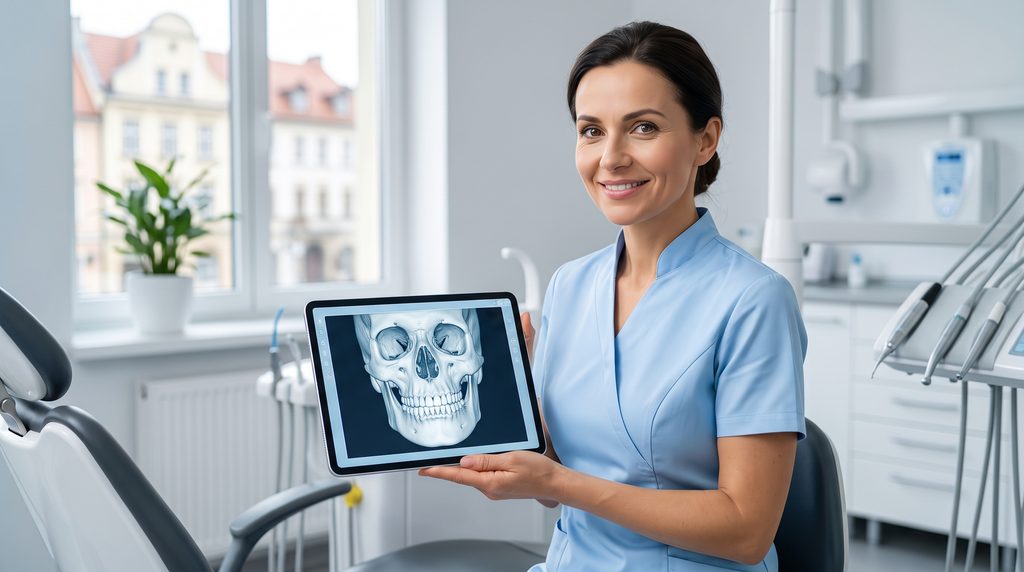
Why facial pain is so easily mistaken for pain from a tooth
Because it reaches the brain by the same route. The trigeminal nerve carries sensation from the teeth, from the maxillary sinuses, from the temporomandibular joint and from the masticatory muscles, so a signal from one of these places is sometimes read as a signal from the one next to it. Then there is a feature of the tooth itself. The pulp, that is the tissue with nerves and vessels inside the tooth, has no position sensors, so a patient is sometimes certain of the wrong tooth. Radiating pain also happens when the tooth really is diseased. In a study of irreversible pulpitis, 23 people whose pain spread beyond the diseased tooth were compared with 12 without it.
Tooth pain when biting - how do you tell the cause is in the tooth?
Usually by the fact that the pain can be provoked.
Pain of dental origin usually has its stimulus: repeatable, and testable in the chair.
The typical set looks like this:
- a reaction to cold or to sweet, brief when the tooth is merely irritated, prolonged in irreversible pulpitis;
- tooth pain when biting, once the inflammation has involved the tissues around the root apex;
- pain that builds after lying down, sharp and throbbing;
- confinement to one tooth, or to two neighbouring ones.
The last point is the most useful. The narrower the area, the greater the chance that the cause sits in the tooth. A toothache with no decay and no leaking filling is not rare - that is exactly when the three remaining trails described below have to be checked. What to do in an acute attack is covered in a seperate article regarding acute toothache.
The other side of this also needs to be noted. The state of the pulp is assessed on weak foundations: there is no reference standard against which the accuracy of the tests could be measured. That is how it is summed up by a review prepared for the European guidelines on managing pulpitis; its authors propose a set of examinations and symptoms instead of a single test.
Toothache or sinus pain - when do several upper teeth on one side hurt at once?
Usually when the floor of the maxillary sinus lies just above the roots of the upper back teeth, and the inflammation irritates them all at once.
With the question of upper teeth and sinus pain, the picture falls into a characteristic shape: no tooth hurts in particular, the pain builds when the head is bent forward, it comes with a blocked nose, thick discharge, sometimes a feeling of pressure under the eye. Cold changes nothing, and biting on a single tooth does not reproduce the complaint.
Inflammation of both sinuses at once argues against a dental cause. Disease of a tooth rarely breaks out on both sides at the same time. Among 261 patients with a dental cause, 223 were unilateral. In the remaining group, 13 in 100 were unilateral. This was counted on computed tomography in 968 patients treated at an ENT clinic; a dental cause was found there in not quite 27 inflammations of the maxillary sinus per hundred. That is a group already selected for imaging, so the proportion cannot be carried over to all patients.
The culprit is usually one of two teeth. The lesion sat most often at the first or the second upper molar; those two teeth accounted for close to four fifths of the changes described. Unilateral inflammation of the sinus with a lesion at a tooth on the same side argues strongly for a dental cause. In the same material it was diagnosed in roughly four cases out of five, in 86 patients out of 108. The authors do not report how they separated out that group.
The hardest part is that the tooth responsible for the inflammation of the sinus usually does not hurt. Chronic inflammation of the periapical tissues can be entirely painless and can develop over years. The sinus often reacts even so: a thickened mucous membrane above the root was visible on 179 of 322 scans. They were taken at an endodontic clinic, only for upper back teeth, most of which had already had root canal treatment.
The gap is on the other side of that border. The state of the dentition was left out of the records of three patients in four referred to an ENT clinic with chronic inflammation of the sinuses. The study rested on entries in the notes, so it speaks about what was written down: the question about the teeth was not reaching the chart. Only the patient sees both sides of that border. When you go to an ENT specialist, say on your own initiative which upper teeth have had root canal treatment, been extracted or hurt.
The patient from the beginning of this article has the full set of features arguing for the sinus: the pain covers several teeth at once, it does not respond to cold, it gets worse when she bends her head forward and it goes together with a blocked nose on the same side. That is the point at which to ask whether anyone has looked at that sinus at all.
When the temporomandibular joint and the masticatory muscles are to blame
Pain in the masticatory muscles is sometimes felt in the teeth, although the teeth are healthy. The masseter, tense from clenching, refers pain into the molars on the same side. The joint lies just in front of the ear canal, which is why toothache radiating to the ear is sometimes joint pain or muscle pain. This pain has a different character from the dental sort. It is dull and diffuse, it covers an area rather than a point, it is sometimes worse in the morning or builds through the day; long chewing and wide opening of the mouth make it worse, and cold makes no difference here. It rarely wakes you at night, but that feature on its own settles nothing: there is pain of dental origin that does not wake you, and muscle pain that does. Muscle pain that spreads beyond the muscle itself goes together with a heavier picture: it lasts longer and covers more painful sites. That is how 196 people with referred pain were compared with 299 without it.
There is something you can check here yourself, though it does not replace an examination. Put your fingers on the cheek above the angle of the jaw and clench your teeth: the hard band that jumps up under your fingers is the masseter. If pressing on that band reproduces the pain in your teeth, the trail leads to the muscle. Check as well how many fingers fit vertically between the incisors at full opening. Fewer than three is worth reporting to a clinician.
Clicking and locking of the jaw are covered under a separate article covering symptoms from the temporomandibular joint, and morning headache and neck tension under bruxism.
Can the pain come from the nerve itself?
Yes. Pain coming from the trigeminal nerve itself looks different from pain from a tooth, from a sinus and from the masticatory muscles: it arrives in attacks, and between them it is sometimes quiet.
Trigeminal neuralgia means attacks of pain lasting from a fraction of a second to two minutes, described as an electric shock and set off by a light stimulus: a touch on the skin of the face, a draught of cold air, brushing the teeth, chewing. The pain is one-sided and keeps to the area of one or several branches of the nerve, most often the branch that supplies the upper or the lower jaw; that is why the first person consulted is sometimes the dentist.
One more thing misleads here. Autonomic features, that is watering of the eye, redness of the conjunctiva and blockage of the nose, were found, even if only singly, in two out of five patients with facial neuralgia. That is how a pooled analysis of studies on facial neuralgias came out. In trigeminal neuralgia the most common was watering of the eye. An attack of pain in the upper jaw with a watering eye and a blocked nose on the same side then looks like a sinus, though it is not one.
Pain that persists in a tooth after correctly performed treatment looks different. Opening the tooth again is then not a route to a diagnosis.
A neuralgia is diagnosed by a neurologist. Extracting a tooth “as a trial” where a neuralgia is suspected is an irreversible procedure that brings no diagnosis.
Tooth, sinus, joint or nerve - a table of differentiating features
The table gathers the features a clinician asks about when taking a history, and shows what to check with the question of toothache or sinus pain.
It is not a test to be carried out on your own and it does not replace an examination.
| Feature of the pain | Argues for | What undermines it |
|---|---|---|
| Prolonged reaction to cold, spontaneous pain waking you at night | the pulp of the tooth | no reaction to cold |
| Tooth pain when biting on one tooth | the tissues around the root apex, a crack | pain on biting on all the teeth on one side |
| Several upper back teeth at once, one side, worse when the head is bent forward | the maxillary sinus | no symptoms from the nose; both sides at once |
| Dull pain over an area, worse in the morning and on chewing, tender muscles | the masticatory muscles and the temporomandibular joint | sharp pain from cold |
| Attacks lasting seconds, like an electric shock, set off by touch or a draught | trigeminal neuralgia | no attacks; a prolonged reaction to cold in one tooth |
| Constant pain in a tooth after correct treatment, with no reaction to stimuli | neuropathic pain following a procedure | a fresh cavity or a leaking filling |
When is this not a matter for the dentist?
When is this not a matter for the dentist?
Flags that point beyond the dental surgery:
- to an ENT specialist: one-sided blockage of the nose, thick discharge, disturbance of smell lasting more than ten days or returning after an antibiotic;
- to a neurologist: paroxysmal pain set off by touch, numbness of part of the face, weakness of the facial muscles, double vision; where the weakness of the facial muscles or the double vision comes on suddenly — immediately to emergency care;
- to a general practitioner without delay: persistent facial pain, lasting weeks despite treatment, accompanied by general symptoms - weight loss, fever with no identifiable cause, night sweats;
- immediately to emergency care: pain in the lower jaw or in the teeth that comes on with exertion and eases at rest, especially with breathlessness, sweating or chest pain, and also spreading swelling of the face with fever or with difficulty opening the mouth and swallowing.
Cardiac pain is sometimes overlooked in this set, and it is well described: pain in the jaw and in the ear is sometimes a symptom of heart disease and of other diseases of the organs of the chest. Pain in the teeth with a trigger of that kind is not a dental matter.
This does not mean that every facial pain calls for computed tomography or a visit to a neurologist. A considerable part of such pains has a dental cause and is explained at the first appointment; the list above says only when it is not permissible to stop at the teeth.
Who should you go to first?
Usually to the dentist. With facial pain and no alarm symptoms, the dentist is the first person to see. The alarm symptoms that change that order are listed in the previous section.
A dental examination combined with radiographic diagnostics is the quickest route to ruling out the most common cause. It is worth coming to the appointment with four answers prepared: how long it has hurt, what brings the pain on, how many teeth it covers and whether anything is happening in the nose on the same side - differentiation starts from these. The patient knows them better than any radiograph does. Ask as well for the reaction to cold to be checked in all the teeth on that side, including the ones that do not hurt.
If the examination finds no cause in the tooth, the order tends to be this: an ENT specialist where there are symptoms from the nose, a clinician who deals with functional disorders of the masticatory system where the muscles are tender and opening is limited, a neurologist where the pain is paroxysmal. Rarely, but it happens, facial pain is the first symptom of a disease running its course outside the face; the case reports of this share the persistence of the pain and general symptoms, weight loss for example.
In everyday clinical practice at Modern Dental & Orthodontics (Klinika MDO) we meet patients who have had two or three procedures on different teeth in the same area. We begin the conversation from what brings the pain on, not from which tooth looks worst on the radiograph.
Which tooth do you open third?
Not that third one. A tooth that hurts despite the absence of decay and despite two procedures on two different teeth is a signal to change the question, not to choose a third tooth. That is when the question of toothache or sinus pain comes back, and with it the three remaining trails. There is no single number of weeks after which unexplained pain becomes urgent; the threshold is a different one. Pain that has survived two courses of treatment, or that persists although the site of the procedure has healed, calls for the diagnosis to be widened beyond the tooth.
The difficulty is not spread evenly. Twelve general dentists assessed case descriptions of facial pain in one study. They did not examine the patients. They did worse with pains not arising from a tooth: neuropathic ones, neurovascular ones and ones referred from the heart. That says which way the difficulty runs. How large it is, the study does not measure.
Every opening of a tooth takes away tissue that cannot be put back. With pain whose source has not been established, it is more sensible to go back to the history than to reach for the bur.
These four sources of pain do not exclude one another: an asymptomatic lesion at the root apex and inflammation of the sinus are by definition two diagnoses at once, and a repaired tooth still hurts if the muscle has not been dealt with. One cause found does not close the case.
The patient from the beginning of this text was not short of procedures. What was missing was the question of whether the pain came from a tooth at all, and an examination of the sinus on the side of the blocked nose. A third tooth will not ask that question.
The typical error in this group is not a missed disease - it is treatment of a tooth that was never the cause.
Frequently asked questions
Does sinus pain cover several teeth at once?
Usually yes, and that is the most characteristic feature of this pain. Inflammation of the maxillary sinus irritates the roots of several neighbouring back teeth on one side, so the patient cannot point to a single culprit. With the question of toothache or sinus pain, this is exactly what counts: pain in a single tooth, brought on reproducibly by biting or by cold, argues rather for a dental cause.
What does tooth pain when biting mean?
Most often that the inflammation has involved the tissues around the root apex - the tooth is then tender to percussion and reacts reproducibly to the same movement. Sharp pain on biting at one point is sometimes a symptom of a crack. When several upper back teeth on one side hurt, the trail leads rather to the sinus.
Why does toothache radiate to the ear?
Because the ear, the temporomandibular joint and the lower molars lie close to one another, and sensation from that area is carried by the same nerve. Pain in a lower molar is sometimes felt as pain in the ear on the same side. With discharge from the ear, fever or worsening hearing, see an ENT specialist.
Will a radiograph settle where the pain comes from?
Rarely on its own. A radiograph shows changes in the bone and the state of the fillings, but it does not show pain or the state of the pulp. A visible lesion at a root is not proof that it is the thing hurting, and its absence does not rule out disease of the tooth. The radiograph is one element of a set of examinations and settles nothing on its own. The range of imaging examinations is covered by a separate guide to dental radiology.
Can treating a tooth bring on inflammation of the sinus?
It can. Procedures on the upper back teeth - root canal treatment, extraction of a tooth, elevation of the sinus floor before an implant is placed - are among the described causes of inflammation of the maxillary sinus. The symptom is then sometimes one-sided blockage of the nose and discharge appearing in the weeks after the procedure, rather than pain in the treated tooth.
Can it be from stress?
Tension in the masticatory muscles is a physical phenomenon, not a way of brushing the patient off - a tense muscle hurts as really as a diseased tooth. In one study, patients with masticatory muscle pain radiating beyond the muscle had more anxiety and more symptoms of low mood than patients without radiation. The two things occurred together. That one brings on the other does not follow from this. The tension is treated independently of the cause.
A tooth hurts after correctly performed root canal treatment. What is that?
When reassessment and a radiograph find no cause in the tooth, and the pain is continuous, dull and does not respond to cold, neuropathic pain following the procedure is taken into account. Classifications of facial pain have a separate category for it: persistent idiopathic dentoalveolar pain, formerly atypical odontalgia. The diagnosis is made by a neurologist or by a clinician who deals with facial pain. Opening the tooth again does not establish it.
Read more:
- Aesthetic and Restorative Dentistry in Warsaw
- Pulpitis - reversible or irreversible. Why this distinction decides the fate of the tooth
Content and liability disclaimer
This article is informational and educational in nature and does not constitute medical advice, a diagnosis or a therapeutic recommendation — it does not replace a consultation with a specialist. If you are experiencing symptoms, have doubts or are facing a decision about treatment, consult a dentist. The methods described and the data cited are general in nature. The results of scientific studies relate to populations, not to an individual patient. The course and outcome of therapy depend on the individual clinical situation and may vary between patients. No information contained in this article constitutes a guarantee of result. The content has been prepared with due care, based on publicly available medical knowledge and the scientific publications indicated in the Sources section. We do not advise taking or refraining from any health-related action solely on the basis of the content of this article, without prior consultation with a doctor.
Sources
Source 1
Links https://doi.org/10.1007/s00784-020-03384-4 │ https://pubmed.ncbi.nlm.nih.gov/32500403/
Description Wuokko-Landén A, Blomgren K, Suomalainen A, Välimaa H. „Odontogenic causes complicating the chronic rhinosinusitis diagnosis.” Clinical Oral Investigations. 2021;25(3):947-955.
Source 2
Links https://doi.org/10.1186/s12903-025-05690-3 │ https://pubmed.ncbi.nlm.nih.gov/40011903/
Description Zhao Y, Huang S, Xu M, Wang Y, Zhang X, Wang K, Lin J. „Characteristics and risk factors in odontogenic maxillary sinusitis from different dental infections: a retrospective study based on sinus CT imaging.” BMC Oral Health. 2025;25(1):308.
Source 3
Links https://doi.org/10.1111/iej.70154 │ https://pubmed.ncbi.nlm.nih.gov/41910221/
Description Mora M, Craig JR, Mehta S, Mehra N, Nguyen J, Gencerliler N, Malek M, Sigurdsson A. „Prevalence and Predisposing Factors of Periapical Mucositis: A Cross-Sectional Study.” International Endodontic Journal. 2026;59(8):1598-1607.
Source 4
Links https://doi.org/10.1111/iej.13762 │ https://pubmed.ncbi.nlm.nih.gov/35536159/
Description Donnermeyer D, Dammaschke T, Lipski M, Schäfer E. „Effectiveness of diagnosing pulpitis: A systematic review.” International Endodontic Journal. 2023;56 Suppl 3:296-325.
Source 5
Links https://doi.org/10.1111/joor.13725 │ https://pubmed.ncbi.nlm.nih.gov/38797958/
Description de Souza PRJ, Ardestani SS, Costa VASM, Alcalde MP, Hungaro Duarte MA, Vivan RR, Conti PCR, Costa YM, Bonjardim LR. „Referred pain is associated with greater odontogenic spontaneous pain and a heightened pain sensitivity in patients with symptomatic irreversible pulpitis.” Journal of Oral Rehabilitation. 2024;51(8):1589-1598.
Source 6
Links https://doi.org/10.1111/joor.13350 │ https://pubmed.ncbi.nlm.nih.gov/35722743/
Description Kreiner M, Viloria J. „A novel artificial neural network for the diagnosis of orofacial pain and temporomandibular disorders.” Journal of Oral Rehabilitation. 2022;49(9):884-889.
Source 7
Links https://doi.org/10.11607/ofph.3317 │ https://pubmed.ncbi.nlm.nih.gov/37389839/
Description Varun S, Anderson GC, Hodges JS, Zhang L, Schiffman EL. „A Controlled Study of Biopsychosocial Differences Observed in Masticatory Myalgia With and Without Pain Referral.” Journal of Oral & Facial Pain and Headache. 2023;37(2):131-138.
Source 8
Links https://doi.org/10.22514/jofph.2024.023 │ https://pubmed.ncbi.nlm.nih.gov/39800568/
Description Thomas DC, Kodaganallur Pitchumani P, Barmak AB, Talluri S, Jiang W. „Autonomic features of craniofacial neuralgias: a systematic review with meta-analysis.” Journal of Oral & Facial Pain and Headache. 2024;38(3):15-31.
Source 9
Links https://doi.org/10.1016/j.adaj.2022.01.007 │ https://pubmed.ncbi.nlm.nih.gov/35277244/
Description Myers DE. „Review of visceral throat and chest disorders causing nonodontogenic orofacial pain.” Journal of the American Dental Association. 2022;153(8):769-775.
Source 10
Links https://doi.org/10.1016/j.joen.2021.08.002 │ https://pubmed.ncbi.nlm.nih.gov/34400198/
Description Katchky L, Gilbert M, Grossman A, Eskander A, Klieb H. „Referred Orofacial Pain as an Initial Symptom of Distant, Nonmetastatic Cancer: Report of a Case and Review of the Literature.” Journal of Endodontics. 2021;47(11):1801-1807.