
Modern orthodontics offers an increasing number of comfortable solutions for patients wishing to correct their malocclusion. Among them, Invisalign deserves particular attention. Wśród nich na szczególną uwagę zasługują przezroczyste aparaty ortodontyczne i system nakładek Invisalign. Ta innowacyjna metoda zdobywa coraz większą popularność, stając się atrakcyjną alternatywą dla tradycyjnych aparatów.
In this article we will outline the Invisalign treatment process, explain how clear aligners work, what their advantages are and for whom they represent the best option.

What are Invisalign aligners and how do they work?
What exactly is Invisalign?
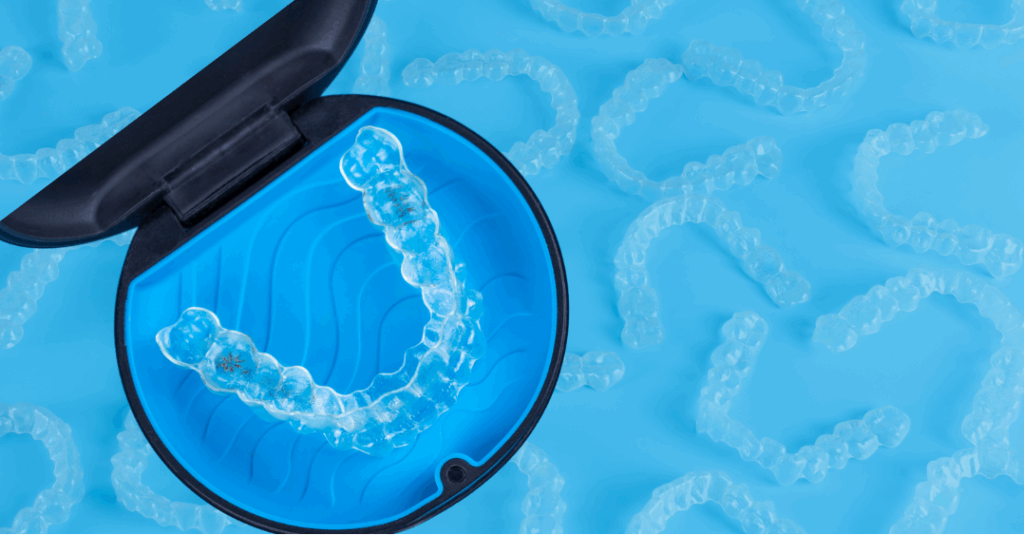
It is an orthodontic treatment system that uses a series of individually designed clear aligners. These thin, transparent trays are made from medical-grade plastic and fit snugly over the teeth, exerting gentle and controlled force. Te cienkie, przezroczyste nakładki wykonane są z elastycznego tworzywa, które delikatnie, ale skutecznie przesuwają zęby do pożądanej pozycji.
How exactly does it work?
Each aligner is slightly different, allowing the teeth to be moved gradually and precisely. Invisalign treatment is carefully planned using advanced 3D software, which enables the orthodontist to visualise the entire course of treatment before it even begins.
Advantages of Invisalign treatment — why choose aligners?
Invisalign treatment offers a number of benefits:
- Discretion: One of the greatest advantages of Invisalign is its discretion. The appliance is virtually invisible on the teeth, allowing you to undergo treatment comfortably and without drawing attention.
- Comfort: Unlike traditional fixed braces, Invisalign aligners have no metal brackets or wires that can irritate the mucosa.
- Predictability: Thanks to virtual Invisalign treatment planning, the patient has the opportunity to see the expected results and the course of therapy. This increases confidence in the chosen method.
- Potentially shorter treatment time: In some cases the treatment time may be shorter than with a traditional appliance, although this is an individual matter depending on the complexity of the malocclusion.
For whom is Invisalign treatment suitable?
Invisalign aligners are effective in treating various malocclusions, in both adults and adolescents. The most commonly treated conditions include:
- Dental crowding (when the teeth overlap, with insufficient space in the arch).
- Gaps between the teeth.
- Crossbite (when the upper teeth bite inside the lower teeth).
- Deep bite (when the upper teeth excessively overlap the lower teeth).
- Open bite (when a gap exists between the upper and lower teeth).
Although clear aligners for children and adolescents are used with increasing frequency, the decision on eligibility for Invisalign treatment depends on the individual assessment of the orthodontist.
We discussed this process in detail in our article on braces for children. We recommend reading it for more information.
How does Invisalign treatment proceed?
Invisalign treatment is a process consisting of several stages:
- Consultation and eligibility assessment: At the first appointment the orthodontist assesses whether Invisalign treatment is appropriate for the patient.
- Documentation for the treatment plan: The orthodontist takes a scan of the teeth to create a virtual model of the patient's occlusion. To plan tooth movements correctly, radiographic imaging (a panoramic radiograph or CBCT) is also needed.
- Virtual treatment planning: On the basis of the 3D model the orthodontist, using specialist software, develops an individual treatment plan that defines the sequence and extent of each tooth movement.
- Fabrication of the series of aligners: On the basis of the treatment plan a series of aligners is manufactured.
- Regular aligner changes: The patient receives a set of aligners and changes them independently, usually every 7–14 days, in accordance with the orthodontist's recommendations.
- Follow-up appointments with the orthodontist: Regular follow-up visits (usually every 8–12 weeks) are essential for monitoring treatment progress and making any necessary modifications.
The duration of Invisalign treatment is highly individual and depends on the complexity of the malocclusion and the consistency with which the patient wears the aligners. The average treatment time is 12–18 months, but it can range from a few months to over two years.

Invisalign vs traditional braces — key differences
When comparing Invisalign treatment with traditional fixed braces, the following aspects are worth noting:
- Aesthetics: The Invisalign system is more aesthetic and discreet.
- Comfort: The aligners are more comfortable to wear and do not cause abrasions or irritation.
- Hygiene: Maintaining oral hygiene is easier because the aligners can be removed for brushing.
- Dietary restrictions: With Invisalign there are no dietary restrictions — you can eat anything.
- Frequency of follow-up visits: Follow-up visits are usually less frequent.
- Removability: Invisalign aligners can be removed, for example for an important occasion, although this should not be done too often.
Summary
Invisalign treatment is a modern, comfortable and discreet alternative to traditional orthodontic appliances. It allows effective correction of a wide range of malocclusions with an emphasis on the patient's comfort and aesthetics.
If you dream of straight teeth and want to find out whether Invisalign is the right treatment method for you, we warmly invite you for a consultation at Klinika Modern Dental & Orthodontics.