
At our clinic we believe that effective dentistry is a combination of practice and sound academic knowledge. The Medical Director and co-owner of our clinic, dr n. med. Ewa Prażmo, is the author of a scientific article on tooth resorption published in the journal Nowa Stomatologia.
We often focus on caries, but there are processes that destroy teeth that are far more difficult for the patient to detect. What is tooth resorption and why is it important to diagnose it early?
What is tooth resorption?
In the simplest terms, resorption is the process of destruction of the hard tissues of the tooth (dentine, cementum) or bone.
- In children: This is a physiological and entirely natural process, because it enables the shedding of primary teeth and makes way for the permanent teeth.
- In adults: This is a pathological (disease) process that is complex and difficult to treat.
Where does the problem come from?
The scientific article identifies three main groups of causes of resorption:
- Trauma: Resorption is frequently a late consequence of a blow, luxation or avulsion of a tooth.
- Infection: Bacteria inside the tooth can trigger an inflammatory process that "eats away" the tissues.
- Pressure: This may be caused by an erupting adjacent tooth (e.g. a wisdom tooth), tumours, or sometimes by inappropriate biomechanical forces (e.g. during excessively aggressive orthodontic treatment).
Can tooth resorption be cured?
The key to success is early diagnosis. Treatment depends on the cause:
- If the cause is infection, antibacterial medicaments and root canal treatment are used, yielding very good results.
- If the cause is pressure, the factor producing it must be removed (e.g. reducing the force applied during orthodontic treatment, extracting the impacted tooth).
- The most difficult case is so-called replacement resorption (ankylosis), in which the tooth fuses with the bone — in such situations we fight to preserve the tissues as long as possible, although the prognosis is usually unfavourable.
Knowledge that heals
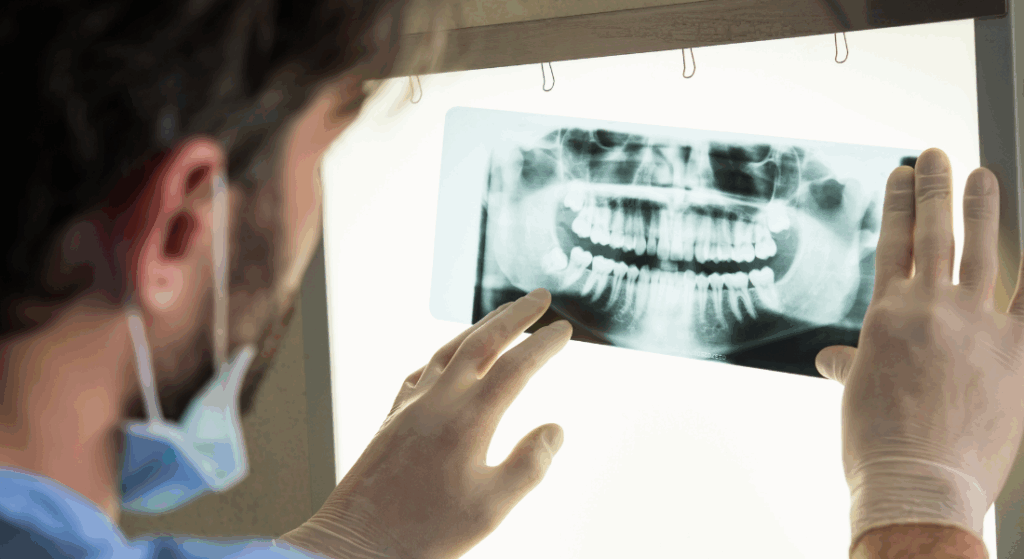
Tooth resorption, particularly the hidden type (internal or cervical), often causes no pain in the early stages. For this reason, regular radiographic check-ups and monitoring are of crucial importance — early detection gives the best chance of saving the tooth.
For those wishing to explore the subject from a medical perspective, we recommend reading the full text of the article by dr n. med. Ewa Prażmo.
Prażmo, E., Mielczarek, A. (2014). Current concepts of tooth resorption aetiology and therapy. Borgis – Nowa Stomatologia, nr. 1, s. 53–58.