
At our clinic we believe that effective medicine rests on the continuous deepening of knowledge. We are not limited to clinical procedures alone — we actively participate in scientific research. We are proud that the results of our work are published in peer-reviewed scientific journals.
The Medical Director and co-owner of our clinic, dr Ewa Prażmo, in collaboration with dr Agnieszka Mielczarek (together with a team of microbiologists and physicists), published a scientific article in the journal New Stomatology (Borgis) that sheds important light on one of the greatest challenges in endodontics.
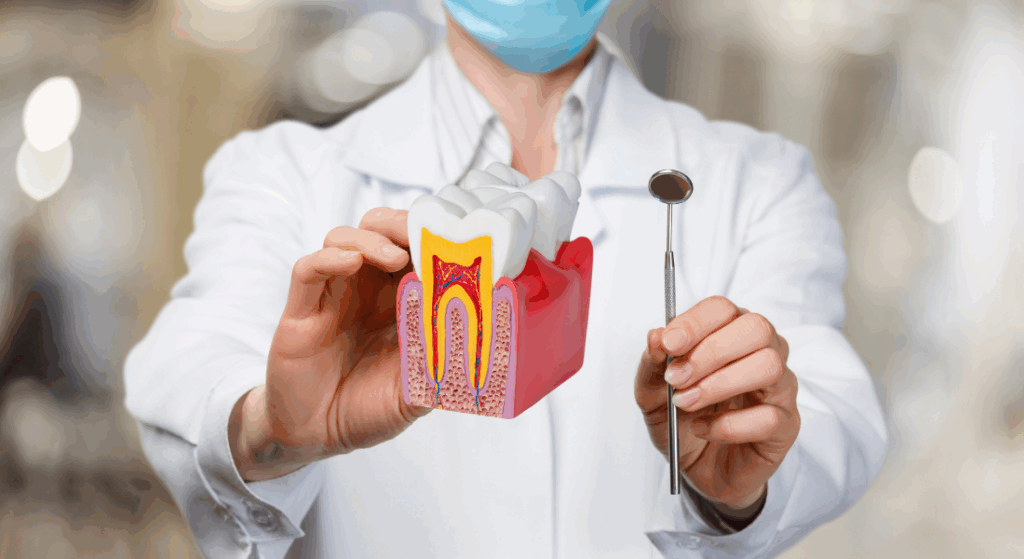
The silent enemy of endodontic treatment — the bacterium Enterococcus faecalis
Root canal (endodontic) treatment usually ends in success. There are, however, situations in which the infection recurs or the healing process does not proceed as planned. In such cases the clinician searches for the cause — and it often proves to be a highly resistant microorganism.
The culprit frequently turns out to be the bacterium Enterococcus faecalis. Studies indicate that it is present in 24% to as many as 77% of teeth in which root canal treatment has failed. Why is it so difficult to eliminate?
Why is this bacterium so hard to defeat?
The article by dr Ewa Prażmo analyses in detail the so-called virulence factors — the characteristics that make this bacterium so "clever" and resistant. Here is what is worth knowing:
- Formation of a protective "shield" (biofilm): E. faecalis can form a biofilm — a highly organised cluster of bacteria surrounded by a special matrix. This biofilm acts as armour, protecting the bacteria from medications and the body's immune cells.
- Survival in adverse conditions: This bacterium can enter a state of "dormancy" (stationary phase) and survive for a long time even in the absence of nutrients. This means it can "wait out" treatment and reactivate when conditions become favourable.
- Chemical resistance: It demonstrates remarkable resistance to high pH. Many standard intracanal medicaments (e.g. calcium hydroxide) work by raising the pH. E. faecalis, however, possesses mechanisms that allow it to neutralise this alkaline environment.
- Invasion deep into the tooth: This bacterium can penetrate deep into the dentinal tubules (the microscopic tubes that make up the tooth), where it becomes invisible to instruments and irrigant solutions used during treatment.
What does this mean for treatment?
The knowledge derived from this publication translates directly into our work in the clinic. Understanding the powerful defence mechanisms of E. faecalis, we can tailor decontamination protocols more precisely to the specific challenge.
That is why at our clinic:
- We employ advanced disinfection procedures aimed at destroying the biofilm.
- We work under a microscope to clean the most difficult-to-reach areas precisely.
- We rely on scientific evidence in selecting the medications and techniques that have a chance of defeating even such resistant bacteria.
Treating difficult cases is our speciality, underpinned not only by practice but also by sound scientific knowledge.
For those interested in the microbiological aspects of endodontics, we recommend reading the full text of the article.
Prażmo, E., Godlewska, R., Kwaśny, M., Mielczarek, A. (2016). The role of Enterococcus faecalis virulence factors in pulp and periapical disease development. Borgis – Nowa Stomatologia, no. 1, pp. 17–24.