
Tooth loss is a situation that requires a decision about how to replace the missing tooth. The two most commonly used methods are an implant with a crown and a dental bridge. Each has different advantages and limitations — and the choice should be based on the patient's individual clinical situation, not on price alone.

What is an implant and what is a dental bridge?
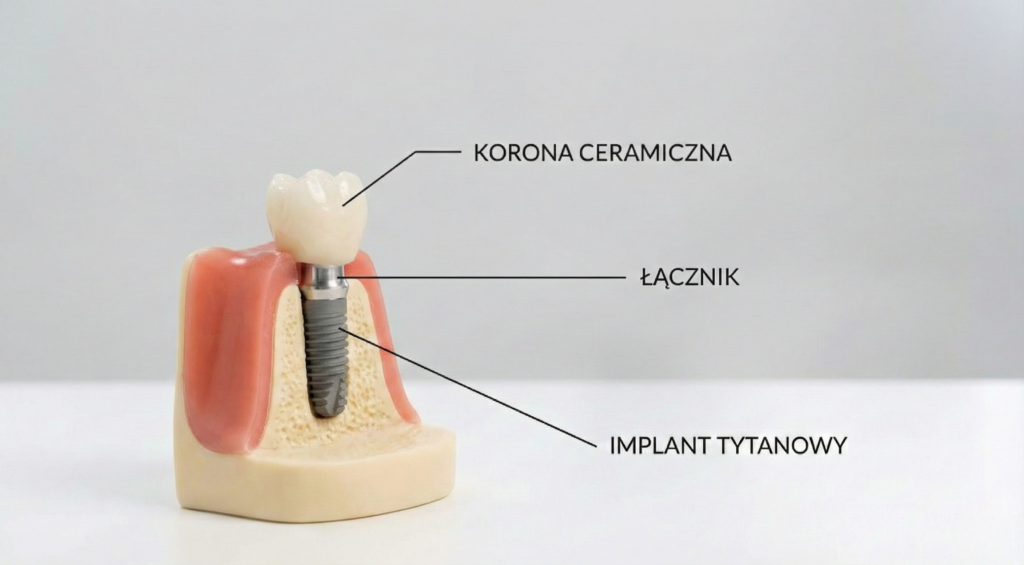
A dental implant is a titanium (or zirconia) screw inserted into the bone of the maxilla or mandible, serving as an artificial tooth root. After a healing period of approximately 3–6 months (osseointegration) a prosthetic crown is placed on the implant — a visible restoration that looks and functions like a natural tooth.
A dental bridge is a fixed prosthesis, most commonly consisting of three connected crowns. The two outer crowns are fitted onto the prepared abutment teeth (the teeth adjacent to the gap), while the middle crown (pontic) replaces the missing tooth. The bridge does not require surgical intervention but does require preparation of the healthy adjacent teeth.
Implant vs bridge — comparison table
The table below sets out the key differences between an implant and a dental bridge.
| Criterion | Implant with crown | Dental bridge |
| Durability | Over 20 years (with good hygiene potentially lifelong) | 15–20 years (usually requires replacement) |
| 10-year survival rate | approx. 96% (implant alone); approx. 89% (crown on implant) | approx. 89% (conventional bridge) |
| Effect on adjacent teeth | None — neighbouring teeth remain untouched | Preparation required (loss of healthy tooth structure) |
| Bone preservation | Implant stimulates bone — prevents atrophy | Bone beneath the pontic resorbs over time |
| Treatment duration | Single-stage: days/weeks. Two-stage: 3–6 months (healing) + crown placement | 2–3 weeks (preparation + impression + cementation) |
| Surgical procedure | Yes — implant placement | No — prosthetic procedure |
| Oral hygiene | Easier — an implant is cleaned like a natural tooth | More difficult — special floss and a water flosser required |
| Aesthetics | Very good — individually customised crown | Good — but preparation of abutment teeth may weaken them |
| Approximate cost | PLN 6,000–12,500 (implant + crown) | PLN 4,000–8,000 (3-unit bridge) |
| Reparability | Crown replaceable without disturbing the implant | Bridge damage often = replacement of the entire restoration |
Durability — how long does an implant last, and how long does a bridge?
An implant is a long-term solution. A meta-analysis by Howe et al. (2019) comprising 18 prospective studies reported a 10-year implant survival rate of 96.1%. With proper oral hygiene and regular follow-up appointments, implants can function for over 20 years.
A conventional dental bridge, according to a systematic review by Pjetursson et al. (2010), has a 10-year survival rate of 89.2%. This means that approximately 1 in 10 bridges requires replacement within 10 years — usually because of caries of the abutment teeth, fracture of the framework or secondary periodontal problems.
Effect on healthy adjacent teeth
This is one of the most important arguments in favour of an implant. An implant is self-supporting — it does not require preparation of or any intervention on the adjacent teeth. If the teeth flanking the gap are healthy and intact, they remain untouched.
In the case of a bridge, the abutment teeth must be prepared — even if they are completely healthy. The removal of a significant amount of enamel and dentine is an irreversible process that increases the risk of sensitivity, caries and, in the long term, the need for root canal treatment of the abutment teeth.
Protection of the maxillary and mandibular bone
An implant stimulates the bone in which it is placed, in a similar way to a natural tooth root. It thereby prevents atrophy (resorption) of the alveolar ridge. This preserves the facial contours and creates better conditions for any future prosthetic treatment.
A dental bridge does not transmit loads to the bone beneath the pontic — as a result, bone at that site gradually resorbs. After many years this may complicate any future implant placement or require bone augmentation.
Cost — implant vs bridge
The initial cost of a bridge is usually lower than that of an implant. In the long term, however, the costs of the two solutions converge. Bridges require replacement after 15–20 years, which means a second investment. Complications on the abutment teeth (caries, root canal treatment) add further costs.
An implant, although more expensive at the outset, often proves more economical over a 20–30 year span. An additional argument is the protection of adjacent teeth — which are not prepared and thus do not require future prosthetic treatment.
W Modern Dental & Orthodontics (Klinice MDO) oferujemy możliwość rozłożenia kosztu leczenia implantologicznego na raty PayU, co czyni tę opcję dostępną dla szerszego grona pacjentów. Szczegóły omawiamy na konsultacji.
When is a bridge the better choice?
Despite the many advantages of implants, there are clinical situations in which a dental bridge may be the more appropriate solution.
A bridge is worth considering when: the abutment teeth already require crown restoration (e.g. because they are extensively damaged by caries), the patient has contraindications to surgery (e.g. uncontrolled diabetes, bisphosphonate therapy, radiation therapy), the patient prefers faster treatment without a surgical phase, or the budget does not allow for implant treatment at this time.
The decision should always be made individually, after analysis of a CBCT scan and a full clinical examination.
When is an implant the better choice?
An implant is usually preferred when: the adjacent teeth are healthy and intact, the patient expects a long-term solution, bone preservation is important, the patient wants to avoid the preparation of healthy teeth.
Most patients tolerate implant placement very well — it is performed under local anaesthesia and is less invasive than, for example, surgical extraction of a wisdom tooth.
Frequently Asked Questions (FAQ)
Is an implant better than a bridge?
In most cases, yes — an implant protects healthy adjacent teeth, prevents bone resorption and lasts longer. The decision depends, however, on the individual clinical situation, and in some cases a bridge may be a more suitable option.
How much does an implant cost compared with a bridge?
A 3-unit bridge costs approximately PLN 4,000–8,000, while an implant with a crown costs approximately PLN 6,000–12,500. Although the implant is more expensive initially, over a 20-year perspective the total cost may be comparable or lower — because the implant does not require replacement and protects healthy teeth.
How long does a bridge on teeth last?
A conventional bridge lasts on average 15–20 years. Over time the abutment teeth may deteriorate, necessitating replacement of the entire restoration. An implant, by contrast, can serve for over 20 years.
Can a bridge be replaced with an implant?
Yes, in many cases the existing bridge can be removed and an implant placed. A prior assessment of bone condition by means of a CBCT scan is necessary — after many years with a bridge, bone resorption beneath the pontic may require augmentation.
Is an implant more painful than a bridge?
Implant placement is performed under local anaesthesia and is usually less painful than a tooth extraction. Preparation of the teeth for a bridge (grinding) also requires anaesthesia and may cause sensitivity. In most cases the post-operative discomfort associated with an implant is moderate and lasts 2–5 days.
Does a bridge damage healthy teeth?
It does not destroy them completely, but it does require preparation — i.e. the removal of a significant amount of enamel and dentine. This is an irreversible process that increases the risk of sensitivity, caries and, in the long term, root canal treatment of the abutment teeth.
When is an implant not possible?
Contraindications include, among others, untreated diabetes, active periodontal disease, certain medications (e.g. bisphosphonates), jaw irradiation and insufficient bone. Some contraindications are relative — after appropriate preparation (e.g. bone augmentation, diabetes control) implant placement may become possible.
How long does implant treatment take?
The entire process (from implant placement to crown fitting) usually takes 3–6 months — mainly because of the healing time (osseointegration). A bridge can be completed in 2–3 weeks. In patients requiring bone augmentation the implant treatment time extends to 6–12 months.
Read more on the Modern Dental & Orthodontics website:
Dental Implants Warsaw Wola | Implant placement
Prosthetics Warsaw Wola | Book an Appointment with a Prosthetist | Offer
Tooth Implants Step by Step - Treatment Stages | Blog
Zirconia vs Metal Crown? A Comparison of Crown Types
Scientific sources
1.Link: https://pubmed.ncbi.nlm.nih.gov/30904559/
Howe M.S., Keys W., Richards D. „Long-term (10-year) dental implant survival: A systematic review and sensitivity meta-analysis.” Journal of Dentistry. 2019;84:9–21.
2.Link:https://pubmed.ncbi.nlm.nih.gov/11040527/
Hebel K., Gajjar R. „Single-tooth replacement: bridge vs. implant-supported restoration.” Journal of the Canadian Dental Association. 2000;66(8):435–438.
3.Link: https://doi.org/10.1111/j.1600-0501.2007.01439.x
Pjetursson B.E., Brägger U., Lang N.P., Zwahlen M. „Comparison of survival and complication rates of tooth-supported fixed dental prostheses (FDPs) and implant-supported FDPs and single crowns (SCs).” Clinical Oral Implants Research. 2007;18(Suppl 3):97–113.