
The cost of a complete single-tooth implant restoration in Poland in 2026 ranges from PLN 6,000 to PLN 12,500. The price comprises: the implant (PLN 3,000–6,000), the abutment (PLN 0–1,500) and the prosthetic crown (PLN 3,000–5,000). The final amount depends on the implant system, the material of the crown, the need for additional procedures (bone augmentation, sinus lift) and the clinic's location.
The decision to replace missing teeth with implants is a strategic investment in overall health. Patients often ask about the cost before they learn what they are actually paying for. This article provides a transparent breakdown of the costs associated with dental implant placement in Poland in 2026.

Why can an implant be a worthwhile investment in health?
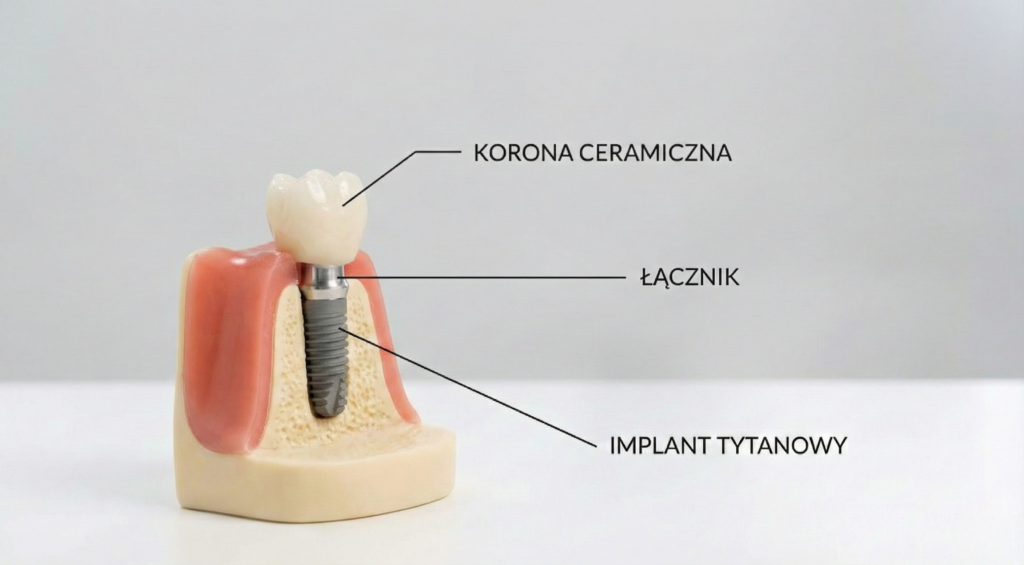
A dental implant is a titanium or zirconia screw surgically inserted into the bone of the maxilla or mandible, which takes over the function of the root of the missing tooth. A prosthetic crown is placed on top — a visible restoration that looks and functions like a natural tooth.
What happens after tooth loss?
After loss of a natural tooth the bone ceases to be stimulated during chewing and begins to resorb. This process leads to:
- Displacement of adjacent teeth — teeth tilt towards the gap, opposing teeth over-erupt from the bone
- Destabilisation of the entire bite — this leads to chewing problems and temporomandibular joint pain
- Resorption of the maxillary/mandibular bone — this affects facial appearance and may complicate future implant placement
It is worth noting that the longer you wait before having an implant placed, the greater the likelihood of requiring costly bone regeneration before the procedure.
Types of dental implant: titanium or zirconia?
The market in 2026 is dominated by two materials. The choice between them depends on aesthetic preferences, the budget and the individual needs of the patient.
Titanium implants
- Material: Biocompatible titanium (does not cause allergies)
- Advantages: Exceptional mechanical strength, excellent integration with bone
- Cost of titanium implants: More affordable
- For whom: An excellent choice for molars, where strength is key
Zirconia implants
- Material: Zirconium oxide (a ceramic with a shade close to that of a natural tooth)
- Advantages: Almost entirely invisible under the gum, very high biocompatibility, slightly less bacterial adhesion
- Cost: Higher (complex manufacturing process)
- For whom: Particularly suitable for anterior teeth, patients with thin gingival tissue
Cost of a dental implant — detailed 2026 cost breakdown
A complete tooth restoration consists of three separate components. The advertised price of "Implant for PLN 3,000" usually refers only to the surgical component — without the abutment and crown.
What makes up the cost?
- Surgical component (Implant): Cost of the screw and the insertion procedure
- Abutment: The component connecting the implant to the crown
- Crown: The visible part of the tooth (porcelain or all-ceramic)
Table 1: Cost of a Complete Restoration
| Cost item | Price range | Estimated median |
| Titanium / zirconia implant (surgical component) | 3,000 – 6,000 PLN | 3500 PLN |
| Abutment* | 0 – 1500 PLN | 1000 PLN |
| Porcelain crown on implant | 3000 – 5000 PLN | 3500 PLN |
| TOTAL FOR A COMPLETE RESTORATION | 6000 – 12500 PLN | 8500 PLN |
*Depending on the dental clinic, the cost of the abutment may be listed separately or included in the implant price. Patients should therefore always ask about the complete cost of restoration rather than the price of the implant alone.
Note: The prices quoted are approximate and may vary depending on the region of Poland, the experience of the implantologist, the reputation of the clinic and the implant system used.
How much do additional procedures associated with implant placement cost?
The difference between the minimum and maximum price often results from the need for preparatory procedures that are crucial to the success of implant placement.
Diagnostics and preparation
- Cone-beam computed tomography (CBCT): PLN 200–800 — precise assessment of bone and nerve structures
- Professional oral hygiene: PLN 300–600 — scaling, air-polishing and polishing before the procedure are not about aesthetics but about safety
Why is hygiene critical? Implant placement is a surgical operation — the operative field must be free of bacteria. Calculus can lead to infection, which is the most common cause of early implant failure.
Reconstructive surgery (when bone is insufficient)
- Guided bone regeneration (GBR): PLN 1,500–4,000 — tissue reconstruction using biomaterials
- Sinus floor elevation (sinus lift): PLN 2,000–7,000 — when the sinus is too close
- Tooth extraction: PLN 300–800 — if the damaged tooth is still in the mouth
How long does dental implant placement take?
Dental implant placement can be a single-stage or a two-stage procedure.
Single-stage (one-stage)
This involves placing the implant and the crown at a single surgical visit.
When is this possible? In principle, when:
- The bone at the implant site is sufficiently dense and tall (good bone parameters)
- The tooth is extracted and the implant is placed at the same time
- The primary stability of the implant is adequate
Advantages: Fewer visits, fewer surgical procedures, faster aesthetic result.
Disadvantages: Requires good anatomical conditions. If adequate primary stability cannot be achieved, the risk of failure is higher.
Two-stage
Here the implant alone is placed first. The surgeon then closes the wound and a waiting period follows — usually 3–6 months — until the implant integrates with the bone. In the second stage the crown is placed on the implant.
When is this used? Most commonly when:
- The bone is insufficient and requires augmentation (additional bone growth)
- The anatomical conditions do not permit immediate loading of the implant
- The patient has lower bone density
Advantages: Greater control over the healing process, higher success rates in more challenging cases, the possibility of bone regeneration before crown placement.
Disadvantages: A longer procedure (several months from start to finish), two surgical interventions, a longer period without a finished tooth.
Summary of the key differences
| Single-stage | Two-stage | |
|---|---|---|
| Number of surgical procedures | 1 | 2 |
| Time from start to crown | Days/weeks | 3–6+ months |
| Bone requirements | High | Lower (augmentation possible) |
| Risk of failure | Slightly higher in challenging cases | Slightly lower |
| Cost | Similar or slightly lower | Similar or slightly higher |
The choice of method depends primarily on the condition of the patient's bone, the location of the implant and the surgeon's assessment. It is not the case that one method is objectively better — rather, each has its own indications.
The most frequently asked questions about dental implants
Does a dental implant hurt?
The procedure is usually performed under local anaesthesia, so you do not feel pain during it. In some cases inhalation or intravenous sedation may also be used.
After the procedure slight swelling and discomfort may occur (similar to an extraction), but a standard analgesic is usually sufficient. Most patients return to normal activities the following day.
How long does a dental implant last?
With proper hygiene and regular follow-up visits (every 6 months), implants can serve for 20–30 years or longer. Unlike bridges, implants do not require the preparation of adjacent teeth and protect the bone against resorption.
Does the NFZ (Polish national health fund) cover dental implants?
Unfortunately, the NFZ does not cover dental implants. It is a privately funded procedure, financed entirely by the patient. Many clinics do, however, offer instalment plans (e.g. PayU, Santander Consumer Bank), which allow the cost to be spread.
Can everyone have an implant?
Most adults can have implants. Contraindications include: uncontrolled diabetes, severe osteoporosis, active cancer, pregnancy, smoking (a relative contraindication) and certain medications (bisphosphonates). Every case requires an individual assessment.
Dental implant vs bridge — which to choose?
Implant: Does not require preparation of adjacent teeth, prevents bone resorption, less expensive in the long term. Bridge: Less expensive initially, faster, but requires the preparation of healthy adjacent teeth and does not prevent bone resorption under the pontic.
Summary: Is it worth investing in dental implants?
The cost of dental implants in Poland ranges from PLN 6,000 to PLN 12,500 for a complete single-tooth restoration. Although the sum may seem high, it is worth considering what you gain in return:
- Quality of life: The ability to eat all foods, a confident smile
- Health: Protection of bone against resorption, preservation of natural facial contours
- Cost-effectiveness: Less expensive in the long term than bridges requiring replacement every 10–15 years
- Self-confidence: Natural sensation, no social limitations
Want to find out the exact cost for your case?
At Modern Dental & Orthodontics we believe that transparency is fundamental. Book an implant consultation — our experienced team of clinicians will prepare a detailed, individualised cost estimate for you.
Information on content and responsibility
This article is intended solely for informational and educational purposes and does not constitute medical advice, a diagnosis or a treatment recommendation. It does not replace a consultation with a dentist or other qualified specialist. Despite every effort to ensure accuracy, the authors accept no liability for decisions made by readers on the basis of the information contained herein.