
Smile design is a digital smile planning process that allows the patient to see the final result of aesthetic treatment before the procedure begins. Thanks to advanced software and an intraoral scanner, the clinician creates a virtual model of the new smile — matched to the proportions of the face, the lip line and the patient's expectations.
At Modern Dental & Orthodontics (Klinika MDO) in Wola, Warsaw, the smile design process is an integral part of planning veneers, bonding and comprehensive smile makeovers.
What is smile design and why is it worth doing?
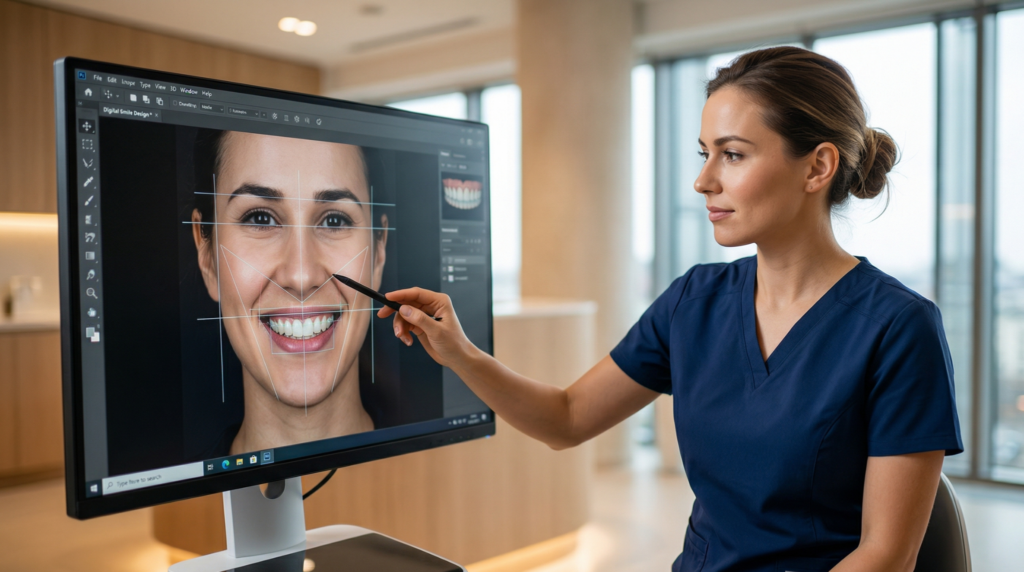
Smile design (Digital Smile Design, DSD) is a method of digitally planning smile aesthetics, based on the analysis of photographs, 3D scans and facial proportions. It enables the patient and the clinician to jointly design the target result — and to verify it in the mouth before any irreversible changes are made.
The Digital Smile Design (DSD) concept was developed by Christian Coachman. The first detailed publication on this method appeared in 2012 (Coachman & Calamita, Journal of Cosmetic Dentistry).
The Modern Dental & Orthodontics (Klinika MDO) team emphasises that smile design eliminates the element of uncertainty — the patient sees their new smile, evaluates it and approves it before any tooth is touched.
The stages of smile design — the entire process step by step
The smile design process consists of several precisely planned stages, leading from diagnostics to cementation of the final restorations. Each step serves a specific purpose.
Step 1: Consultation and photographic documentation
The first visit includes a detailed history, an analysis of the patient's expectations and full photographic documentation. The clinician takes photographs of the face at rest, during a full smile and from the side, as well as intraoral photographs.
Step 2: 3D scan and digital analysis
An intraoral scanner creates a three-dimensional model of the dentition with accuracy to a few tens of microns. The model is imported into the DSD software, where it is superimposed on the facial photographs.
Step 3: Virtual smile design
On the basis of data from the scan and photographs, the clinician designs the new smile in dedicated software. The patient sees a 2D visualisation superimposed on their own photograph — the shape, length, width and symmetry of each tooth are displayed.
Step 4: Mock-up — the trial smile
A mock-up is a temporary shell of composite resin (most commonly bis-acryl), placed directly on the patient's teeth. It allows the patient to "try on" the new smile — assess the aesthetics, comfort and proportion directly in the mouth, during speech and smiling.
Step 5: Preparation and fabrication of the restorations
After acceptance of the mock-up the clinician proceeds with tooth preparation (if required) and takes a digital scan for the definitive restorations (in some cases an impression). The prosthetic laboratory fabricates the veneers or crowns on the basis of the approved design.
Step 6: Cementation and final evaluation
The finished restorations are tried in, assessed for colour, shape and fit, and then permanently cemented. The clinician checks the bite, comfort and aesthetics. The patient leaves with the new smile.
Smile design stages — summary
The table below presents the individual stages of the smile design process with approximate durations and what the patient can expect.
| Stage | What happens? | Duration |
| 1. Consultation | History, photographic documentation, analysis of expectations | 45–60 min |
| 2. 3D scan | Intraoral scanning, import to DSD | 20–30 min |
| 3. Digital design | 2D/3D visualisation of the new smile, modifications | Follow-up visit after 3–5 days |
| 4. Mock-up | Temporary trial overlay on the teeth | 30–45 min |
| 5. Preparation and restorations | Preparation (optional), impressions, CAD/CAM milling | 1–2 visits |
| 6. Cementation | Cementation of the definitive veneers/crowns | 60–90 min |
Who is smile design for?
Smile design is intended for every patient who is planning an aesthetic change to their smile and wants full control over the final result. The method works equally well for minor corrections (e.g. two front teeth) and for comprehensive makeovers (10–12 teeth).
The most common indications are: changes in tooth shape and colour, closing diastemas (gaps between teeth), correction of gummy smile (excessive gum exposure when smiling), post-orthodontic cosmetic corrections and replacement of old, discoloured restorations.
The Modern Dental & Orthodontics (Klinika MDO) team recommends smile design to patients considering veneers or bonding. Digital planning reduces the risk of dissatisfaction and allows both parties to agree on the result before treatment begins.
Smile design and veneers — does one require the other?
Smile design is a diagnostic and planning tool; veneers are one of the possible ways of implementing the design. It is possible to carry out smile design and then proceed with bonding, crowns, orthodontics or a combination of methods — the design is independent of the execution technique.
Increasingly, smile design is combined with a minimally invasive approach, including no-prep veneers. CAD/CAM technology enables direct transfer of the digital design to the laboratory, ensuring a faithful reproduction of the approved project.
How much does smile design cost?
The cost of the digital smile design itself depends on the scope of work and the technology used. In many clinics smile design is included in the cost of the definitive restorations.
It is worth noting that Klinika MDO offers the option of spreading the cost of treatment into PayU instalments, making a comprehensive smile makeover more accessible financially.
Advantages of Digital Smile Design — why choose digital planning?
Digital smile design offers a range of benefits for both the patient and the clinician. A narrative review by Alkarkan (2024) indicates that DSD improves communication, increases predictability and reduces the risk of dissatisfaction.
- Predictability of the result: the patient sees the final outcome before treatment begins, significantly reducing the risk of dissatisfaction.
- Better communication: 2D/3D visualisation facilitates understanding between the clinician, the laboratory technician and the patient.
- Minimally invasive preparation: precise planning allows the maximum amount of healthy tooth tissue to be preserved.
- Shorter treatment time: integration with CAD/CAM systems eliminates the need for multiple try-ins and adjustments.
- Medico-legal documentation: the digital design constitutes precise documentation of the treatment plan agreed with the patient.
FAQ — frequently asked questions about smile design
Does smile design hurt?
The smile design process itself is completely painless. It involves photographs, an intraoral scan and placement of a mock-up — none of these requires anaesthesia or causes discomfort.
How long does the entire smile design process take?
From the first consultation to cementation of the finished restorations, usually 2 to 4 weeks pass. The digital design and mock-up require 2–3 visits. The time depends on the number of teeth and the type of restorations.
Is a mock-up compulsory?
A mock-up is not technically compulsory but is recommended. It allows the patient to assess the appearance of the new smile in the mouth — during speech, smiling and eating — before committing to irreversible changes.
Can smile design be done before bonding?
Yes. Smile design works equally well before composite bonding and before porcelain veneer placement. In the case of bonding, the digital design helps the clinician plan proportions, symmetry and the colour scheme.
Does the smile design result always match reality?
Modern DSD software ensures a high degree of correspondence between the design and the final outcome. The mock-up stage additionally verifies the design under real-life conditions — which is why it is so valuable.
Is smile design available on the NFZ?
No. Smile design is an aesthetic procedure that is not covered by the National Health Fund. At Modern Dental & Orthodontics (Klinika MDO) the option of PayU instalments is available.
What software is used for smile design?
A number of DSD software products are available, including CEREC Smile Design (Sirona), Smile Composer (3Shape), Digital Smile System (DSS), Romexis Smile Design (Planmeca) and the original DSD app (Coachman).
Read more on Modern Dental & Orthodontics
▶ Aesthetic & Restorative Dentistry → klinikamdo.pl/en/offer/aesthetic-and-restorative-dentistry/
▶ Porcelain vs Composite Veneers → klinikamdo.pl/en/blog/porcelain-vs-composite-veneers/
▶ No-Prep Veneers → klinikamdo.pl/en/blog/no-prep-veneers/
▶ Dental Bonding — A Quick Smile Makeover → klinikamdo.pl/en/blog/dental-bonding-quick-smile-makeover/
Sources
- Alharkan H.M. „Integrating Digital Smile Design into Restorative Dentistry: A Narrative Review of the Applications and Benefits.” Saudi Dent J. 2024;36(4):561–567.
- Stanley M., Paz A.G., Miguel I., Coachman C. „Fully digital workflow, integrating dental scan, smile design and CAD-CAM: case report.” BMC Oral Health. 2018;18(1):134.
- Cervino G., Fiorillo L., Arzukanyan A.V., Spagnuolo G., Cicciù M. „Dental Restorative Digital Workflow: Digital Smile Design from Aesthetic to Function.” Dent J (Basel). 2019;7(2):30.
- Jafri Z., Ahmad N., Sawai M., Sultan N., Bhardwaj A. „Digital Smile Design – An innovative tool in aesthetic dentistry.” J Oral Biol Craniofac Res. 2020;10(2):194–198.
Information on content and responsibility
This article is intended solely for informational and educational purposes and does not constitute medical advice, a diagnosis or a treatment recommendation. It does not replace a consultation with a dentist or other qualified specialist. Despite every effort to ensure accuracy, the authors accept no liability for decisions made by readers on the basis of the information contained herein.