
No-prep veneers are ultrathin ceramic or composite shells that are cemented onto the tooth without removing any enamel. The procedure is fully reversible, painless and requires no anaesthesia. This article explains how they differ from conventional veneers, who is a suitable candidate and what the evidence says about their longevity.
Fear of tooth grinding is one of the main reasons patients decline veneers. Yet modern aesthetic dentistry offers solutions that allow an impressive smile transformation without touching the enamel at all.

What are no-prep veneers? Definition and differences
No-prep veneers (no-preparation veneers) are ceramic or composite restorations only 0.1–0.5 mm thick, cemented adhesively to an intact tooth surface. No enamel is removed — the veneer is bonded directly to the existing tooth.
It is worth distinguishing three levels of invasiveness:
| Veneer type | Preparation | Veneer thickness | Reversibility |
| No-prep | None | 0,1–0,5 mm | Full |
| Minimally invasive | 0.1–0.3 mm of enamel | 0,3–0,5 mm | Partial |
| Conventional | 0.3–0.7 mm of enamel | 0,5–0,7 mm | None |
The term "no-prep veneers" is used for both ceramic (porcelain) no-prep veneers and direct composite veneers in which the clinician applies the material by hand without grinding.
Who are no-prep veneers for? Clinical indications
No-prep veneers are not a universal solution — they require appropriate tooth anatomy and realistic patient expectations. Below are the situations in which they work best.
Ideal indications
- Diastemas (gaps between teeth) — closing gaps by adding material without grinding.
- Short or worn teeth — lengthening the incisal edge or adding volume to teeth that are shorter than desired.
- Shape anomalies (e.g. peg-shaped teeth) — correction of peg-shaped, fan-shaped or irregularly contoured teeth.
- Lingually positioned teeth — teeth set back relative to the dental arch, which can be "brought forward" optically without risk of excessive contour.
- Minor incisal edge defects — small chips or enamel defects that can be masked with an additive veneer.
Contraindications — when no-prep will not work
- Severe discolouration (e.g. tetracycline staining) — no-prep ceramic (0.1–0.5 mm) cannot mask a dark substrate; a thicker veneer requiring preparation is needed.
- Protrusive teeth — adding material to flared teeth creates excessive contour and disrupts the emergence profile.
- Bruxism (without occlusal protection) — excessive occlusal forces may fracture ultrathin veneers.
- Significant crowding — no-prep veneers cannot change the position of significantly crowded teeth; orthodontics is indicated first.
Durability and efficacy of no-prep veneers — evidence from studies
Clinical studies confirm that correctly executed no-prep veneers achieve very high survival — often comparable to or higher than conventional veneers.
The key conclusion from the evidence: the absence of preparation means that the entire adhesive bond remains within enamel, which is the strongest prognostic factor for longevity.
What does the procedure for placing no-prep veneers look like?
The procedure is shorter and less invasive than for conventional veneers. It does not require anaesthesia or temporary restorations.
Porcelain no-prep veneers — stages
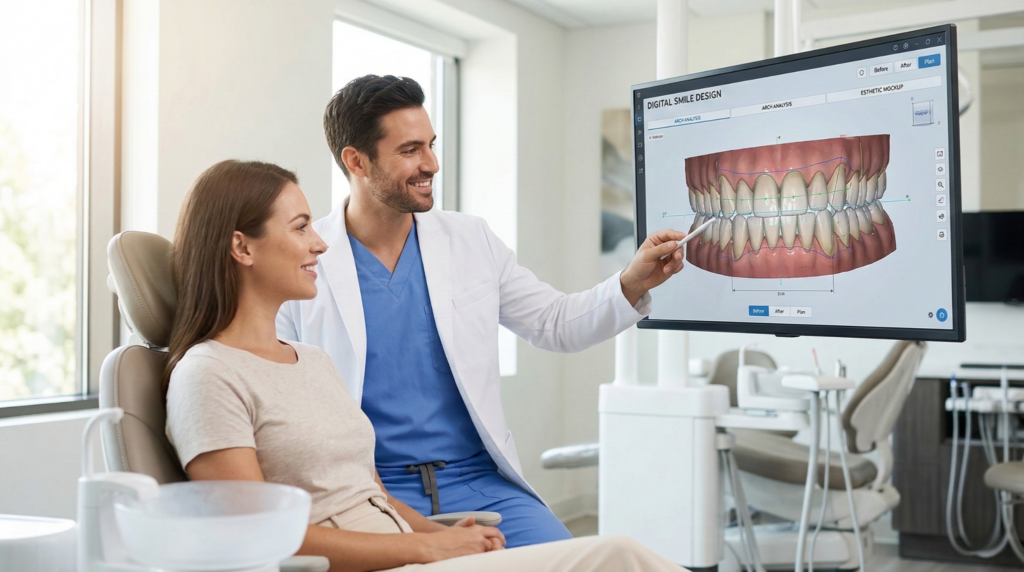
- Consultation and design — smile analysis, photographs, intraoral scan or impressions. Smile design and mock-up — the patient sees the final result before committing to treatment.
- Scan/impression without preparation — nothing is ground. The clinician takes a scan or impression of the unprepared teeth. The laboratory fabricates ultrathin veneers based on the digital model.
- Try-in and cementation — the veneers are tried in, checked for colour, shape and fit, and then adhesively cemented (etching, bonding, light-curing).
- Finishing — polishing, occlusal check, hygiene instructions.
The entire procedure usually takes 2 visits (consultation + cementation), rarely 3. The absence of preparation eliminates the need for temporary veneers.
Direct composite no-prep veneers — stages
- Consultation — smile analysis, planning of the correction.
- Direct application — layer by layer, the clinician applies composite resin directly to the unprepared tooth surface, sculpts the shape and cures each layer with an LED lamp.
- Finishing — final shaping, polishing and occlusal check.
The procedure is usually completed in a single visit (1–3 hours, depending on the number of teeth). It is a faster and less expensive option than porcelain, but with a shorter lifespan and greater susceptibility to staining.
Advantages and limitations of no-prep veneers
No-prep veneers have many advantages but are not without limitations. An honest presentation of both sides helps the patient make an informed decision.
Advantages
- Full reversibility — the tooth remains intact; the procedure can be reversed at any time.
- Painless — no need for anaesthesia and no pain.
- High durability — the entire adhesive bond is on enamel; studies report survival approaching 100% after many years.
- Shorter treatment time — usually 2 visits (porcelain) or 1 visit (composite).
- No sensitivity — no enamel removal means no risk of post-operative sensitivity.
Limitations
- Narrow indications — not every case qualifies for the no-prep method (see: contraindications).
- Risk of excessive contour — adding material without removing enamel may create a slightly "bulky" contour, particularly on teeth with adequate volume already.
- Limited colour masking — ultrathin ceramic (0.1–0.3 mm) has a limited ability to mask a dark substrate; a colour change of more than 2 shades usually requires preparation.
- High technical sensitivity — the success of no-prep requires precise planning, an experienced clinician and a skilled prosthetic laboratory.
No-prep or conventional veneers? When to choose which?
The choice between no-prep and conventional veneers depends on the individual clinical situation, not on patient preference.
- Choose no-prep when: closing diastemas, lengthening teeth, minor shape corrections, young patients seeking a reversible solution.
- Choose conventional when: masking severe discolouration, significant shape change, correction of protrusion, cases requiring greater ceramic thickness.
- A staged approach: one can start with composite no-prep veneers as a trial and then progress to porcelain (with or without preparation).
Frequently Asked Questions (FAQ)
Are no-prep veneers durable?
Yes — they are usually very durable. No-prep veneer survival consistently exceeds 90% in multi-year scientific studies.
Do no-prep veneers look natural?
Yes — ultrathin ceramic beautifully reproduces the translucency of natural enamel. The limitation is masking severe discolouration — with a dark substrate the result may appear opaque.
Can everyone have no-prep veneers?
No. No-prep veneers work well for diastemas, short teeth, shape anomalies and minor corrections. They are not suitable for severe discolouration, protrusive teeth, significant crowding or bruxism without an occlusal splint.
Can no-prep veneers be removed?
Yes — it is a reversible procedure. Because no enamel was removed, the tooth returns to its original state after the veneer is removed. This is one of the main advantages of the no-prep method.
Does placing no-prep veneers hurt?
No. The absence of grinding means no need for anaesthesia and no pain either during or after the procedure. The patient also experiences no post-operative sensitivity.
How do no-prep veneers differ from Lumineers?
Lumineers is a trade name for ultrathin porcelain no-prep veneers manufactured by DenMat. The term "no-prep veneers" is broader and encompasses various ceramic systems and composites.
Read more on Modern Dental & Orthodontics
▶ Veneers and Bonding — Aesthetic Dentistry
▶ Porcelain vs Composite Veneers? A Comparison
▶ Do Veneers Damage Teeth? Facts and Myths
▶ How Long Do Veneers Last? Durability in the Light of Evidence
Sources
[1]: https://doi.org/10.1007/s00784-021-04289-6
Śmielak B, Armata O, Bojar W. „A prospective comparative analysis of the survival rates of conventional vs no-prep/minimally invasive veneers over a mean period of 9 years.” Clin Oral Investig. 2022;26(3):3049–3059.
[2] https://doi.org/10.1016/j.prosdent.2022.04.006
Śmielak B, Armata O, Bociong K. „Clinical longevity and trend analysis of 801 ultrathin ceramic veneers: A clinical cohort study.” J Prosthet Dent. 2024;131(6):1084–1092.
[3]: https://doi.org/10.1016/j.prosdent.2021.04.016
De Angelis F, D’Arcangelo C, Angelozzi R, Vadini M. „Retrospective Clinical Evaluation of a No-Prep Porcelain Veneer Protocol.” J Prosthet Dent. 2023;129(1):40–48
[4]: https://doi.org/10.3390/jfb15050131
Alghazzawi TF. „Clinical Survival Rate and Laboratory Failure of Dental Veneers: A Narrative Literature Review.” J Funct Biomater. 2024;15(5):131.
[5] https://doi.org/10.1186/s12903-023-02949-5
Kam Hepdeniz O, Temel UB. „Clinical survival of No-prep indirect composite laminate veneers: a 7-year prospective case series study.” BMC Oral Health. 2023;23(1):257.