
You are brushing your teeth in the evening, you spit into the basin and you see blood. The first thought: "probably from the new toothbrush". The second — one that many of us heard somewhere — "gums bleed in everyone". Both of these explanations may be true. But they may also mask an early symptom of gum disease that, ignored, progresses to periodontitis and eventually tooth loss.

Healthy gums do not bleed — this is the fundamental principle
In periodontology a simple rule applies, based on the consensus documents of the 2017 World Workshop on the Classification of Periodontal Diseases and the EFP S3 guidelines (Sanz et al., 2020): bleeding on probing is the earliest and most sensitive clinical sign of gingival inflammation.
In everyday practice at Modern Dental & Orthodontics we see patients who for years ignored bleeding, considering it "normal". Many of them arrive with advanced periodontitis — a disease that destroys bone and can lead to tooth loss.
At the same time, there are situations in which a few days of mild bleeding does not indicate disease and resolves on its own. Distinguishing between these two scenarios is the task of this article.
When bleeding probably does not indicate disease (and resolves in 3–5 days}
There are four typical situations in which short-lived bleeding is not a symptom of developing periodontal disease. They all share a common feature: they are self-limiting and resolve within a few days without intervention.
1. A new toothbrush or a change in bristle firmness
When you change your toothbrush — especially to one that is slightly firmer or has a different head shape — the gums may react with mild bleeding for 3–5 days. This is a mechanical irritation of the gingival margin that subsides as the tissue adapts.
2. Returning to regular hygiene after a break
After a holiday, illness or hospitalisation during which brushing was irregular, bacterial plaque has had time to accumulate along the gum line. The first sessions of thorough brushing and flossing remove this plaque, causing short-lived bleeding.
3. After dental procedures
Professional hygiene (scaling, air-polishing), restoration of cavities near the gum margin, minor extractions — all of these procedures can cause short-lived gingival bleeding that resolves within 3–7 days.
4. Pregnancy — pregnancy gingivitis
Hormonal changes during pregnancy (especially in the second trimester) increase gum sensitivity to bacterial plaque. The phenomenon of "pregnancy gingivitis" is described in detail in our article on oral health during pregnancy.
When bleeding may indicate disease (and will not resolve on its own)
If bleeding persists for more than two weeks despite correct brushing and flossing, there is a high probability that it indicates gingivitis — inflammation of the gums caused by bacterial plaque. This is a reversible stage — but only with treatment.
In everyday practice we diagnose gingivitis clinically on the basis of four features: redness of the marginal gums, swelling, bleeding on probing and the absence of bone loss on the radiograph.
If, in addition to bleeding, the following appear: persistent gum recession, bad breath, a metallic taste, tooth mobility, a feeling of "elongation" of the teeth — these signs may indicate progression to periodontitis (an advanced, irreversible stage of periodontal disease).
Decision table: when to wait, when to call
The table below summarises the most common scenarios. Treat it as a guide, not as a substitute for a consultation — every case is individual.
| Scenario | What to do | Appointment timeframe |
|---|---|---|
| New toothbrush, bleeding on day 2–3 | Continue hygiene, observe | Only if it lasts >7 days |
| After a holiday, first days of brushing | Thorough hygiene + flossing | If it lasts >14 days |
| Persistent bleeding for >2 weeks | Seek a consultation | Within 2–3 weeks |
| Bleeding + bad breath | Seek a consultation sooner | Within 7–10 days |
| Bleeding + mobile teeth | Periodontist, do not delay | Within a week |
| Bleeding + purulent discharge from the gum | Urgent appointment | Within 48 hours |
| Bleeding in a pregnant woman | Hygiene + appointment | Within 2–3 weeks |
The myth that harms: "bleeding is a sign of good brushing"
| This is potentially the most important piece of information in this article: gum bleeding is NOT a sign that "you are brushing well". This is a popular but incorrect belief that delays patients from seeking help. |
Where did this myth come from? Partly from the fact that when someone starts regular flossing after years of not doing so, bleeding does occur for the first few days. This is a short-lived reaction. But if it continues beyond two weeks, it is a symptom — not a sign of diligence.
The practical consequence: you should not accept persistent bleeding. If it continues for longer than 2 weeks despite good hygiene, it is a sign that you cannot manage on your own and need professional help.
What to do: a simple 14-day plan
If you notice bleeding and there is no factor to explain it (a new toothbrush, returning after a break), you can try a 14-day self-assessment plan before booking an appointment:
- Brush your teeth twice daily for 2 minutes. Not harder — more thoroughly. Small circular movements, the brush angled at 45° to the gum line.
- Floss once daily — preferably in the evening. If you struggle with floss, you may use interdental brushes or a water flosser (in addition, not instead of floss).
- Use a fluoride toothpaste (1,450 ppm). Toothpastes "for bleeding gums" containing chlorhexidine may help in the short term, but not for longer than 14 days.
- Avoid alcohol-based mouthwashes during this period — they dry out the mucosa and may worsen the condition of the gums.
- Observe: is the bleeding decreasing after 7 days? After 14 days? If yes — continue. If not — book an appointment.
In practice at Modern Dental & Orthodontics we find that approximately 60–70% of patients with mild gingivitis notice an improvement within the first 10 days of correct hygiene. The remaining 30–40% require professional intervention (scaling, subgingival instrumentation).
When to see a periodontist and when a general dentist
Most cases of gum bleeding can be resolved by a general dentist or a dental hygienist. A periodontist — a specialist in periodontal disease — is needed when the disease has progressed beyond the gingivitis stage.
Signs that you need a periodontist, not just a dentist: deep periodontal pockets found on examination (>4 mm), bone loss visible on a radiograph, tooth mobility, a history of previous periodontal treatment with unsatisfactory outcomes.
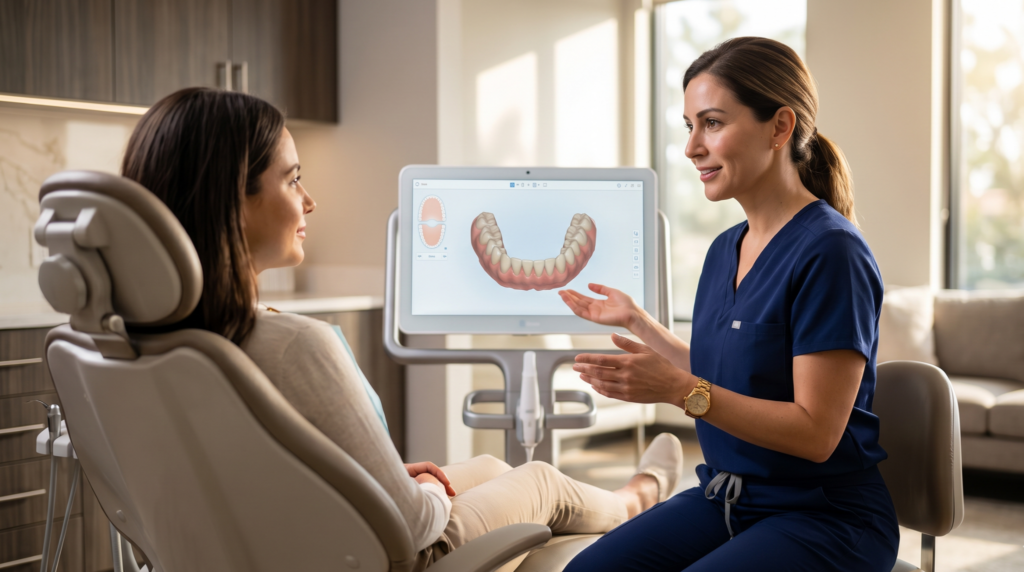
At our clinic in Wola, Warsaw, we offer periodontal consultations that begin with a full periodontal pocket assessment (probing depth and bleeding measurement at every site), imaging diagnostics and an individualised treatment plan. More information: klinikamdo.pl/en/offer/periodontist-warsaw.
The most frequently asked questions from patients
Does a hard toothbrush cause bleeding?
A hard toothbrush can cause mechanical irritation of the gums and, in the long term, recession. But it should not cause persistent bleeding. If the bleeding continues for more than a week — regardless of the type of toothbrush — it is worth having the gums checked.
Why do I bleed in only one spot?
Localised bleeding (at only one tooth or one area) is common and usually indicates local inflammation — for example, due to unremoved subgingival calculus, a poorly fitting restoration, or an area where floss does not reach.
Is gum bleeding always a sign of periodontitis?
No. Bleeding most commonly indicates gingivitis (early, reversible gum inflammation), not periodontitis (advanced, irreversible periodontal disease). But gingivitis, if untreated, can progress to periodontitis — which is why early reaction is so important.
Read more:
- Periodontist Warsaw — Klinika MDO services
- Smile design step by step — how does smile design work?
- Dental calculus — how to recognise it and remove it effectively
- Mouthwash for gingivitis — what does the evidence say really works?
Sources
Source 1
Links
https://pubmed.ncbi.nlm.nih.gov/40186219
https://doi.org/10.1186/s12903-025-05888-5
Opis: Benavides-Reyes C, Cabello I, Magán-Fernández A, Rodríguez-Barranco M, Usta SN, Mesa F. „Clinical effects of probiotics on the treatment of gingivitis and periodontitis: a systematic review and meta-analysis.” BMC Oral Health. 2025;25(1):490.
Source 2
Links
https://doi.org/10.1038/s41598-023-44307-z
https://www.nature.com/articles/s41598-023-44307-z
Opis: Patel JS, Shin D, Willis L, Zai A, Kumar K, Thyvalikakath TP. „Comparing gingivitis diagnoses by bleeding on probing (BOP) exclusively versus BOP combined with visual signs using large electronic dental records.” Scientific Reports. 2023;13:17065.
Source 3
Links
https://pubmed.ncbi.nlm.nih.gov/32383274
https://doi.org/10.1111/jcpe.13290
Sanz M, Herrera D, Kebschull M, Chapple I, Jepsen S, Berglundh T, Sculean A, Tonetti MS; EFP Workshop Participants and Methodological Consultants. „Treatment of stage I–III periodontitis—The EFP S3 level clinical practice guideline.” Journal of Clinical Periodontology. 2020;47(Suppl 22):4–60.
Source 4
Links
https://pubmed.ncbi.nlm.nih.gov/33573801
https://doi.org/10.1016/j.jdent.2020.103562
Opis: West N, Chapple I, Claydon N, D’Aiuto F, Donos N, Ide M, Needleman I, Kebschull M; British Society of Periodontology and Implant Dentistry Guideline Group Participants. „BSP implementation of European S3 – level evidence-based treatment guidelines for stage I-III periodontitis in UK clinical practice.” Journal of Dentistry. 2021;106:103562.