
The Sentence Patients Don't Expect
A patient who has been self-conscious about their bite for years finally decides to book an orthodontic consultation. They expect to hear: "Braces for 18 months and you'll be fine." Instead, they sometimes hear: "Braces alone won't be enough — in your case, jaw surgery is also necessary."
This article explains what orthognathic surgery actually involves and when it is genuinely needed. It also walks through the 18–24-month treatment plan and explains why this is a procedure that requires close collaboration between an orthodontist and a maxillofacial surgeon. It is written for people who have just received this diagnosis and need reliable information before making a decision.
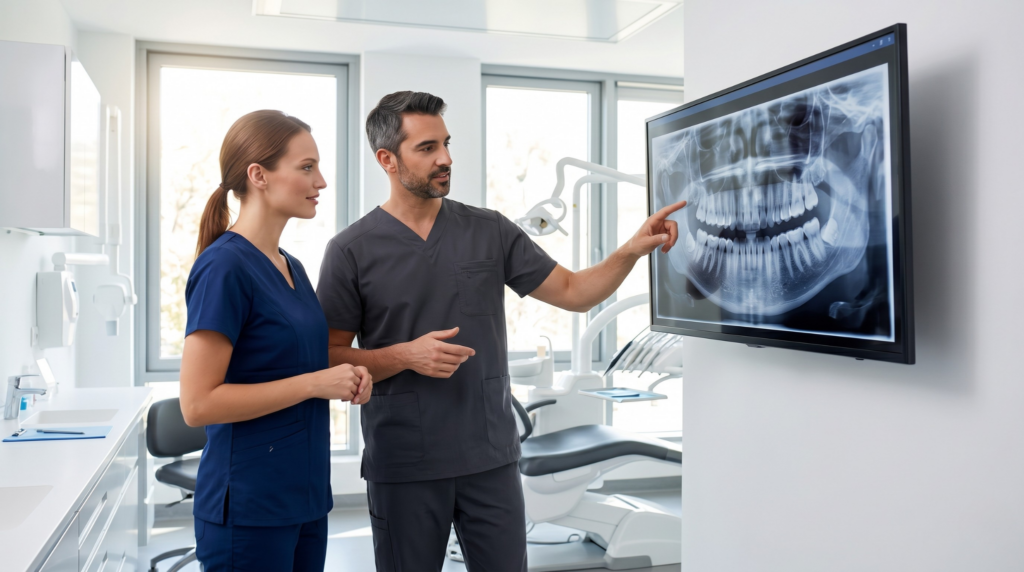
Dental Malocclusion vs. Skeletal Discrepancy – Two Different Problems
To understand why some bite problems require surgery, it helps to distinguish between two types of issues. A dental malocclusion means the teeth are misaligned, but the jaw bones themselves are proportioned correctly. Here the orthodontist has full flexibility — teeth are moved with fixed braces or aligners and the desired result is achievable.
A skeletal discrepancy is a different matter: the problem lies in the bones themselves. The lower jaw is too long or too set back, the upper jaw is too narrow, or the facial bones have grown asymmetrically. Braces can straighten the teeth within the existing bone, but they cannot change the proportions of the bone itself. That is how biology works — and no aligner system can get around it.
Classic Skeletal Discrepancies – What Actually Requires Surgery
The most common situations in which orthognathic surgery becomes the treatment of choice:
- Mandibular prognathism (skeletal Class III) – the lower jaw protrudes noticeably forward; lower teeth overlap upper teeth. Braces can align the teeth but cannot push the jaw back.
- Retrognathia (skeletal Class II, "receding chin") – the lower jaw is set back, producing a flat or "bird-like" profile. Full correction requires surgically moving the entire lower jaw forward.
- Skeletal open bite – the front teeth do not meet even when the back teeth are together. The patient has difficulty biting food and often has a lisp.
- Skeletal facial asymmetry – one side of the face is noticeably different from the other, most commonly due to a condylar growth disorder.
- Narrow upper jaw requiring expansion in an adult – in children this is addressed with a palatal expander; in adults (after the palatal suture has fused), surgically assisted rapid palatal expansion (SARPE) is required.
All of these cases share a common denominator: the problem lies in bone proportions, not tooth position — and braces alone will not solve it. Ignoring this distinction means that after years of wearing braces, the patient may have straight teeth, but the functional problem (chewing, speech, breathing) and the aesthetic problem (profile, facial proportions) will remain.
Three Phases of Orthognathic Treatment – An 18–30 Month Timeline
Surgical-orthodontic treatment is not a single operation — it is a complex process that typically divides into three phases and lasts 18 to 24 months. Patients need to understand this before making a decision.
Phase 1: Pre-Surgical Orthodontics (12–24 months)
It may come as a surprise that the first step in surgical treatment is… braces. The goal of this phase is not aesthetic improvement — in fact, the bite often looks worse before the operation than it did at the start. The orthodontist positions the teeth so that once the bones are surgically repositioned, the teeth will fit together perfectly. This involves decompensation (teeth naturally compensate for a skeletal discrepancy by tilting — this must be reversed before surgery), relieving crowding, and coordinating arch widths. Duration: typically 12–24 months, depending on severity.
Phase 2: Surgery (one hospitalization, several hours in the operating room)
The operation is performed in an operating theatre by a maxillofacial surgeon under general anaesthesia. Depending on the diagnosis, the procedure may involve mandibular osteotomy (BSSO — bilateral sagittal split osteotomy), upper jaw osteotomy (Le Fort I), chin osteotomy (genioplasty), or a combination of two or three procedures (bimaxillary surgery). Incisions are made from inside the mouth, so no visible external scars result. The repositioned bone segments are stabilized with titanium miniscrews and miniplates, which usually remain permanently (rarely requiring removal). Hospital stay is typically 2–4 days; full return to normal daily life takes 4–6 weeks.
Phase 3: Post-Surgical Orthodontics (~6 months) and Retention
Once the bones have healed, the orthodontist returns to fine-tuning tooth position — minor contact adjustments, closing remaining spaces, refining the bite. This phase typically lasts 4–8 months. Afterward, the patient moves into long-term retention. The full timeline should be presented to the patient after the first consultation — without it, informed decision-making is difficult.
Table: Skeletal Discrepancy → Type of Surgery → Expected Outcome
| Skeletal Discrepancy | Type of Surgery | Expected Outcome |
|---|---|---|
| Mandibular prognathism (Class III) | BSSO (setback) ± genioplasty | Chin setback, harmonious profile, correct anterior occlusion |
| Retrognathia (Class II) | BSSO (advancement) ± genioplasty | Lower jaw and chin advancement, improved profile, often improved airway |
| Skeletal open bite | Le Fort I + BSSO (bimaxillary surgery) | Closure of anterior open bite, improved biting function and speech |
| Narrow upper jaw in adult | SARPE (surgically assisted expansion) | Wider upper jaw, improved smile width, correction of crossbite |
| Facial asymmetry | Bimaxillary surgery with individual 3D plan | Facial symmetry restored, midline corrected |
| Excess vertical jaw height (skeletal "gummy smile") | Le Fort I with impaction | Reduced gum show on smiling, facial harmony |
This table is intentionally simplified — in real practice, almost every treatment plan combines elements of several procedures and is designed for the individual patient using 3D digital planning and patient-specific printed surgical guides.
Risks and Limitations – What Patients Have the Right to Hear
Orthognathic surgery is a safe procedure, performed in Poland for decades, but like any craniofacial surgery it carries risks that the patient must be informed of before signing consent:
- Temporary or permanent altered sensation in the lower lip and chin after BSSO – due to proximity to the inferior alveolar nerve. Most disturbances resolve within 6–12 months; permanent reduction in sensation is reported in a proportion of patients (figures vary depending on technique and surgeon experience).
- Post-operative swelling – peaks on days 3–5, resolves within 4–6 weeks. This is not a complication but an expected part of healing.
- Minor relapse – particularly with large forward movements of the lower jaw. Risk is reduced by stable titanium fixation and proper orthodontic retention.
- Need for re-operation – rare, but possible in cases of abnormal healing or displacement of bone segments.
- General complications related to general anaesthesia – typical of any major procedure (assessed individually during anaesthetic evaluation).
An honest discussion of risks is the clinician's duty and the patient's right. If your consultation did not include a frank conversation about complications, it is worth seeking a second opinion.
Why This Is Always a Team Effort – Division of Roles
Orthognathic surgery is not a one-person procedure. The patient effectively has two co-treating clinicians who must work closely together: the orthodontist (who manages the appliance before, during, and after surgery) and the maxillofacial surgeon (who performs the operation itself). The treatment plan is created jointly, at the table, with a 3D model of the patient's face — not in isolation from one another.
At Modern Dental & Orthodontics, Dr. Ewa Prażmo, PhD, leads the diagnostics, planning, and all orthodontic phases. The surgical procedure itself is carried out by a collaborating maxillofacial surgery team. The patient receives a treatment plan naming the specific clinicians responsible for each phase. This model — orthodontist and surgeon as one team — is the standard of care for this category of problems and allows for truly informed treatment.
When It May Not Be Worth It – An Honest Discussion of Limits
Not every patient with a skeletal discrepancy needs surgery. Factors that argue for deferring the decision or exploring alternatives:
- A mild skeletal discrepancy where the functional result achievable with braces is sufficient for the patient — not every Class II is an indication for surgery.
- The patient has not yet finished growing (people under 18–20 are rarely candidates; for younger patients, growth modification through orthopaedic appliances is attempted first).
- Systemic conditions posing anaesthetic risk — assessed individually by the anaesthesiologist.
- Insufficient patient motivation for 18–24 months of treatment. Orthognathic surgery is a marathon, not a sprint.
- Active periodontitis — periodontal stabilization is required before orthodontic tooth movement begins on teeth with compromised supporting structures.
For selected patients — particularly those with moderate Class II — an alternative may be treatment using orthodontic mini-implants (TADs). There are cases where precise biomechanics with skeletal anchorage can achieve a result approaching surgery without an operation. The decision always rests with the team and the patient after an honest conversation about the limits of each option.
The most frequently asked questions from patients
How much does the full orthognathic treatment cost?
The total cost covers orthodontics plus the surgical procedure. We always provide a specific quote individually after consultation.
Is the surgery covered by the national health service (NFZ)?
In certain clinical cases — yes. This applies mainly to patients with significant functional impairments (e.g. severe Class III with chewing difficulties). Reimbursement is at the discretion of the maxillofacial surgeon following qualification for the procedure in a hospital setting.
Will I have scars on my face?
No. The incisions are intraoral; no external scars result.
How long will I be off work?
Typically 2–3 weeks of full recovery, followed by a further 4–6 weeks on a soft diet with restricted activity. Patients with desk jobs usually return in the third week; those in physical work return later.
Are there any permanent sensory disturbances?
In a small percentage of patients — a few percent — some reduction in sensation in the area supplied by the inferior alveolar nerve may be permanent. In the majority, it resolves within 6–12 months.
Is the result permanent?
In most cases yes, provided retention is maintained. Minor relapse in the first 12–24 months is possible — which is why the retention protocol is more intensive than in standard orthodontic treatment.
Read more:
- Orthodontist Warsaw Wola | Orthodontic appliances and Invisalign
- Dental Surgery Warsaw Wola | Make an appointment
- First visit to the orthodontist – step by step | MDO Clinic
- What does getting braces look like? A step-by-step guide
Sources
1. Cremona M, Bister D, Sheriff M, Abela S. „Quality-of-life improvement, psychosocial benefits, and patient satisfaction of patients undergoing orthognathic surgery: a summary of systematic reviews.” Eur J Orthod. 2022;44(6):603–613. DOI: 10.1093/ejo/cjac015. PMID: 35511144.
2. Meger MN, Fatturi AL, Gerber JT, Weiss SG, Rocha JS, Scariot R, Wambier LM. „Impact of orthognathic surgery on quality of life of patients with dentofacial deformity: a systematic review and meta-analysis.” Br J Oral Maxillofac Surg. 2021;59(3):265–271. DOI: 10.1016/j.bjoms.2020.08.014. PMID: 33546846.
- https://pubmed.ncbi.nlm.nih.gov/33546846/
- https://www.sciencedirect.com/science/article/abs/pii/S0266435620304010
3. Inchingolo AM, Patano A, Piras F, de Ruvo E, Ferrante L, Di Noia A, Dongiovanni L, Palermo A, Inchingolo F, Inchingolo AD, Dipalma G. „Orthognathic Surgery and Relapse: A Systematic Review.” Bioengineering (Basel). 2023;10(9):1071. DOI: 10.3390/bioengineering10091071. PMID: 37760172.
4. Duarte V, Zaror C, Villanueva J, Andreo M, Dallaserra M, Salazar J, Pont À, Ferrer M. „Oral Health-Related Quality of Life Changes in Patients with Dentofacial Deformities Class II and III after Orthognathic Surgery: A Systematic Review and Meta-Analysis.” Int J Environ Res Public Health. 2022;19(4):1940. DOI: 10.3390/ijerph19041940. PMID: 35206128.
5. Sen E, Duran H, Sarı M, Akbulut N, Demir O. „Orthognathic surgery improves quality of life: a survey clinical study.” BMC Oral Health. 2024;24(1):844. DOI: 10.1186/s12903-024-04638-3. PMID: 39054469.
- https://bmcoralhealth.biomedcentral.com/articles/10.1186/s12903-024-04638-3
- https://pmc.ncbi.nlm.nih.gov/articles/PMC11270847/
6. Alsenaidi A, Al Hashmi A, Al Nabhani M, Bakathir A, Jose S, Qutieshat A. „Health-related quality of life and satisfaction following orthognathic surgery: a prospective cohort study.” Oral Maxillofac Surg. 2024;28(3):1251–1258. DOI: 10.1007/s10006-024-01250-1. PMID: 38602585. [Poprawione: oryginalna bibliografia zawierała błędny DOI (10.1007/s10006-024-01217-2) oraz błędną numerację stron (28(2):987-996)]
- https://link.springer.com/article/10.1007/s10006-024-01250-1
- https://pubmed.ncbi.nlm.nih.gov/38602585/
7. Lin C, Zhang J, Zheng M, Li M, Zhu C, Wan Q. „Factors influencing the quality of life among orthognathic patients: a systematic review and meta-analysis.” Eur J Orthod. 2025;47(3):cjaf034. DOI: 10.1093/ejo/cjaf034. PMID: 40353447.