
Getting braces is, for many patients, the most mysterious stage of treatment, shrouded in numerous questions and concerns. This uncertainty is entirely natural — but it should not cause anxiety.
At our clinic we ensure that you feel confident and safe from the very start of treatment. That is why we have prepared this guide for you, explaining what happens before, during and after the fitting of braces.

Before you sit in the chair: What needs to be done before getting braces?
Proper orthodontic treatment is a process that begins long before the first brackets appear on your teeth. Thorough preparation is the foundation of success.
First step — Consultation and treatment plan
Everything starts with a consultation appointment, during which the orthodontist carefully assesses the malocclusion, takes a medical history and presents the available treatment options. Together you choose the type of appliance best suited to your case.
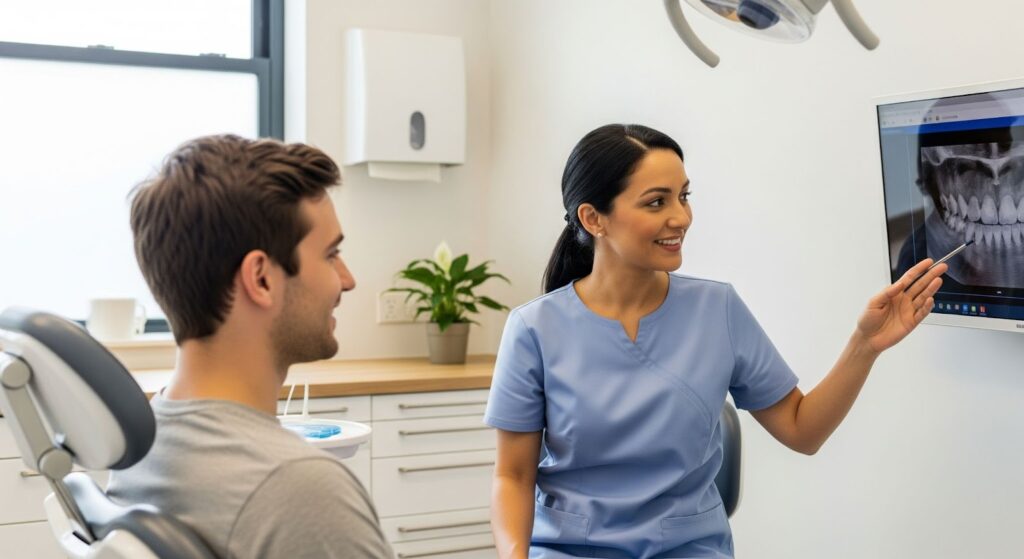
Essential diagnostics — Radiographic imaging
A precise treatment plan requires thorough imaging diagnostics. At our clinic we use state-of-the-art equipment that allows a panoramic radiograph (OPG) and, where necessary, a cone-beam computed tomography scan (CBCT) to be taken.
Health first — Treatment and professional hygiene
An absolute prerequisite for starting orthodontic treatment is an optimal state of oral health. This means that all carious lesions must be treated and a professional hygiene appointment (scaling and polishing) must be completed beforehand.
What does getting fixed braces look like? The process step by step
When all preparations are complete, the day of fitting arrives. The entire process is carefully planned and carried out with the utmost precision.
1. Enamel preparation
First the orthodontist thoroughly cleans and polishes the surface of your teeth with a special paste. A conditioning agent is then applied to the enamel to enable the adhesive to bond effectively.
2. Bracket placement
The clinician applies a small amount of specialist orthodontic adhesive to each bracket and then precisely positions the bracket on the tooth surface.
3. Curing the adhesive
Once all the brackets are in place, the adhesive is cured using light from a special polymerisation lamp. This process takes just a few seconds per tooth.
4. Fitting the archwire
A thin metal wire, known as the archwire, is threaded through the slots in the brackets. It is the main "engine" of the appliance — it exerts a constant, gentle force on the teeth, gradually guiding them to their correct positions.
5. Fitting the ligatures
Finally, the archwire is secured to the brackets with small elastic bands — the ligatures. Patients can often choose their colour, which is a fun element, especially for younger patients.
The first days with braces — what next?
After fitting, a short adaptation period begins. During the first days it is advisable to opt for soft and liquid foods (yoghurts, cream soups, porridge), as the teeth will be slightly tender.
To help you establish good habits from the outset, we have prepared a comprehensive guide. Find out how to care for your hygiene step by step: How to brush your teeth with braces?
Frequently Asked Questions (FAQ)
Does getting braces hurt?
The fitting process itself is completely painless. You will not feel pain during the appointment. However, in the days following fitting you may experience a feeling of tightness and slight tenderness of the teeth. This is a natural response — the teeth are beginning to move. The discomfort usually subsides within 3–5 days.
How long does it take to fit fixed braces?
An appointment to fit braces on one arch (upper or lower) usually takes approximately 45–60 minutes. If fitting on both arches is planned at the same visit, you should allow approximately 90–120 minutes.
What should I buy before getting braces?
To be fully prepared for maintaining your hygiene from day one, it is worth putting together a small starter kit. Here is what it should contain:
- A specialist orthodontic toothbrush with a groove in the centre.
- Single-tuft brushes for cleaning the areas around the brackets.
- A dental water flosser, which is excellent for flushing out food debris.
- Orthodontic wax to cover any elements that may irritate the cheeks or lips.
- An alcohol-free mouthwash.
Can I eat normally straight after getting braces?
It is recommended that you do not eat for one hour after fitting. Throughout the entire treatment period you should avoid extremely hard, sticky and crunchy foods (e.g. nuts, toffees, hard apples). A detailed dietary guide will be provided at the appointment.

Summary
Getting fixed braces is a precise, painless and relatively quick procedure that constitutes the most important step on the path to a healthy and beautiful smile.
Are you ready for a change? Take the first step on your journey to a beautiful smile and book an orthodontic consultation. We look forward to seeing you!