
Root canal treatment has attracted many myths that are easy to find in online discussions — that the procedure is painful, expensive or that it is better simply to extract the tooth and have an implant. Such simplifications can discourage patients from undergoing treatment that may save a natural tooth for many years.
That is why today we have invited an endodontist from Klinika Modern Dental & Orthodontics to answer the most frequently asked — and at the same time the most challenging — questions about root canal treatment.
Here is a compendium of knowledge that will dispel your doubts before your appointment.
Comfort and the course of root canal treatment
1. Why do I have to lie down during treatment, and what is the "rubber cover" on the tooth?
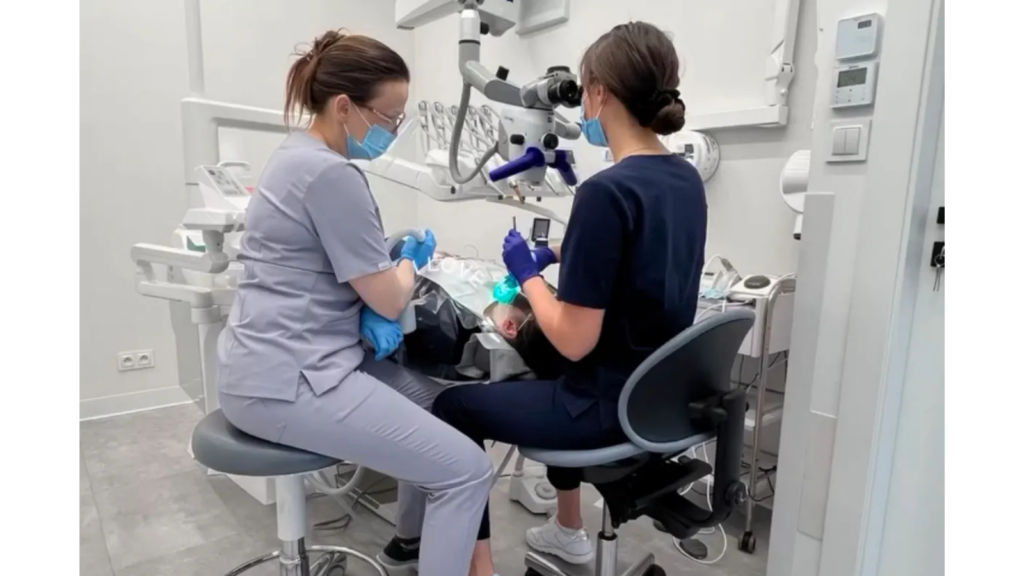
A supine position is the standard at our clinic — indeed, a technical requirement. Because we work under a microscope, a precise field of view must be maintained, which is only possible when the patient is lying flat.
That "rubber" is a rubber dam. It is a latex shield (also available in a latex-free version for patients with allergies) that isolates the tooth being treated from the rest of the oral cavity. Its three key functions are:
- Safety: It protects you from accidentally swallowing instruments or irrigant solutions reaching the throat.
- Sterility: It protects the open tooth from bacteria in the saliva.
- Dryness: It ensures an ideally dry operative field, which is essential for the longevity of the materials.
It is worth emphasising that root canal treatment without a rubber dam is simply not possible in modern dentistry.
2. I have a cold sore, but my tooth needs treatment. Can I come for the appointment?
Unfortunately, no. For your safety and that of the staff, we ask you to inform us about viral infections (such as cold sores) and to reschedule the appointment. The herpes simplex virus is highly contagious, and performing procedures during an active outbreak carries a risk of cross-infection.
3. My tooth does not hurt. Could the dentist have been wrong in referring me for root canal treatment?
This is a common misconception. Remember, however, that the absence of pain does not mean the absence of disease. Many inflammatory conditions of the pulp or the periapical tissues take a chronic, painless course. Radiographic imaging may reveal changes that are invisible and unfelt but require treatment. The rule of thumb: trust the diagnostics, not the symptom.
Technology and diagnostics in endodontics
4. Is treatment under a microscope just marketing, or a real benefit?
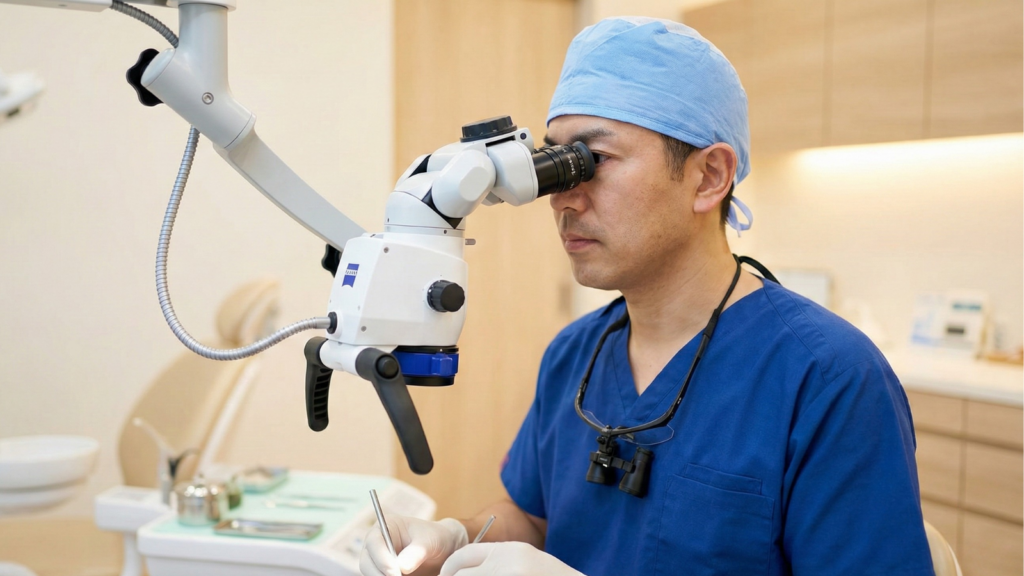
It is an absolute necessity for the efficacy of the therapy, not a marketing gimmick. The interior of a tooth is a complex labyrinth with a diameter measured in fractions of a millimetre. A microscope provides magnification of up to ×25, enabling the clinician to see details that are invisible to the naked eye.
Thanks to the magnification we can:
- Locate the smallest additional canals that without a microscope would be missed (and cause pain in the future).
- Detect micro-cracks of the root.
- Prepare the tooth tissues conservatively, which extends the tooth's lifespan.
At Klinika Modern Dental & Orthodontics every root canal treatment is performed under a microscope.
5. Can I refuse radiographic imaging? I am worried about radiation
Root canal treatment without radiographic diagnostics is impossible and would constitute a breach of the standard of care. The clinician must see what they are treating — we do not work "by feel".
- Minimum: Two periapical radiographs (small doses) — before and after treatment.
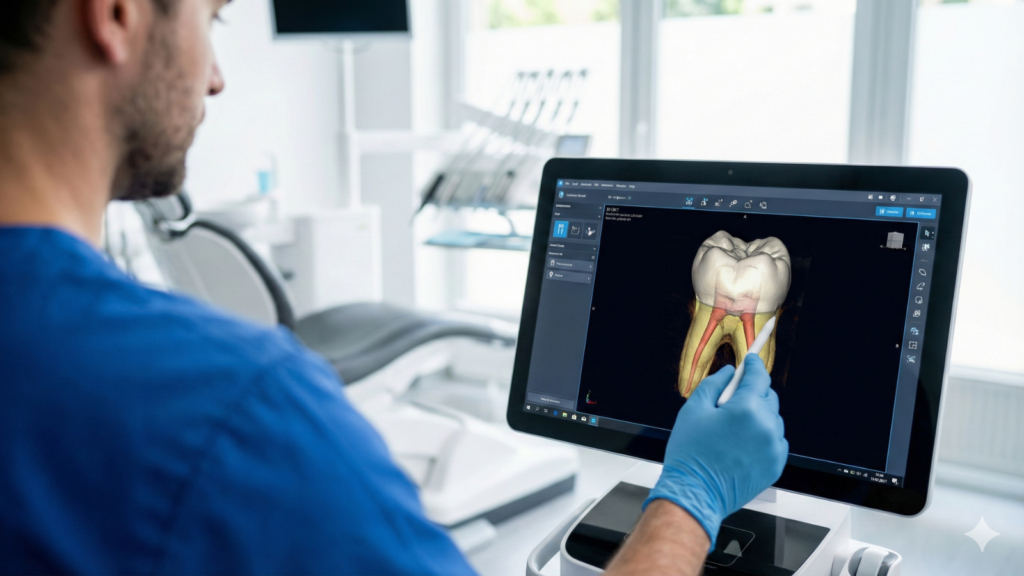
- 3D standard: In equivocal cases we take a cone-beam computed tomography scan (CBCT) with a small field of view. It allows the three-dimensional anatomy of the tooth to be visualised, which is particularly important in the case of complex root canal systems.
The doses in modern digital radiology are negligible. The only exception are pregnant patients — they must inform the clinician of their pregnancy before any radiographic examination.
6. How does the clinician know how many canals my tooth has?
It is a combination of anatomical knowledge and precise imaging diagnostics. The clinician can determine for each group of teeth (incisors, premolars, molars) the statistically most common number of canals, and then verify this information using CBCT and observation under the microscope during the procedure.
The cost of root canal treatment
7. How much exactly does root canal treatment cost?
The cost depends on the complexity of the case (primary vs retreatment) and the number of canals in the tooth. At our clinic the price usually ranges from PLN 1,500 to PLN 3,500 per tooth (the exact price list is available on our website).
Importantly, the price includes the full safety infrastructure:
- Treatment under a microscope.
- Use of a rubber dam.
- Local anaesthesia.
Please note that the price list on the website is indicative. The clinician will provide a precise cost estimate after examining the tooth.
8. Can there be any additional costs beyond the root canal treatment itself?
Yes, you should be aware that endodontic treatment is a process that sometimes requires accompanying procedures. The most common additional costs are:
- Tooth wall build-up: If the tooth is severely damaged by caries, we must first rebuild it in order to place the rubber dam (so-called pre-endo build-up).
- Emergency/intermediate appointment: Application of an intracanal medicament in the case of severe inflammation.
- Specialist procedures: E.g. removal of a fractured instrument left during treatment at another clinic, removal of an old post from the root canal, or treatment of a perforation. These are complex interventions that extend the treatment time and cost.
9. What is root canal retreatment (re-endodontics) and why is it more expensive?
Retreatment is, in the simplest terms, the rescue of a tooth that has already been treated but in which the infection has returned. It is a significantly more difficult procedure than primary treatment because the clinician must first remove the old filling material from the canals, clean all residual infection and then re-seal the canal system.
Endodontics and prosthetic treatment
10. Is the "filling" included in the cost of root canal treatment?
No. It is important to distinguish these two stages: root canal treatment is the "foundation", and the crown restoration is the "house" built on top of it. The restoration is not included in the cost of endodontic treatment. After root canal treatment the tooth must be rebuilt. Two options are available:
- A standard filling (composite restoration) — this is the less expensive option (direct restoration).
- A prosthetic restoration (onlay, crown) — more expensive, but strongly recommended by clinicians.
11. The tooth has been treated. Do I need a crown, or is a filling sufficient?
We strongly recommend a prosthetic restoration (crown or onlay). Why? Because a non-vital tooth is considerably more brittle and susceptible to fracture than a vital one. A crown acts as a "helmet" that holds the tooth structure together and protects it from cracking under occlusal forces.
12. Will I receive a guarantee that the tooth will last forever after root canal treatment?
In medicine the concept of a guarantee does not exist. The clinician performs the procedures to the best of their ability, but has no control over the individual regenerative capacity of the body. What we can guarantee is: the highest standard of procedure, full commitment and honesty regarding the prognosis.
13. Wouldn't it be simpler to extract the tooth and have an implant?
This is a question many patients ask when weighing up the costs. Our answer is: your own tooth is always the best implant. Extraction is an irreversible procedure. A natural tooth has a periodontal ligament that cushions forces and has sensory receptors that artificial replacements do not possess. If there is a chance of saving the tooth through root canal treatment, it is worth taking it.
Are you struggling with pain or have a tooth requiring root canal treatment? Do not delay — time works against your teeth. Book an appointment at Klinika Modern Dental & Orthodontics.