
Key points in brief
- Gum treatment before a crown or bridge is needed when the gums bleed or are swollen, or when the dentist has found pockets, that is deepened gaps between the tooth and the gum.
- It usually takes from a few weeks to a few months, depending on how deep the inflammation reaches. The dentist sets the date for the impression after measuring your gums again.
- If the tooth has already been ground down, a temporary crown protects it in the meantime. When you clean between your teeth every day, your gums stop bleeding sooner.
- Swollen gum shrinks after treatment. If the crown were fitted to swollen gum, its edge could later become exposed.
- Once a crown or bridge has been fitted on your own teeth, the gums need regular check-ups, usually every 3–12 months.
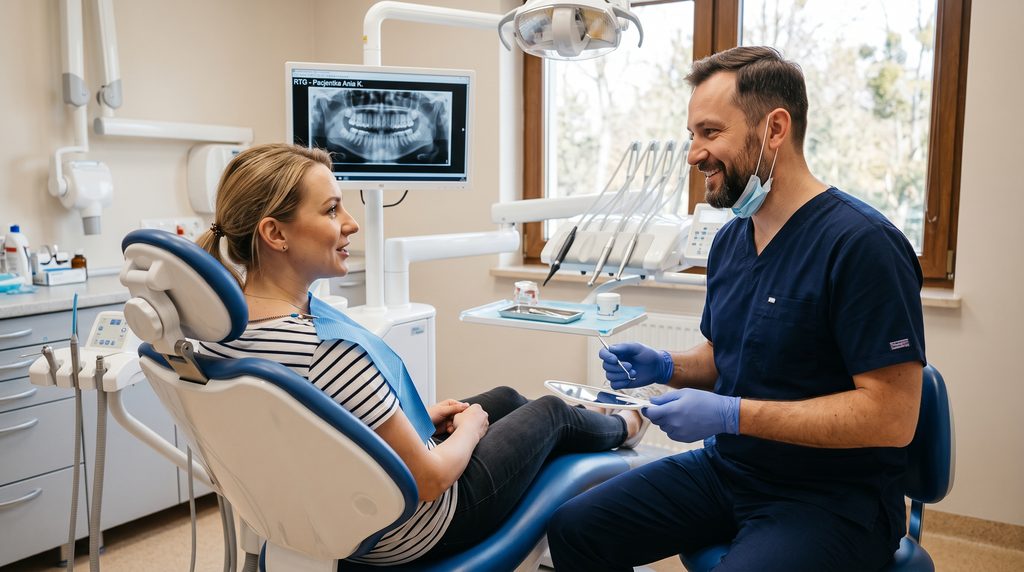
How bleeding gums affect a crown or a bridge
The inflammation that makes gums bleed makes an accurate impression harder and changes where the gum will settle around the crown. If the inflammation reaches the bone, the tooth is also held less firmly.
A crown has to fit tightly right up to the edge of the tooth that has been ground down for it. This edge usually lies right at the gum or just below it. Bleeding, swollen gum hides it in the impression material and on the scan. The deeper below the gum the edge lies, the harder it is to reproduce accurately. A crown that does not fit tightly traps bacterial plaque and itself keeps the inflammation going.
As the inflammation settles, the gum shrinks and recedes a little. If the crown was fitted to swollen gum, its edge may later become exposed. With a crown on a metal base, a dark line then shows, and with any crown a ledge may form where plaque collects more easily.
Periodontitis, commonly called gum disease, destroys the bone around the teeth. The periodontium is the tissue that holds a tooth in place - the gum, the fibres that connect the root to the bone, and the bone itself. A tooth that has lost some of its bone may become loose and copes less well with biting forces. With a bridge this matters especially, because the teeth the bridge rests on also take the load for the missing tooth.
This is why periodontal treatment, that is treatment of the tissues that hold the teeth, usually comes before the permanent crown or bridge. If the tooth has an old crown that no longer fits tightly, the dentist first removes it and fits a temporary one, because otherwise the gum around that tooth often does not stop bleeding. If you are planning an implant instead of a crown on your own tooth, gum treatment before an implant follows a similar order, but with different risks.
What to ask the dentist before the impression for your crown
Before the dentist takes the impression for your permanent crown or bridge, it helps to know the answers to a few questions. They show what stage of treatment you are at and how much longer it will take:
- Are my gums ready for the impression yet, or do we need to wait a little longer?
- After treatment, could the gum around this tooth still recede?
- Will I need a procedure on the gum or the bone before the crown?
- How long will I wear the temporary crown, and how should I clean it?
- How often should I come for gum check-ups after the crown or bridge is fitted?
What gum treatment before a crown involves and how long it takes
Inflammation of the gums alone - without pockets and without bone loss - usually settles within a few weeks of a professional cleaning and better everyday care of your teeth. With periodontitis, the date for the impression is set after the gums have been measured again, usually 1–3 months after the pockets were cleaned. If a procedure on the gum or the bone is needed, another period of healing is added, from a few weeks to a few months.
| Stage | When | What happens |
|---|---|---|
| Examination and professional cleaning | first visit | The dentist measures the pockets around the teeth and looks at the X-rays and any old crowns. The hygienist removes tartar and shows you how to clean between your teeth. |
| Cleaning the pockets | one or several visits, usually under local anaesthetic | The dentist removes tartar and bacteria from the roots below the gum. Crowns that no longer fit tightly are replaced with temporary ones, and fillings that stick out are corrected. |
| Healing | usually 1–2 months | The gum stops bleeding, shrinks and recedes. |
| Re-evaluation | after healing, usually 1–3 months after the pockets were cleaned | The dentist repeats the measurement. Deep pockets that have not become shallower may need a surgical procedure and another period of healing. |
| Procedure before the crown, if needed | healing from a few weeks to a few months | Crown lengthening, that is exposing more of the tooth when too little of it is left above the gum. |
| Impression, then the crown or bridge | once the gum is stable | The dentist takes an impression or a scan and, a few days or weeks later, fits the crown or bridge. |
| Maintenance visits | ongoing, at intervals agreed with the dentist | The dentist or hygienist measures the pockets, removes tartar and checks the edge of the crown and the area under the bridge. |
Pockets are first cleaned without cutting the gum. Those that have not become shallower are sometimes cleaned after the gum has been cut and lifted away from the tooth. These two methods are closed and open curettage.
The order of the stages is fixed, but the exact intervals between them cannot be planned in advance. It is not known exactly after how many weeks the gum stops changing. It changes most during healing, but the tissues go on maturing for a few more months.
You can influence how quickly your gums stop bleeding. The most important thing you can do at home is to clean between your teeth. For people who have had treatment for periodontitis, interdental brushes sized to fit each gap work best. The hygienist chooses the sizes, because a brush that is too large can injure the gum, and one that is too small does not remove plaque. The hygienist also shows you how to use them.
Preparing the gums for a bridge looks the same as before a single crown. The difference is that the dentist assesses several teeth at once. They check whether each tooth the bridge is to rest on has enough bone and is not getting looser over time. If it is uncertain how long one of these teeth will last, the dentist discusses this before planning the bridge. Removing such a tooth later usually means replacing the whole bridge.
What the dentist checks in your gums before a crown or bridge
A periodontal assessment before prosthetic treatment, that is before treatment with crowns and bridges, shows whether the gums and the bone around the teeth are ready for it. The dentist measures the depth of the pockets with a thin probe that has a measuring scale, and checks whether bleeding appears after the measurement. They also assess whether the teeth are loose, how much bone can be seen around the roots on the X-ray, and where plaque collects. They record how advanced the disease is and how fast it has progressed.
Before taking the impression for the permanent crown, the dentist checks whether these conditions are met:
- the gums do not bleed when examined, or bleed only in isolated spots
- deep pockets have become shallower and do not bleed
- the gum around the tooth that will carry the crown does not change position between two visits
- teeth that were loose are not getting any looser
- there is little plaque, because cleaning between the teeth has become a habit
- the wound after a gum procedure, if one was needed, has healed
It is not always possible to meet all of these conditions in full. The dentist then judges whether the problem concerns the tooth that will carry the crown or the teeth that will carry the bridge, and whether it changes the treatment plan.
When a procedure on the gum or bone is needed before a crown
A procedure on the gum or bone before a crown is needed when too little healthy tooth is left above the gum for the crown to rest on it securely. This happens, for example, when decay or a fracture reaches below the gum. A second reason can be deep pockets that have not become shallower after cleaning.
Between the edge of the crown and the bone, a band of tissue has to remain - the tissue by which the gum attaches to the tooth. If the crown reaches too deep and encroaches on this band, the gum around it may stay inflamed. Over time the gum may also recede, or bone may be lost.
When too little healthy tooth is left above the gum, the dentist carries out surgical crown lengthening under local anaesthetic. After the procedure the gum heals and may partly grow back up over the tooth.
If the crown is made before the gum has stabilised, the edge of the gum may later shift, leaving the edge of the crown too deep or exposed. So the dentist sets the date for the permanent crown after checking how the gum has healed. This is usually a few weeks after the procedure. For front teeth, which show when you smile, the wait is usually longer. During this time the tooth is protected by a temporary crown.
Crown lengthening is not always necessary. If the damage to the tooth ends above the gum or right at it, and the gum is healthy, the procedure is usually not needed. Sometimes simply trimming overgrown gum is enough, without changing the level of the bone.
How to look after your gums once the crown or bridge is fitted
Gum treatment before a crown continues after the crown is fitted, in the form of regular maintenance visits, usually every 3–12 months. They are a precondition for a crown or bridge to last. The more advanced the disease was, and the faster it progressed before treatment, the shorter the intervals usually are.
Bridges supported by your own teeth and made after treatment for periodontitis usually last many years, including in people with the most advanced disease, whose teeth had lost a lot of bone. Over periods ranging from 2 to more than 30 years, people with such advanced disease lost roughly 1 supporting tooth in 20. A supporting tooth is one that a bridge rests on.
When large bridges spanning many teeth failed after years in people treated for periodontitis, the most common reason was decay at the supporting teeth. This happened more often in people who cleaned their teeth less well.
When can the impression for the permanent crown or bridge be taken?
The impression for the permanent crown or bridge can be taken once the gums bleed in isolated spots at most, the pockets have become shallower, and the gum around the tooth has stopped changing position. Until then, a temporary crown protects the ground-down tooth, and you help your gums by cleaning between your teeth every day.
If pus or swelling appears around the tooth, see a dentist by the next day at the latest, and if the tooth starts to get looser, within a few days. If swelling of the face is getting worse, or you have a fever, seek help straight away. If the swelling makes it hard to swallow, speak or breathe, call 112, the emergency number in Poland and across the EU, or have someone drive you to a hospital emergency department.
Frequently asked questions
Can the impression for a crown be taken if my gums bleed?
Slight bleeding usually does not get in the way of the impression if it appears only when the gum is being moved aside with a thin cord, because the dentist stops that kind of bleeding on the spot. The dentist postpones the impression when the gum is swollen and bleeds at a light touch, because that is a sign of active inflammation. Such inflammation has to be treated first, otherwise the edge of the crown could later become exposed.
Does a bridge harm your gums?
A well-fitting bridge does not in itself damage the gums or the tissues that hold the teeth, but it makes cleaning harder. Plaque builds up more easily under the part of the bridge that replaces the missing tooth and around the teeth the bridge rests on. If it is not removed every day, gum inflammation may come back around the bridge, and decay may develop on the supporting teeth.
How do I clean under a bridge, where the missing tooth was?
You clean under a bridge with floss that has a stiffened end, which you thread underneath, or with an interdental brush. The hygienist will show you how to thread the floss under the bridge once it has been fitted. An oral irrigator, a device that rinses with a jet of water, can help as an extra, but it does not replace the brush.
Does smoking get in the way of gum treatment before a crown?
Smoking does not rule out gum treatment, but in people who smoke the pockets usually do not become quite as shallow. Their gums may also bleed less than in non-smokers, so inflammation is easier to miss. This is why the dentist talks about stopping smoking at the very first stage of treatment.
Can a temporary crown stay on longer if the gums are slow to heal?
Yes, a temporary crown can protect the tooth for a few weeks, and sometimes for a few months. It is made from a less durable material, so if you wear it for longer, the dentist checks whether it still fits well and is not wearing down. Clean it like an ordinary tooth, and slide the floss out sideways rather than pulling it back up the same way, because that can lever the crown loose.
How might my teeth look and feel after gum treatment?
After treatment the gum usually recedes a little, so your teeth may look slightly longer. Small gaps may also appear between the front teeth where there used to be swollen gum. This is why the dentist decides on the shape of a crown on a front tooth only once the gum has healed. For a few weeks the teeth can be sensitive to cold.
What does the gum around a new crown look like in the first month?
In the first week after the crown is fitted, the gum at its edge can be tender and slightly red, and it can bleed when you brush, especially if it was recently moved aside with a cord. It usually returns to normal within about a month. Clean it as usual, gently. If the bleeding is increasing, show the tooth to your dentist within a few days, and if there is swelling or pus, by the next day at the latest.
Read more:
- Periodontist in Warsaw Wola
- Closed vs open curettage — a comparison of methods for treating advanced periodontitis
- Surgical crown lengthening — when is it necessary and how is it performed
- Temporary crown — what it is for, how long it lasts and how to look after it
- Periodontitis: Symptoms, causes and modern treatment methods. How to treat periodontal disease
Content and liability disclaimer
This article is informational and educational in nature and does not constitute medical advice, a diagnosis or a therapeutic recommendation — it does not replace a consultation with a specialist. If you are experiencing symptoms, have doubts or are facing a decision about treatment, consult a dentist. The methods described and the data cited are general in nature. The results of scientific studies relate to populations, not to an individual patient. The course and outcome of therapy depend on the individual clinical situation and may vary between patients. No information contained in this article constitutes a guarantee of result. The content has been prepared with due care, based on publicly available medical knowledge and the scientific publications indicated in the Sources section. We do not advise taking or refraining from any health-related action solely on the basis of the content of this article, without prior consultation with a doctor.
Sources
Source 1
Links https://doi.org/10.1111/jcpe.13290 │ https://pubmed.ncbi.nlm.nih.gov/32383274/
Description Sanz M, Herrera D, Kebschull M, Chapple I, Jepsen S, Berglundh T, Sculean A, Tonetti MS; EFP Workshop Participants and Methodological Consultants. „Treatment of stage I-III periodontitis-The EFP S3 level clinical practice guideline.” Journal of Clinical Periodontology. 2020;47(Suppl 22):4-60.
Source 2
Links https://doi.org/10.1111/jcpe.13985 │ https://pubmed.ncbi.nlm.nih.gov/38706227/
Description Paternò Holtzman L, Valente NA, Vittorini Orgeas G, Copes L, Discepoli N, Clementini M. „Change in clinical parameters after subgingival instrumentation for the treatment of periodontitis and timing of periodontal re-evaluation: A systematic review and meta-analysis.” Journal of Clinical Periodontology. 2025;52(1):137-158.
Source 3
Links https://doi.org/10.1111/jcpe.14141 │ https://pubmed.ncbi.nlm.nih.gov/40081317/
Description Nibali L, Cortellini P. „Changes in Osseous Morphology Following Non-Surgical Periodontal Therapy: A Possible Paradigm Shift for the Treatment of Intrabony Defects?” Journal of Clinical Periodontology. 2025;52(6):836-842.
Source 4
Links https://doi.org/10.1111/jopr.13292 │ https://pubmed.ncbi.nlm.nih.gov/33210761/
Description Ercoli C, Tarnow D, Poggio CE, Tsigarida A, Ferrari M, Caton JG, Chochlidakis K. „The Relationships Between Tooth-Supported Fixed Dental Prostheses and Restorations and the Periodontium.” Journal of Prosthodontics. 2021;30(4):305-317.
Source 5
Links https://doi.org/10.1016/j.prosdent.2025.07.026 │ https://pubmed.ncbi.nlm.nih.gov/40858421/
Description Revilla-León M, Ntovas P, Li J, Barmak AB, Kois JC, Gómez-Polo M. „Tooth preparation-related factors that impact the accuracy of intraoral scanners for fabricating tooth-supported restorations: A systematic review.” The Journal of Prosthetic Dentistry. 2025;134(5):1555.e1-1555.e20.
Source 6
Links https://doi.org/10.1186/s12903-022-02491-w │ https://pubmed.ncbi.nlm.nih.gov/36324171/
Description Oh SL, Abrera-Crum L, Yang JS, Choi SK. „New approach to expedite the delivery of the final crowns for teeth requiring crown lengthening surgery: a pilot study.” BMC Oral Health. 2022;22(1):462.
Source 7
Links https://doi.org/10.1111/jcpe.13384 │ https://pubmed.ncbi.nlm.nih.gov/33022758/
Description Chang J, Meng HW, Lalla E, Lee CT. „The impact of smoking on non-surgical periodontal therapy: A systematic review and meta-analysis.” Journal of Clinical Periodontology. 2021;48(1):60-75.
Source 8
Links https://doi.org/10.1111/jcpe.13482 │ https://pubmed.ncbi.nlm.nih.gov/34786742/
Description Montero E, Molina A, Palombo D, Morón B, Pradíes G, Sanz-Sánchez I. „Efficacy and risks of tooth-supported prostheses in the treatment of partially edentulous patients with stage IV periodontitis. A systematic review and meta-analysis.” Journal of Clinical Periodontology. 2022;49(Suppl 24):182-207.
Source 9
Links https://doi.org/10.1111/jcpe.14116 │ https://pubmed.ncbi.nlm.nih.gov/39757087/
Description Fardal Ø, Grytten J. „A Retrospective Study of Stabilizing Bridges in Patients With Stages III and IV Periodontitis: Up to 35 Years of Clinical Audit.” Journal of Clinical Periodontology. 2025;52(6):826-835.
Source 10
Links https://doi.org/10.1111/jopr.14015 │ https://pubmed.ncbi.nlm.nih.gov/39763171/
Description Fouad M, Mahmoud AAA, Al-Rabab’ah M, Kasabreh N. „The impact of retraction cords on the gingival margin level: A randomized clinical trial.” Journal of Prosthodontics. 2025;34(2):139-148.