
Key points in brief
- An implant does not have to stand under every missing tooth. With three missing teeth in a row, a bridge on two implants is often enough; with two, sometimes one implant; and with four, two or three.
- Such a bridge works well when the bone allows the implants to go in the right places, the bite is not overloaded, for example by grinding, and you can clean thoroughly under the bridge.
- Your dentist decides how many implants to place, and where, after a cone beam CT scan, which is a three-dimensional X-ray. At the consultation, ask where the implants will go and how you will clean under the bridge.
- With a bridge, losing one implant or repairing one of its teeth usually means removing the whole bridge. A separate crown can be repaired without disturbing its neighbours.
- An implant under every tooth is not automatically better. If the bone, the bite and cleaning allow a bridge, research does not show that more implants give a longer-lasting result.
Does every missing tooth need its own implant?
No, you do not need an implant for every missing tooth to fill a gap permanently. When several teeth next to each other are missing, dental implants can support a bridge, so there may be fewer implants than missing teeth. The dentist first plans the teeth that will fill the gap, and then works out how many implants will carry them and where they should go.
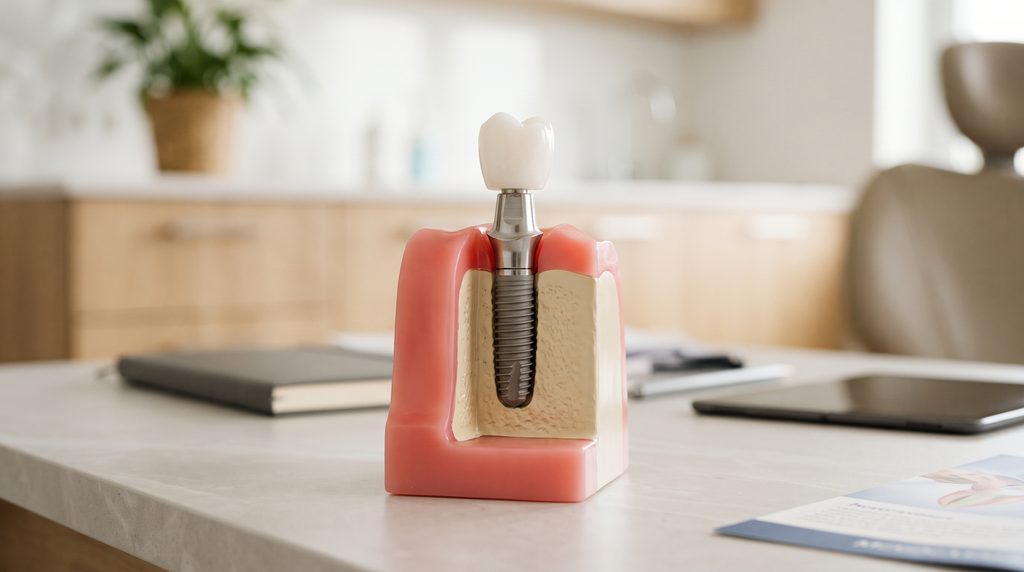
An implant-supported bridge is a set of artificial teeth joined together and resting on implants. The teeth next to the gap do not need to be ground down.
The simplest example is 3 teeth on 2 implants. The implants stand at the two ends of the gap, and the middle tooth of the bridge, called the pontic, has no implant beneath it. You can bite on the pontic of such a bridge on two implants as on your other teeth, because the implants on either side carry the load. In one study, roughly 9 in 10 implant-supported bridges were still in use after 10 years. This held regardless of how many teeth of the bridge each implant carried, or each natural tooth, when the bridge also rested on one.
Instead of implants, a bridge can rest on the ground-down teeth next to the gap, so you have a choice between an implant and a bridge on your own teeth. The number of implants when all the teeth are missing in the upper or lower jaw is decided by different rules than with two, three or four missing teeth.
What to ask your dentist when the plan has fewer implants than missing teeth
A plan with fewer implants is common and usually well justified: fewer implants mean a smaller procedure, and sometimes no need for bone grafting. A few questions will help you understand what the plan is based on:
- Why this number of implants, and where will they go?
- Will any tooth of the bridge extend beyond the last implant, with no implant under it (a so-called cantilever)?
- What will I use to clean under the bridge, and how?
- Does the fact that I clench or grind my teeth change the plan?
- What will happen to the bridge if one of the implants fails?
Your dentist will usually show you the answers on the CT images and on the design of the future bridge. If you have older dental X-rays, bring them to the consultation. They show how the bone has changed since the teeth were lost.
A bridge or a crown on every implant: what research shows and what shows up at check-ups
Research does not show that an implant under every tooth gives a longer-lasting result. The differences lie in what goes wrong, how it is repaired and how it is cleaned. Your dentist can leave crowns on implants standing next to each other separate, or join them together (splint them).
| What we compare | An implant under every tooth | A bridge on fewer implants |
|---|---|---|
| Do the implants last | Research: implants under crowns are rarely lost, even after 10 years. At check-ups: problems more often involve the crown than the implant itself. | Research: with two missing teeth, one implant with a second tooth extending to the side of it was not lost noticeably more often than two implants with separate crowns. At check-ups: losing an implant is rare, but when it happens the bridge usually has to be removed. |
| How long the crowns and the bridge last | Research: within 10 years, more than 1 crown in 10 had to be replaced. At check-ups: a damaged crown is replaced without disturbing the neighbouring ones. | Research: in the back teeth, a bridge with a pontic performed about as well over the first few years as crowns joined together, each on its own implant. At check-ups: to repair one tooth of the bridge, the whole bridge usually has to be removed. |
| Technical problems: screws and porcelain | Research: the screw that holds the crown to the implant is what most often works loose, within 5 years in roughly 1 crown in 11. In the back teeth, crowns joined together had fewer technical problems than separate ones. At check-ups: the screw is usually tightened or replaced at a single visit. | Research: porcelain chipping is the most common problem, within 5 years in roughly 1 bridge in 9, and more often with some materials. When a tooth extended beyond the last implant, there were more technical problems. At check-ups: a screw-retained bridge can be removed and sent for repair. |
| Inflammation and bone around the implant | Research: in the back teeth, joining the crowns did not change the risk of inflammation. At check-ups: the health of the gum depends mainly on daily cleaning and regular visits. | Research: a tooth extending beyond the implant did not noticeably increase bone loss around the implants. At check-ups: there is no implant under the pontic, so the bone there may gradually lose height over time, as it does in a gap. |
| Cleaning | Research: it is not known which option is easier to keep clean. At check-ups: between separate crowns you clean with an interdental brush, as you do between your own teeth. | Research: when the shape of the bridge makes cleaning difficult, inflammation around the implants is more likely. Reshaping the bridge and using interdental brushes help to bring this inflammation under control. At check-ups: under the pontic you need to thread floss with a stiffened end, or dental tape, every day. |
| The gum between teeth that show when you smile | Research: between two implants placed side by side, the gum often does not fill the whole space. At check-ups: in the front teeth, a dark triangle may remain between the crowns. | Research: next to a tooth extending beyond the implant, the gum does not always fill the space between the teeth either. It fills it most completely next to a neighbouring natural tooth. At check-ups: a pontic resting lightly on the gum can partly fill this space. |
The figures in this comparison come from different studies, so they do not show which option is better. A toothbrush cannot reach under the pontic, so with a bridge, implant hygiene also includes floss or tape, with a water flosser as an addition.
How many implants for 3 teeth, and how many for two or four missing teeth
For 3 teeth in a row, 2 implants are often enough. The most common arrangements are:
- two missing teeth: two implants side by side, each with its own crown, or one implant with the second tooth extending to the side of it;
- three missing teeth: often a bridge on two implants, with the implants at the two ends of the gap and the pontic in the middle;
- four missing teeth: two implants when the bite does not put heavy load on the teeth, or three when it does and the bone allows an implant to be placed in the middle of the gap as well.
How many implants a particular person will have depends above all on the bone, the forces in the bite and where the gap is. An implant needs bone on every side. The dentist checks this on the cone beam CT scan, because an ordinary X-ray does not show how wide the bone is. Where there is not enough bone in one spot, the dentist can rebuild it before the procedure, choose a shorter implant, or plan a pontic in that spot instead of an implant.
Implants also cannot stand too close to each other, because the bone between them then loses height more easily. So a narrow gap sometimes has room for fewer implants than there are missing teeth.
The forces in the bite depend on whether front teeth or molars are missing, which teeth bite against them, and whether you clench or grind your teeth. The greater the load, the more cautiously the dentist plans any teeth extending beyond the last implant.
The cost of treatment also depends on the number of implants, any bone grafting, and the type of bridge or crowns. Before the bridge can be made, the implants have to fuse with the bone. Treatment with an implant-supported bridge is therefore spread over several stages.
When an implant under every tooth has the advantage over a bridge on two implants
An implant under every missing tooth may have the advantage mainly when there is enough bone in every spot and the bite puts heavy load on the teeth. More implants then spread the pressure over more points, and no tooth extends beyond an implant.
When two molars are missing, where chewing forces are greatest, two implants are planned more often than one implant with a tooth extending to the side of it. An extending tooth acts like a lever and puts greater pressure on the single implant. In the back teeth, one very short implant with a tooth extending to the side of it performed similarly to two such implants in one study. However, patients lost some implants in both arrangements, and with a single implant the failures appeared earlier, probably because of overload.
What happens if one implant under a bridge fails
Losing one implant under a bridge does not always mean losing the whole bridge, but the bridge usually has to be removed and the treatment planned again. The dentist assesses whether a new implant can be placed in the same spot or in another one, sometimes after bone grafting. They also check whether the bridge needs to be made differently. If the bridge is screw-retained, the dentist can unscrew it without damaging it. This makes it easier to treat the gum and bone around the implant and to plan a new bridge. A cemented bridge is usually harder to remove in one piece.
Signs that something is wrong with an implant under a bridge are a bridge that moves, pain on biting, bleeding or pus at the gum, and swelling. If the bridge moves, have your dentist look at it within 1–2 days, even if it does not hurt. Report pain on biting or bleeding around an implant to your dental practice without waiting for your next check-up.
If swelling, pus or a fever appears, see the nearest available dentist or go to an emergency dental service on the same day, and contact the practice that is treating you over the following days. If you have difficulty breathing, difficulty swallowing, swelling spreading down to the neck or a high fever, go to a hospital emergency department (SOR) or call 112.
What to clarify before you agree to a treatment plan
A bridge on two implants and an implant under every tooth are both established options. The number of implants depends above all on the bone and on how much load your bite puts on the teeth. Two plans for a similar gap may therefore differ. If you clench or grind your teeth, mention it at your very first visit.
Frequently asked questions
Can a bridge on implants be extended later if another tooth has to be removed?
An existing bridge is usually not extended. When a neighbouring tooth has to come out, a separate implant with a crown or a new, longer bridge is the more common solution. If the dentist sees that a tooth next to the gap may soon need removing, they usually allow for this in the plan from the start.
Can an implant be joined to my own tooth with a bridge?
Yes, such a bridge is possible if the tooth has healthy roots and gums, but the tooth then has to be ground down. According to one study, such bridges lasted about as long as bridges supported by implants alone. The connection between the tooth and the implant should be rigid, because with a non-rigid connection the tooth may gradually sink deeper into the jaw. A healthy tooth is not removed just to avoid this kind of bridge.
If I grind my teeth, is a bridge or single crowns the better choice?
Research has not settled which option is better in that case. Grinding increases the risk of losing an implant: in the studies taken together, people who grind lost roughly 7 implants in 100, and others 3–4 in 100. That is why the dentist usually joins the crowns on neighbouring implants, avoids teeth extending beyond an implant and recommends a night guard. When there is enough bone, they also more often plan an implant under every tooth.
Can shorter implants help avoid bone grafting?
In some patients, short implants make it possible to avoid bone grafting. In studies over 5 years, they usually survived about as often as longer implants, including when they were used instead of a sinus lift, that is, adding bone in the upper jaw beneath the sinus. The procedure is then smaller. For the shortest implants and for very low bone, the evidence is incomplete, so the dentist decides after the CT scan.
Is a bridge on implants screwed in or cemented?
Both methods are used, although specialists more often favour screw retention in their recommendations. The dentist can remove a screw-retained bridge for repair or a check-up, and no cement is left under the bridge. Cement remnants promote inflammation around an implant. Cementing is sometimes chosen when the screw hole would end up in a visible place. The dentist then carefully removes excess cement from under the gum.
What does it feel like in the first days after two or three implants are placed side by side?
In the first days there is usually swelling and tenderness, at their worst on the second or third day and clearly less within a week. After several implants they can be greater than after one. Cold compresses, soft food and the painkillers your dentist recommends all help. If the swelling gets worse instead of better, or pus or a fever appears, see the nearest available dentist or go to an emergency dental service on the same day. If you have difficulty breathing, difficulty swallowing, swelling spreading down to the neck or a high fever, go to a hospital emergency department (SOR) or call 112.
What is biting like in the first weeks after a bridge on implants is fitted?
For the first few days the bridge may feel foreign, and your tongue will often go back to it. An implant fuses with the bone without the ligament that senses pressure in a natural tooth, so it is easy to bite harder than you mean to. Start with soft foods, and come in for a check-up if your teeth do not close evenly. Avoid very hard things, such as ice or nutshells, for good.
Read more:
- Dental implants in Warsaw Wola
- All-on-4 vs All-on-6 — for whom and when do two extra implants matter?
- Bone augmentation before an implant — when is it necessary and what types are available?
- Peri-implantitis — inflammation around a dental implant. Symptoms, treatment, prevention
- Bruxism and implants, crowns and veneers: how to protect expensive prosthetic work
Content and liability disclaimer
This article is informational and educational in nature and does not constitute medical advice, a diagnosis or a therapeutic recommendation — it does not replace a consultation with a specialist. If you are experiencing symptoms, have doubts or are facing a decision about treatment, consult a dentist. The methods described and the data cited are general in nature. The results of scientific studies relate to populations, not to an individual patient. The course and outcome of therapy depend on the individual clinical situation and may vary between patients. No information contained in this article constitutes a guarantee of result. The content has been prepared with due care, based on publicly available medical knowledge and the scientific publications indicated in the Sources section. We do not advise taking or refraining from any health-related action solely on the basis of the content of this article, without prior consultation with a doctor.
Sources
Source 1
Links https://doi.org/10.1111/prd.12416 │ https://pubmed.ncbi.nlm.nih.gov/35103329/ │ https://pmc.ncbi.nlm.nih.gov/articles/PMC9305548/
Description Sailer I, Karasan D, Todorovic A, Ligoutsikou M, Pjetursson BE. „Prosthetic failures in dental implant therapy.” Periodontology 2000. 2022;88(1):130-144.
Source 2
Links https://doi.org/10.1111/clr.14103 │ https://pubmed.ncbi.nlm.nih.gov/37750526/
Description Pjetursson BE, Sailer I, Merino-Higuera E, Spies BC, Burkhardt F, Karasan D. „Systematic review evaluating the influence of the prosthetic material and prosthetic design on the clinical outcomes of implant-supported multi-unit fixed dental prosthesis in the posterior area.” Clinical Oral Implants Research. 2023;34(Suppl 26):86-103.
Source 3
Links https://doi.org/10.1016/j.prosdent.2024.05.020 │ https://pubmed.ncbi.nlm.nih.gov/38955598/
Description Pascoal ALB, Paiva KRG, Marinho LCN, Bezerra ADS, Calderon PDS. „Impact of splinting implant-supported crowns on the performance of adjacent posterior implants: A systematic review and meta-analysis.” Journal of Prosthetic Dentistry. 2025;133(2):402-410.
Source 4
Links https://doi.org/10.1007/s00784-025-06548-2 │ https://pubmed.ncbi.nlm.nih.gov/40960697/ │ https://pmc.ncbi.nlm.nih.gov/articles/PMC12443873/
Description Waldecker M, Rammelsberg P. „Prognosis of multi-unit implant supported and combined tooth-implant supported fixed dental prostheses: a retrospective cohort study with a mean observation period of 4.27 years.” Clinical Oral Investigations. 2025;29(10):463.
Source 5
Links https://doi.org/10.1111/jcpe.13541 │ https://pubmed.ncbi.nlm.nih.gov/34448219/ │ https://pmc.ncbi.nlm.nih.gov/articles/PMC9292666/
Description Thoma DS, Wolleb K, Schellenberg R, Strauss FJ, Hämmerle CHF, Jung RE. „Two short implants versus one short implant with a cantilever: 5-Year results of a randomized clinical trial.” Journal of Clinical Periodontology. 2021;48(11):1480-1490.
Source 6
Links https://doi.org/10.1186/s40729-024-00573-8 │ https://pubmed.ncbi.nlm.nih.gov/39570465/ │ https://pmc.ncbi.nlm.nih.gov/articles/PMC11582258/
Description Kondo Y, Sakai K, Minakuchi H, Horimai T, Kuboki T, et al. „Implant-supported fixed prostheses with cantilever: a systematic review and meta-analysis.” International Journal of Implant Dentistry. 2024;10(1):57.
Source 7
Links https://doi.org/10.1002/cre2.773 │ https://pubmed.ncbi.nlm.nih.gov/37592440/ │ https://pmc.ncbi.nlm.nih.gov/articles/PMC10728520/
Description Meijer HJA, Stellingsma K, Pol CWP, Vissink A, Gareb B, Raghoebar GM. „Dental implant treatment for two adjacent missing teeth in the esthetic region: A systematic review and 10-year results of a prospective comparative pilot study.” Clinical and Experimental Dental Research. 2023;9(6):954-968.
Source 8
Links https://doi.org/10.1111/jcpe.13711 │ https://pubmed.ncbi.nlm.nih.gov/36054620/ │ https://pmc.ncbi.nlm.nih.gov/articles/PMC9805102/
Description de Tapia B, Bonnin M, Valles C, Mozas C, Herrera D, Sanz M, et al. „Clinical outcomes and associated factors in the treatment of peri-implant mucositis, combining mechanical debridement and prosthesis modification: A 30-month follow-up prospective case series.” Journal of Clinical Periodontology. 2022;49(12):1357-1365.
Source 9
Links https://doi.org/10.1111/jcpe.13981 │ https://pubmed.ncbi.nlm.nih.gov/38764386/
Description Ravidà A, Serroni M, Borgnakke WS, Romandini M, Wang II, Arena C, et al. „Short (≤6 mm) compared with ≥10-mm dental implants in different clinical scenarios: A systematic review of randomized clinical trials with meta-analysis, trial sequential analysis and quality of evidence grading.” Journal of Clinical Periodontology. 2024;51(7):936-965.
Source 10
Links https://doi.org/10.1111/joor.13567 │ https://pubmed.ncbi.nlm.nih.gov/37589382/
Description Häggman-Henrikson B, Ali D, Aljamal M, Chrcanovic BR. „Bruxism and dental implants: A systematic review and meta-analysis.” Journal of Oral Rehabilitation. 2024;51(1):202-217.