
Key points in brief
- A reline, that is, refitting the denture to the gum, is usually enough for a loose denture if the denture itself is in good condition. A new denture is usually the better choice when its teeth are worn or when several things have changed at once.
- The choice depends on what has changed since the denture was made: the bone and gum underneath it, the denture itself, the bite, or the amount of saliva in your mouth.
- Denture adhesive can improve how well the denture stays in, but it does not remove the cause of the looseness. If the denture starts to move or you need more and more adhesive, show it to your dentist.
- Come to the appointment without a fresh layer of adhesive, and bring your previous denture if you still have it.
- If you have a painful sore under the denture, contact the practice without waiting for your planned appointment. A sore that does not heal within 2 weeks always needs to be examined.
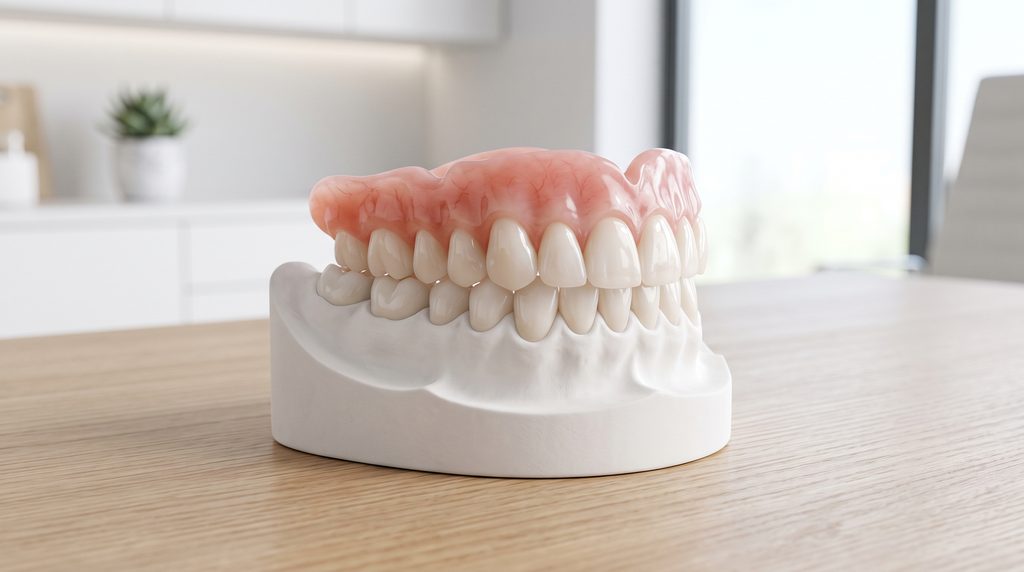
What the dentist checks when a denture no longer stays in as it used to
When a complete denture that held well for years becomes loose, there is usually one of four reasons. The bone and gum under the denture have changed, the denture itself has worn, the bite has changed, or there is less saliva in the mouth. Often several of these apply at once. If the denture is new, pressure spots and loosening in the first weeks usually settle after a few adjustments and are part of adapting to a new denture.
A lower complete denture naturally holds less well than an upper one, because there is no palate for it to seal against. If a lower denture has held poorly from the start, the cause is usually the shape of the lower jaw. In that case the dentist may consider an implant-supported denture.
In your mouth, the dentist assesses the bone and gum that the denture rests on. They check whether the gum is healthy and whether there are rubbed areas, redness or folds of tissue under the edge of the denture. They also assess how much saliva there is. They ask how many years you have worn the denture, when it was last relined and what medicines you take. Sometimes an X-ray of the whole upper and lower jaw is needed - especially when it hurts under the denture for no visible reason or when implants are being considered.
Then they look at the denture itself. They check whether the acrylic, the plastic the denture is made of, has cracked and whether the denture teeth are worn. The dentist assesses the fit against the gum with a thin layer of a special paste. Once the denture is put in, the paste shows where the denture sits close to the gum and where it stands away from it. Finally they check the bite, that is, how the teeth of the upper and lower dentures meet when you close your mouth.
What to note down before your appointment
A few observations from recent months help to find the cause of the looseness sooner. Before your appointment, write down:
- when the denture moves: when you speak, eat or yawn, or also at rest, and whether it is the upper or the lower one;
- whether you use more adhesive than a year ago and whether the denture still stays in without it;
- where rubbing, sores or a burning feeling appear and how long they last;
- whether you have started any new medicines since your last check-up and whether your mouth feels dry more often;
- whether the lower part of your face looks shorter or the corners of your mouth crack.
Come to the appointment wearing your denture, but without a fresh layer of adhesive. The dentist needs to see how the denture stays in on its own. If you still have a previous denture that once fitted well, bring that too. It shows which shape and tooth position were comfortable for you.
Relining, rebasing or a new denture
A reline is usually enough when the gum and bone under the denture have changed and the denture itself is in good condition. When the denture teeth have worn and the bite has become lower, or when several things have changed at once, a new denture is usually the better choice. A lowered bite means that when you close your mouth, your upper and lower jaws come closer together than they used to.
| Solution | When it usually works | What it will not fix |
|---|---|---|
| Reline (a new layer on the side facing the gum) | The denture is in good condition, the denture teeth and the bite are correct, and only the gum and bone under the denture have changed | Worn denture teeth, cracked acrylic, an uneven bite |
| Rebase (replacing the whole pink part of the denture) | The acrylic is old or porous, the denture has already been relined several times, and its teeth are in good condition | Worn teeth and a lowered bite |
| Bite adjustment and repair | The denture fits the gum well, but the teeth of the upper and lower dentures meet unevenly or a piece has broken off | Loss of fit against the gum |
| New denture | The denture teeth are worn, the bite has become lower, the denture has been repaired many times | Severe bone loss: then biting is weaker even with a new denture |
A denture reline means adding a new layer of acrylic on the side that faces the gum. The denture fits closely against the gum again, and its teeth, appearance and bite stay as they were. A laboratory reline can make a loose upper denture hold well again and leave the patient satisfied with it. This applies to a relatively new denture, with its teeth and bite in order, over bone that is well preserved.
It is not possible, however, to say in advance how long a reline will last, because that depends on how quickly the bone under the denture changes. That is why the dentist sets a date for the next check-up after a reline.
A reline can be done at the practice or in a dental laboratory. A layer made in the laboratory is usually more durable, but the denture typically stays there for a day or two - during that time you are without it.
The relining material can be hard or soft. A soft one is chosen most often when the gum is thin and painful. Studies show that a denture relined with a soft material usually improves biting and reduces pain - at least in the first months. A soft material, however, usually has to be replaced more often than a hard one.
A rebase, that is, replacing the whole pink part of the denture, is carried out by a dental laboratory. While the denture is at the laboratory, you are without it.
A bite adjustment means grinding the denture teeth so that they meet evenly on both sides when you close your mouth. A cracked denture is repaired by the laboratory. After a repair the dentist also checks the fit, because a crack is sometimes the result of a loose denture rocking.
Replacing an old denture means new teeth, a new bite and a few weeks of getting used to it. To make this easier, the dentist may suggest a new denture that copies the shape of the old one. This may help especially people who felt comfortable in their current denture. Until you receive the new denture, you usually keep wearing your current one.
With severe bone loss in the lower jaw, biting can be weaker than with slight bone loss, also with an implant-supported denture. The dentist therefore assesses how much bone has been lost before suggesting a new denture or other prosthetic treatment.
Why a denture becomes loose over the years
The bone and gum under the denture have changed
After teeth are lost, the bone that the denture rests on slowly shrinks. A denture resting on the gum does not stop bone loss after tooth loss, and the denture itself keeps its old shape. A gap forms between the denture and the gum, and the denture starts to rock. Bone usually shrinks faster in the lower jaw than in the upper jaw, which is why a lower denture needs relining more often.
The denture itself has worn
Over time, the denture acrylic can crack or become porous. Even a small crack can change the fit. A porous surface is harder to clean, and a film of bacteria and fungi that irritates the gum builds up on it more easily.
The bite has changed
Denture teeth wear down as you bite. Over time they meet unevenly: the teeth on one side touch first and lever the denture up when you close your mouth. Worn teeth also lower the bite. The lower part of the face may then look shorter, and cracks may appear in the corners of the mouth.
There is less saliva in the mouth
One of the things that keeps a denture in place is a thin layer of saliva between it and the gum. Many medicines reduce the amount of saliva. People with a dry mouth are usually less satisfied with their denture and find it harder to eat with it. A reline alone will not change that. Frequent small sips of water and mouth-moisturising products help. It is worth talking about medicines that dry the mouth with the doctor who prescribed them.
When denture adhesive only masks the problem
Studies show that adhesive improves how well a denture stays in, especially a lower one, and the force of biting. Adhesive does not, however, change the shape of the denture or of the bone beneath it. If a loose denture rocks because the bone under it has shrunk, the adhesive fills the gap and the bone continues to shrink. At Modern Dental & Orthodontics we often see patients who increased the amount of adhesive for many months and only then reported that the denture had stopped staying in.
Adhesive is masking the problem when:
- you need more and more of it or apply it several times a day;
- without adhesive the denture does not stay in at all, although it once did;
- sore spots appear under the denture and the adhesive helps you put up with them.
In any of these situations, show the denture to your dentist. Dry mouth is a different case: in people with a dry mouth, adhesive improves how well a well-fitting denture stays in.
How to look after your gums until your appointment
The gum under a loose denture is more prone to rubbing and irritation. Until your appointment you can use adhesive in the amount recommended by the manufacturer. Do not increase it to hold in a denture that rubs or presses.
Take the denture out at night, every night. Wearing a denture overnight encourages inflammation of the gum under the denture. It is caused by bacteria and fungi from the film on the denture. Clean the denture every day with a brush and a cleaner made for dentures, then rinse it thoroughly. Overnight, keep it in a container of water or denture solution, because acrylic that dries out can change shape. Massage your gums morning and evening with a finger or a soft brush - this may improve their blood supply.
Do not reline the denture yourself with materials bought at a chemist's, and do not grind it down. A home-made layer can change the bite and press on the gum in new places. Do not mend a cracked denture with general-purpose glue - such glue can irritate the gum and makes repair at the laboratory more difficult. If a painful sore spot appears, wear the denture only when you have to, and contact the practice. A sore that does not heal within 2 weeks needs to be examined, even if it has stopped hurting.
When to show your denture to a dentist
Show your denture to a dentist as soon as it starts to move when you speak or eat. A loose denture will not return to its old fit by itself. Adhesive hides the symptom, and the gum and bone under the denture keep changing.
Frequently asked questions
How long can one denture be used?
There is no single point after which a denture has to be replaced. Many dentures serve well for several years, and sometimes longer, if they are relined and repaired. The dentist suggests replacement when the denture teeth have worn, the bite has become lower or relining stops helping. That is why it is worth showing your denture to a dentist roughly once a year, even when nothing is bothering you.
Can a reline be done in one day?
Yes, if the dentist relines the denture at the practice. They apply a new layer that sets in the mouth and finish in a single appointment. With a laboratory reline, the denture usually stays there for a day or two. If the gum is irritated or has sores, the dentist first gives it time to heal, because the new layer would copy the shape of the swollen gum.
Can a loose denture cause sores?
Yes. A denture that moves rubs the gum when you eat and speak, and that is how painful sore spots develop. Long-term pressure from the edge of a loose denture can also cause gum overgrowth, that is, a fold of tissue under the edge of the denture. The dentist looks at every sore and every overgrowth before relining, and examines more closely any changes that do not heal.
Is it safe to use denture adhesive every day?
Yes, if you use it in the amount recommended by the manufacturer and remove it thoroughly from the denture and your gums every day. The risk arises with excessive use, for example when you apply it several times a day or use it up faster than the manufacturer intends. In such cases, neurological disorders and changes in blood test results have been reported. Adhesive is meant to support a well-fitting denture and will not replace relining it.
When do implants improve how well a denture stays in?
The lower denture, which holds least well without implants, usually gains the most. Patients with an implant-supported denture usually rate eating and comfort better than with a conventional denture. For the upper denture, studies do not show a clear advantage of implants over a well-made conventional denture. The dentist takes into account the amount of bone, general health and the patient's expectations.
How long does it take to get used to a denture after a reline?
Getting used to a denture after a reline usually takes a few days, because its teeth and appearance stay the same. At first the denture may feel tighter and press in one place. The dentist eases such a spot at a short follow-up appointment. How well the denture stays in may continue to improve over the first 2 weeks of wear.
What should I expect in the first days with a new denture?
At first a new denture usually feels large and foreign. For a few days there may be more saliva, slightly changed speech and pressure in a few places. The dentist adjusts spots that press or rub at follow-up appointments in the first weeks. This is what typical adaptation to a new denture looks like, and for most patients it takes a few weeks.
Read more:
- Prosthetics Warsaw
- Complete dentures — why the upper one sometimes holds better than the lower, and what can be done
- New dentures hurt — what's normal in the first few weeks and what isn't
- Implant-supported denture (overdenture) – who is this solution for
- Jawbone loss after tooth loss — what happens and why time matters
Content and liability disclaimer
This article is informational and educational in nature and does not constitute medical advice, a diagnosis or a therapeutic recommendation — it does not replace a consultation with a specialist. If you are experiencing symptoms, have doubts or are facing a decision about treatment, consult a dentist. The methods described and the data cited are general in nature. The results of scientific studies relate to populations, not to an individual patient. The course and outcome of therapy depend on the individual clinical situation and may vary between patients. No information contained in this article constitutes a guarantee of result. The content has been prepared with due care, based on publicly available medical knowledge and the scientific publications indicated in the Sources section. We do not advise taking or refraining from any health-related action solely on the basis of the content of this article, without prior consultation with a doctor.
Sources
Source 1
Links https://doi.org/10.1007/s00784-025-06379-1 │ https://pubmed.ncbi.nlm.nih.gov/40394268/
Description Borges GA, Borges MHR, Dini C, Marcello-Machado RM, Barão VAR, Mesquita MF. „Prognosis of removable complete dentures considering the level of mandibular residual ridge resorption: a systematic review and meta-analysis.” Clinical Oral Investigations. 2025;29(6):307.
Source 2
Links https://doi.org/10.1186/s12903-024-05298-z │ https://pubmed.ncbi.nlm.nih.gov/39755611/
Description Kamal MNM. „Comparison between relining of ill-fitted maxillary complete denture versus CAD/CAM milling of new one regarding patient satisfaction, denture retention and adaptation.” BMC Oral Health. 2025;25(1):18.
Source 3
Links https://doi.org/10.1111/jopr.70183 │ https://pubmed.ncbi.nlm.nih.gov/42318679/
Description Al-Mohammad YN, Kelly C, Szalai EÁ, Fazekas KK, Géczi Z, Kivovics M, Hegyi P, Varga G. „Complete denture soft liners improve bite force, mastication, and life quality: A systematic review and meta-analysis.” Journal of Prosthodontics. 2026;Epub ahead of print.
Source 4
Links https://doi.org/10.1007/s00784-023-05467-4 │ https://pubmed.ncbi.nlm.nih.gov/38183500/
Description Giok KC, Veettil SK, Menon RK. „Comparative effectiveness of types of denture adhesives in enhancing retention and function of complete dentures: a systematic review with network meta-analysis.” Clinical Oral Investigations. 2024;28(1):78.
Source 5
Links https://doi.org/10.1016/j.prosdent.2021.03.003 │ https://pubmed.ncbi.nlm.nih.gov/33888328/
Description Costa RTF, Barbirato DDS, Santiago Junior JF, Barros MCM, Pellizzer EP, Moraes SLD. „Toxicity potential of denture adhesives: A scoping review.” The Journal of Prosthetic Dentistry. 2022;128(6):1239-1244.
Source 6
Links https://doi.org/10.2186/jpr.JPR_D_26_00006 │ https://pubmed.ncbi.nlm.nih.gov/42716735/
Description Mukaibo T, Kondo Y, Munemasa T, Nodai T, Takahashi M, Muranaka T, Hosokawa R, Masaki C. „Dental prosthetic treatment outcomes in patients with xerostomia and hyposalivation: A scoping review.” Journal of Prosthodontic Research. 2026;Epub ahead of print.
Source 7
Links https://doi.org/10.1111/jopr.13687 │ https://pubmed.ncbi.nlm.nih.gov/36988151/
Description McReynolds DE, Moorthy A, Moneley JO, Jabra-Rizk MA, Sultan AS. „Denture stomatitis-An interdisciplinary clinical review.” Journal of Prosthodontics. 2023;32(7):560-570.
Source 8
Links https://doi.org/10.1016/j.jdent.2024.105490 │ https://pubmed.ncbi.nlm.nih.gov/39613136/
Description Michaud PL, Talmazov G, Dort H. „Are patient-reported outcomes improved by implant-assisted maxillary prostheses compared to conventional maxillary dentures? A systematic review.” Journal of Dentistry. 2025;152:105490.
Source 9
Links https://doi.org/10.1016/j.identj.2026.109782 │ https://pubmed.ncbi.nlm.nih.gov/42567046/
Description Heboyan A, Kaur K, Saini RS, Kanji MA, Alarcón-Sánchez MA, Mosaddad SA, Fiorillo L, Flores-Fraile J. „Implant-Supported and Conventional Dentures: A Meta-Analysis in Older Adults.” International Dental Journal. 2026;76(5):109782.