
The tooth stays if its prognosis after treatment is acceptable
- When the prognosis remains hopeless despite the treatment that can be given, the dentist plans what will replace the tooth and when.
- Bleeding gums, gums receding, pus discharge, mobility and teeth drifting apart you will see for yourself. The rest is not visible without a probe, and it is worth asking for that measurement after treatment.
- Extensive bone loss around a single tooth settles nothing by itself. What speaks to the decision is the state of the whole dentition, not the worst single tooth.
- An implant does not end periodontal disease. It comes in only once the disease has been treated and brought to a standstill, and the risk of inflammation follows the patient onto the new foundation.
- This article concerns advanced disease and several teeth at once. With a single tooth the choice looks different and is described in save the tooth or place an implant.
Who decides that a tooth is hopeless?
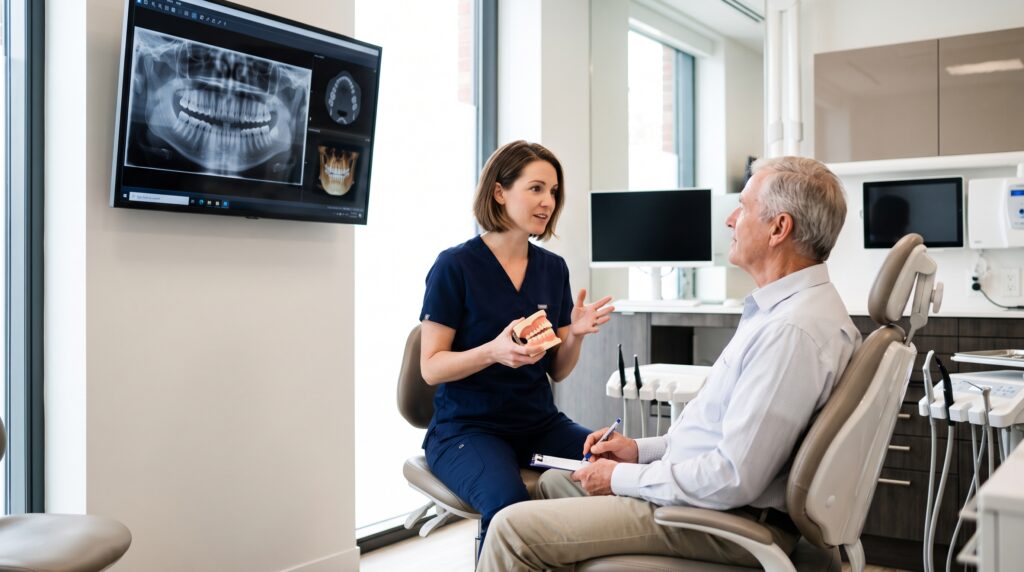
"Hopeless" is not a diagnosis but a prediction - a statement about what will happen, made on the basis of what can be seen today. It is made by a team: the periodontist measures how much the tooth has lost of its connective tissue attachment, that is of what holds it to the bone, the implantologist looks at the site that will be left after the tooth, and the prosthodontist asks whether the tooth will still be needed for anything.
Several things go into that assessment. How much bone is left around the root, and whether in a molar the furcation is involved - the place where the roots divide, which a toothbrush barely reaches. How deep the pockets are after periodontal treatment has finished, rather than before it, and whether the tooth has ever had endodontic, that is root canal, treatment, and how that ended. Pockets measured after completed periodontal therapy can be the decisive ones among these.
Three further factors do not concern the tooth itself, yet in the prognosis they weigh no less than the state of a single root:
- Smoking lowers the prognosis of all the teeth at once, and along the way masks the bleeding by which the dentist recognises active inflammation.
- Poorly controlled diabetes changes how the tissues respond to treatment and slows healing.
- Regularity of supportive appointments is a factor: patients who attended as planned lost teeth less often than those who broke off care.
An initial prognosis for the tooth is established before treatment, and after the non-surgical phase it is verified at a repeat examination. The dentist repeats the examination a few months after treatment without surgical procedures (the non-surgical phase) has finished. A tooth that looks lost at the first assessment is sometimes quiet and stable a few months later: the swelling goes, the gum sits more tightly, and the deepest pocket becomes two or three millimetres shallower. The same probe then shows a different number, although the bone has not grown back by a single millimetre.
What the research says, and what can be seen in the surgery
| What the dentist sees | What the research says |
|---|---|
| Before treatment less than 40 percent of the bone is left around the root, so the tooth is labelled "hopeless" | Twenty years after the completion of the definitive treatment (active therapy), about one such tooth in three had been extracted |
| A molar with deep furcation involvement | From the detection of such involvement, an estimated 4 such molars per 100 are lost within five years and 8 per 100 within ten |
| The tooth supports a bridge or a denture, so it "has to stay" | Teeth serving as abutments were lost more often than the rest, and most often those supporting a removable denture |
| The patient remains in supportive care after completed treatment | Loses on average 0.07 of a tooth a year, that is fewer than one tooth per decade |
| A prognostic scale shows "tooth cannot be kept" | The scales identify accurately the teeth that will survive. They identify considerably less well the one that will actually be lost |
Prognostic scales err asymmetrically. That is the least comfortable thing in this whole assessment. When such a system said "this tooth will stay," the tooth usually stayed. When it said "this tooth will be lost," it was often wrong. This is known from a study in which prognostic systems were validated on 143 patients, followed for five years after active therapy.
A pessimistic prognosis is therefore a weaker argument than an optimistic one, and the decision to extract rests on precisely the weaker of the two. This does not mean that the scales are useless. It means that their pessimistic reading has to be confirmed a second time before the tooth goes for extraction.
The figures in the table cover teeth lost from any cause, including causes other than periodontal disease.
Before you sign the consent form for extraction
Questions that change the conversation:
- Was this assessment made before periodontal treatment, or after it had finished?
- What is the "hopeless" assessment based on, and what could confirm it?
- How many teeth in this plan have a certain prognosis and how many a doubtful one, and what was that measured with?
- Is the tooth being removed for its own sake, or for its neighbour or for a future restoration?
- What will happen if we wait six months and assess again?
- What would the plan look like if implants were not an option at all?
A plan that ceases to exist without implants is a prosthetic plan, not a periodontal one. This does not mean it is a bad plan, only that it was built from the end and it is worth seeing its beginning.
Strategic extractions: why remove a tooth that is still holding on?
Essentially so that the rest of the plan has something to stand on. The reason is sometimes one of these situations:
- The tooth is a constant source of inflammation for its neighbour.
- It stands in a place needed for a future restoration.
- It blocks bone regeneration around the teeth next to it.
- More bone will be lost by keeping it than is gained by its standing there.
In periodontal disease such decisions are surprisingly few. Just under four teeth per hundred were judged at the outset not to be worth treating and were removed straight away - in a practice that followed its patients for thirty years, with periodontal review appointments every three to six months.
Outside that one practice, tooth loss from periodontal disease usually looks different. Roughly one patient in ten lost more than one tooth, and roughly one in four lost at least 2 millimetres of attachment at more than one site. That is how patients fared who remained in supportive care for five to twenty years in the prospective studies pooled together, with a very uncertain estimate.
Four teeth per hundred is, however, the proportion of teeth removed at the start of treatment, not the proportion of patients losing teeth over years of care.
In one place practice parts company with the data. Deep furcation involvement sounds in the surgery like a sentence and is sometimes an argument for removing a molar. The measured loss is, however, small: over ten years from the detection of such involvement, 8 molars per 100 are lost. The argument still stands, but it weighs less than it sounds - on its own it is not enough to remove a tooth that is otherwise quiet.
Will an implant with periodontal disease last longer than your own tooth?
It is not known, and the available data do not speak in favour of the implant. For full-arch restorations in stage IV periodontitis there are no studies with random allocation directly comparing tooth-supported prostheses with implant-supported ones. All the figures in this section therefore come from observation, and none of them settles anything.
In full-arch rehabilitation in people with periodontitis at its most severe stage, about 1 percent of the patients' own teeth and about 4 percent of the implants were lost over ten years. The comparison, however, sets against each other groups followed for different lengths of time, because prostheses supported by the patients' own teeth were tracked considerably longer than those supported by implants. The two figures therefore cannot be placed side by side directly.
Technical complications, that is faults in the prosthesis itself, diverged more sharply: they were recorded in 8 percent of the tooth-supported prostheses, followed for 7.2 years on average, and in 42 percent of the implant-supported ones, followed for 2.6 years on average. These are repairs, not loss of the restoration; the restorations themselves were lost at a similar rate in both groups. None of these figures says that an implant is worse than a tooth. What they say is that a prosthesis on implants needs servicing more often.
What a past disease does to an implant has also been counted separately. In people with a history of periodontitis, implants failed more often than in the rest - in follow-up longer than five years roughly twice as often, and inflammation around the implant occurred in them about four times as often. Bone around the implant was lost in them by 0.75 millimetres more on average, although the abstract does not state over what period. The certainty of these data is low. The direction, however, is consistent across these studies.
The rule admits no exception: an implant with periodontal disease comes in only after the disease has been brought to a standstill. Residual pockets on the patient's own teeth on the day of placement were associated with later inflammation around the implant (peri-implantitis) - that is how a follow-up reaching nine years on average turned out. An implant with periodontal disease in a patient with active inflammation speeds nothing up; it moves the problem to a new site, harder to treat than the patient's own tooth, because an implant surface cannot be cleaned the way a root can.
An implant with periodontal disease is the last stage of treatment and comes in when the gums have stopped bleeding and the patient is keeping to the rhythm of review appointments. Whoever reverses that order looks at the consequences for years: an implant placed in uncontrolled inflammation needs more frequent intervention and loses bone earlier, and the sheer number of implants is not a matter of indifference either, because each one adds a surface that has to be cleaned every day.
There are, however, situations in which an implant with periodontal disease wins out over saving the tooth. The first: a tooth which, if kept on, takes away bone needed later for the restoration. The second: an extensive edentulous space in which a bridge resting on teeth of doubtful prognosis loads them beyond what they can take. The condition is the same in both cases and does not go away: the disease must be brought under control first.
What a radiograph alone will not tell you
A radiograph shows the bone on a single day. It does not show how fast that bone was being lost, and the rate means more than the state itself: a defect that took twenty years to form is a different disease from the same defect formed over three. A two-dimensional image also understates furcation involvement, especially in upper molars. No radiograph, finally, will say whether the patient will give up smoking or whether they will come for review in six months, and these are variables of a weight comparable to the amount of bone.
Nor will a radiograph taken before extraction answer the reverse question, that is whether an implant can later be placed at that site: that will be decided by the bone left once the socket has healed, and that image does not exist yet.
The disease does not go away with the tooth
Tooth loss from periodontal disease is a symptom. The disease does not end there. Susceptibility to periodontitis remains and carries over to whatever is put in the place of the tooth. That is why the order is always the same: first bring the inflammation to a standstill, then assess the prognosis, and restore last. A plan that begins with a number of implants skips the first two steps and usually comes back to them later, with worse bone and less choice than at the outset.
Frequently asked questions
Can an implant be placed in periodontal disease?
Yes, provided the disease has first been brought to a standstill and remains under control. A history of periodontal disease alone does not rule implants out, but it places the patient in a higher-risk group. That means a tighter schedule of review appointments and reacting earlier to bleeding around the implant than in someone without such a history of the disease.
Does periodontal disease attack implants the way it attacks your own teeth?
Not identically, but similarly. Around an implant an inflammation develops with a different tissue structure and a different course, called peri-implantitis. In people with a past periodontal disease it was found more often than in the rest, and bone around the implant was lost to a greater extent. An implant is not immune to what destroyed the teeth earlier.
Is it worth saving a tooth with little bone left around it?
Sometimes yes. The amount of bone alone does not settle it: teeth with less than 40 percent of their support remaining survived twenty years from the end of therapy in two cases out of three. Two other things carry weight: whether the tooth is needed in the restorative plan, and whether the patient actually attends supportive appointments.
Does periodontal treatment have to be finished before implants?
Yes, and it is a condition, not a recommendation. Residual pockets on the patient's own teeth on the day of placement foreshadowed inflammation around the implant in the following years of follow-up. Whoever places an implant into active inflammation is putting titanium into the very environment that has just destroyed the neighbouring teeth. Hygiene afterwards will not make up for it.
Is treating a tooth that will be lost in a few years anyway a waste?
It does not have to be. A tooth kept for a few years holds, during that time, bone that begins to resorb once the tooth is removed, and holds its neighbours in place. It also postpones the decision about restoration to a point at which the bone and the plan are better understood. A doubtful prognosis does not mean a prognosis of zero.
What does the first year after having several teeth removed for periodontal disease look like?
For the first few days swelling predominates, along with pain controlled by painkillers. Pain that increases after the third day instead of easing, fever, or bleeding that cannot be controlled by pressure is a reason to contact the practice the same day. In the second and third weeks the gum closes over the sockets, and the temporary denture begins to rub and needs adjustment. Over the following months you eat everything with it except hard and sticky things. The bone remodels for many months, and the date of the permanent restoration is set individually, after assessing how the tissues have healed and whether the abutment teeth or implants are ready.
How long must one wait from tooth extraction to implant placement?
The timing of placement depends, among other things, on the presence of acute infection, on the preservation of the socket walls, on the condition of the soft tissues, on whether primary stability can be achieved and on the need for augmentation. An implant can be placed immediately, early or late; the choice, and any bone reconstruction, is decided individually.
Read more:
- Periodontist in Warsaw Wola — periodontal treatment at Modern Dental & Orthodontics
- Save the tooth or place an implant — how to make a decision you will not regret
- Peri-implantitis — inflammation around a dental implant. Symptoms, treatment, prevention
- Closed vs open curettage — a comparison of methods for treating advanced periodontitis
- Jawbone loss after tooth loss — what happens and why time matters
Content and liability disclaimer
This article is informational and educational in nature and does not constitute medical advice, a diagnosis or a therapeutic recommendation — it does not replace a consultation with a specialist. If you are experiencing symptoms, have doubts or are facing a decision about treatment, consult a dentist. The methods described and the data cited are general in nature. The results of scientific studies relate to populations, not to an individual patient. The course and outcome of therapy depend on the individual clinical situation and may vary between patients. No information contained in this article constitutes a guarantee of result. The content has been prepared with due care, based on publicly available medical knowledge and the scientific publications indicated in the Sources section. We do not advise taking or refraining from any health-related action solely on the basis of the content of this article, without prior consultation with a doctor.
Sources
Source 1
Links https://doi.org/10.1111/jcpe.13348 │ https://pubmed.ncbi.nlm.nih.gov/32696485/
Description Rahim-Wöstefeld S, El Sayed N, Weber D, Kaltschmitt J, Bäumer A, El-Sayed S, Eickholz P, Pretzl B. „Tooth-related factors for tooth loss 20 years after active periodontal therapy – A partially prospective study.” Journal of Clinical Periodontology. 2020;47(10):1227-1236.
Source 2
Links https://doi.org/10.1111/jcpe.13754 │ https://pubmed.ncbi.nlm.nih.gov/36415171/
Description Trullenque-Eriksson A, Tomasi C, Petzold M, Berglundh T, Derks J. „Furcation involvement and tooth loss: A registry-based retrospective cohort study.” Journal of Clinical Periodontology. 2023;50(3):339-347.
Source 3
Links https://doi.org/10.1111/jcpe.13770 │ https://pubmed.ncbi.nlm.nih.gov/36631984/
Description Agudio G, Buti J, Bonaccini D, Pini Prato G, Cortellini P. „Longevity of teeth in patients susceptible to periodontitis: Clinical outcomes and risk factors associated with tooth loss after active therapy and 30 years of supportive periodontal care.” Journal of Clinical Periodontology. 2023;50(4):520-532.
Source 4
Links https://doi.org/10.1111/jcpe.13943 │ https://pubmed.ncbi.nlm.nih.gov/38409875/
Description Hasan F, Magan-Fernandez A, Akcalı A, Sun C, Donos N, Nibali L. „Tooth loss during supportive periodontal care: A prospective study.” Journal of Clinical Periodontology. 2024;51(5):583-595.
Source 5
Links https://doi.org/10.1111/jcpe.13553 │ https://pubmed.ncbi.nlm.nih.gov/34761412/
Description Leow NM, Moreno F, Marletta D, Hussain SB, Buti J, Almond N, Needleman I. „Recurrence and progression of periodontitis and methods of management in long-term care: A systematic review and meta-analysis.” Journal of Clinical Periodontology. 2022;49(Suppl 24):291-313.
Source 6
Links https://doi.org/10.1111/jcpe.13511 │ https://pubmed.ncbi.nlm.nih.gov/34761430/
Description Tomasi C, Albouy JP, Schaller D, Navarro RC, Derks J. „Efficacy of rehabilitation of stage IV periodontitis patients with full-arch fixed prostheses: Tooth-supported versus Implant-supported – A systematic review.” Journal of Clinical Periodontology. 2022;49(Suppl 24):248-271.
Source 7
Links https://doi.org/10.1111/cid.13330 │ https://pubmed.ncbi.nlm.nih.gov/38720611/
Description Serroni M, Borgnakke WS, Romano L, Balice G, Paolantonio M, Saleh MHA, Ravidà A. „History of periodontitis as a risk factor for implant failure and incidence of peri-implantitis: A systematic review, meta-analysis, and trial sequential analysis of prospective cohort studies.” Clinical Implant Dentistry and Related Research. 2024;26(3):482-508.
Source 8
Links https://doi.org/10.1111/clr.13741 │ https://pubmed.ncbi.nlm.nih.gov/33714224/
Description Vagia P, Papalou I, Burgy A, Tenenbaum H, Huck O, Davideau JL. „Association between periodontitis treatment outcomes and peri-implantitis: A long-term retrospective cohort study.” Clinical Oral Implants Research. 2021;32(6):721-731.