
A night guard (in clinical terms an occlusal splint) comes in three basic variants, and what separates them is not price but purpose:
• hard acrylic — the standard option: sleep bruxism, protection of the teeth and of prosthetic work;
• soft, thermoformed — most often a temporary measure;
• repositioning — used essentially in selected temporomandibular joint disorders, after imaging.
The choice is determined by the diagnosis and by the condition of the opposing teeth, not by patient preference. Below: what each type actually does, and what selecting a splint in the clinic involves, step by step.
What a night guard does, and what it does not do
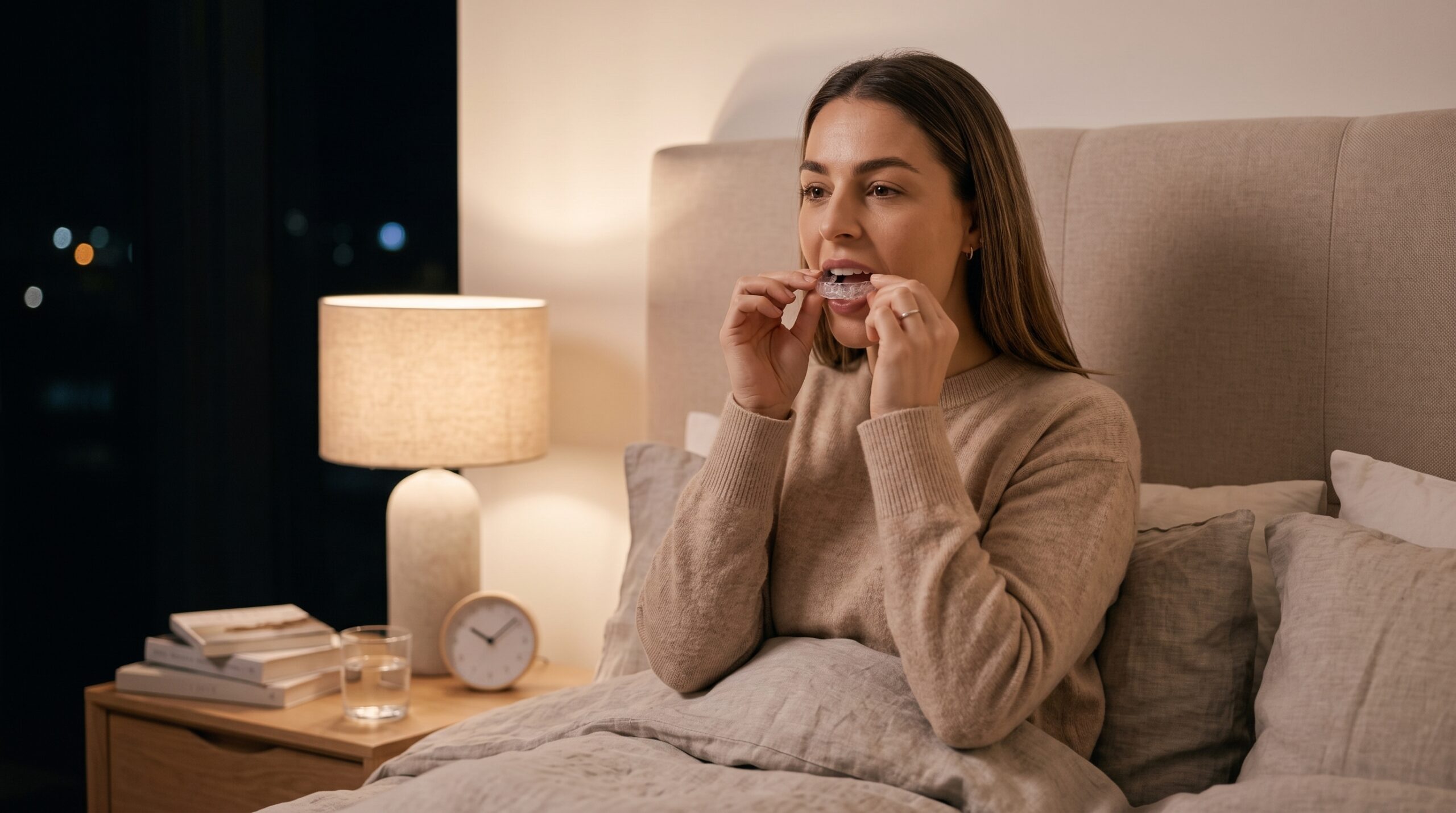
A night guard — clinically an occlusal splint, also known as a bite guard — is a custom-made plastic appliance fitted over a single dental arch. It separates the teeth and takes up the forces generated by clenching and grinding.
What it does:
- it protects enamel and restorations from wearing against each other — the splint takes over the tooth-to-tooth contact;
- it distributes the clenching force across all the teeth instead of a few points;
- in some patients it is accompanied by a reduction in masticatory muscle pain (superiority over other methods has not, however, been demonstrated) [5, 6].
What it does not do: - it does not treat the habit itself — the evidence that a splint lastingly reduces grinding is weak [1];
- it is not a sports mouthguard and not an orthodontic appliance — it does not absorb impact and it does not move teeth;
- it does not remove the cause: stress, sleep disorders or the effects of medication.
.
In short: it is a proven way of protecting the tissues and a frequent component of pain management, but not a cure that removes the habit. If you recognise the symptoms of bruxism in yourself, a splint is usually one element of the plan rather than the whole plan.
The hard (acrylic) splint — the standard approach
A hard night guard is made from acrylic (PMMA, a material used in prosthetic dentistry for decades). It may be built up by hand in the laboratory and, over the past few years, is increasingly milled from a blank or 3D-printed from a scan. The choice of technique turns on biocompatibility, scope for later adjustment and cost — most material comparisons, however, come from laboratory studies, so they do not transfer directly to everyday practice [3].
- Strength: a rigid surface gives reproducible contacts with all the opposing teeth, and the clinician can adjust them precisely with a bur at the fit appointment and at subsequent reviews.
- Weakness: hard acrylic wears the tissues on the opposing side. In laboratory studies, heat-cured acrylic wore them more than cold-cured acrylic; exposed dentine was the most vulnerable, glass-ceramic the least [4].
- Practical conclusion: what matters is not only which splint, but what sits on the other side of the arch — the material is chosen differently for teeth with composite fillings than for exposed dentine.
- Coverage: the standard is a splint covering the full arch. A design covering only part of it leaves some teeth without contact, and teeth deprived of an opposing stop may over-erupt in time.
The soft splint — comfortable at first, troublesome longer term
A soft night guard is produced by forming a flexible sheet over a model. It is cheaper, quicker to make and, for the first few nights, subjectively more comfortable — which is why it is often the first thing patients think of when they hear the word “guard”. The problems begin with longer wear.
- The flexible material yields under pressure, so it does not create stable occlusal contacts, and clinical observation suggests that in some people it may intensify the urge to clench — precisely the behaviour it was meant to limit.
- It cannot be finely adjusted, it wears and deforms faster, and it takes up stains and odours more readily.
- It collects more bacteria. In a laboratory study comparing 9 splint materials, most plaque built up on the materials with the roughest surfaces — a flexible resin and a conventional acrylic; the smoother the material, the fewer the bacteria. The authors note that thermoplastic materials, from which soft splints are made, tend to be rougher, and they link this to a risk of caries and gingivitis [10].
It is worth knowing that the evidence base in this area is narrow. The soft splint has legitimate temporary uses — for instance where the teeth need protecting quickly, or where a patient cannot tolerate rigid acrylic. For long-term protection, however, it is reached for less often.
The repositioning splint — narrow indications, continuous supervision
This splint belongs to a different category. Its main purpose is not to protect the teeth but to guide the mandible forward so that the articular disc regains a correct relationship with the mandibular condyle. It is used in selected cases of disc displacement with reduction (the disc returns to position on mouth opening, which is usually audible as a click) and only where the diagnosis has been confirmed by imaging.
- Effectiveness: in an analysis of 82 patients and 140 joints, in which the splint was worn full-time for at least six months with monthly adjustments, an excellent result was achieved in six joints out of ten, partial improvement in about a third, and in a few per cent of cases the treatment produced no effect [7].
- Durability of the result: after treatment ends, symptoms may return, particularly where the occlusion is unstable — which is why the appliance is withdrawn gradually rather than stopped overnight [8].
- Even the classic stabilisation splint is not neutral for the occlusion: after completed treatment, small but reproducible changes have been described — slight retrusion of the mandible and a change in the inclination of the occlusal plane [9]. This is an argument not against splints but for monitoring; we develop the subject of temporomandibular joint treatment and the occlusion in a separate article.
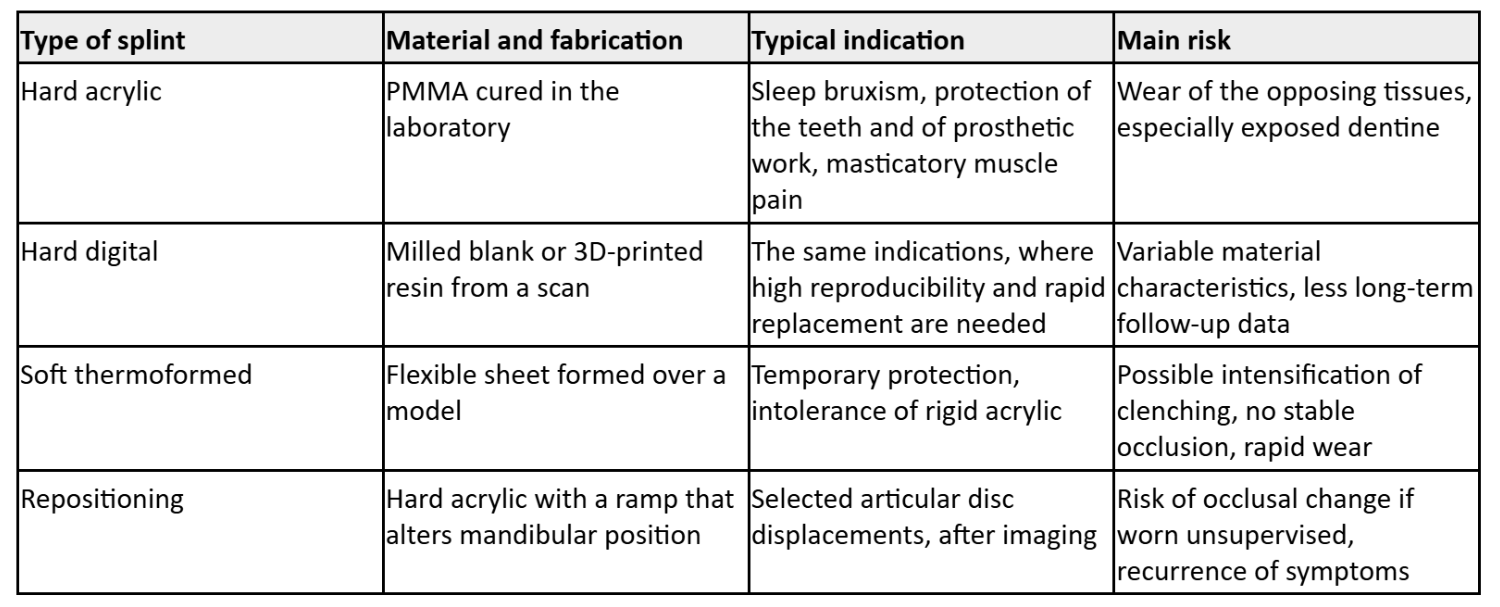
Comparison table: material, indication, risk
Upper or lower, night or day
- Which arch: the choice between an upper and a lower night guard is not settled in advance. It depends on the number and distribution of the teeth, the presence of crowns and bridges, the gag reflex and the appliance’s effect on speech. An upper splint is usually retained better; a lower one tends to be less visible and to interfere less with speaking.
- When to wear it: in sleep bruxism — at night, because that is when the parafunction occurs. Awake clenching is a different mechanism: there the work goes primarily into recognising and interrupting the habit, with the splint in a supporting role.
- Guards bought without a dental appointment: the key difference is not the material but the absence of individual occlusal adjustment. A ready-made guard moulded at home offers no way of checking the contacts or correcting them later.
- Two splints at once: in typical clinical situations there are no grounds for this — they do not protect better, and they make the occlusion harder to control.
How a splint is selected in the clinic — four steps
Selecting a night guard begins with the diagnosis, not with the material.
- Diagnosis. A history covering sleep, stress and medication taken, examination of the masticatory muscles and the joint, assessment of the wear pattern and of the condition of fillings and restorations. If you snore, wake unrefreshed or have diagnosed obstructive sleep apnea, it is essential to tell your clinician — in some patients a splint covering the full arch can worsen apnea, and a different approach is then required.
- Documentation. Impressions or an intraoral scan, a record of the occlusion and, in selected situations, imaging of the joint.
- Fabrication. Fabrication of the splint in the dental laboratory with a defined material, thickness and extent of guidance.
- Fit and adjustment. Contacts are checked with articulating paper, overloaded points are relieved and lateral guidance is set. This is a separate stage of treatment, not a formality.
In our dental practice at Modern Dental & Orthodontics (Klinika MDO) we observe that patients who return after two weeks for an adjustment are considerably less likely to abandon their splint than those who became discouraged after the first few uncomfortable nights. Later reviews make it possible to pick up wear of the material and changes in the occlusion before they become a problem — particularly where reconstruction of worn teeth is planned.
The first two weeks — what to expect
- Nights 1–2: a marked sense of a foreign body, more saliva, sometimes removing the splint while asleep. This is an expected reaction, not a reason to give up.
- Days 3–6: speech returns to normal and salivation settles. Some patients notice transient muscle tension on waking — the muscles are working in a new position.
- Days 7–14: time for a review appointment. The clinician relieves pressure points, assesses the wear marks on the splint and checks that it stays securely in place all night.
Contact the clinic sooner if you develop pain in a specific tooth or mobility of that tooth, a clear change in the way your teeth meet that persists during the day, new clicking or locking of the jaw, or irritation of the gum where the splint sits.
In our everyday clinical practice at Modern Dental & Orthodontics (Klinika MDO) we encounter situations in which the entire difficulty with adaptation comes down to a single unadjusted contact point — and correcting it takes a few minutes.
Frequently asked questions
How long does it take to get used to a night guard?
For most patients the first two or three nights are the hardest: the sense of a foreign body and increased salivation get in the way. Within a week the complaints usually settle, and full adaptation takes about two weeks. If the splint is still uncomfortable after that, what is needed is an adjustment in the clinic, not abandoning treatment.
Does a night guard treat bruxism, or only protect the teeth?
Primarily it protects. Reviews of the evidence show that the case for a lasting reduction in grinding itself is weak. The appliance does, however, protect the tissues against wear, and in some patients it is accompanied by a reduction in masticatory muscle pain. The causes of bruxism — stress, sleep disorders, medication — require separate management.
Can a night guard do harm?
It can, if it is poorly fitted or worn without supervision. Laboratory studies point to wear of the opposing tissues by hard acrylic, and clinical observation to possible changes in the position of the mandible and teeth after prolonged therapy. That is why an occlusal splint calls for periodic review appointments, not simply a one-off fabrication.
How should a night guard be cleaned and stored?
After removing it, rinse it and brush it with a soft brush without toothpaste, then dry it. It is kept in a dry, ventilated case away from sources of heat — unless the manufacturer of the material advises otherwise, since some acrylics are stored damp. Disinfectant preparations are used only as directed by your clinician.
How many years does a custom-made splint last?
That depends on the force of clenching, the material and hygiene. The literature gives no single figure for durability, but in clinical practice a hard acrylic splint in a patient with moderate bruxism usually serves for several years, markedly less in people who grind intensively, and soft splints the shortest time of all. Replacement is decided by the state of the surface and the fit.
Does a night guard change the bite?
The classic stabilisation splint is not designed to change the occlusion, but clinical studies do show measurable shifts in the position of the mandible and teeth after therapy. Repositioning splints carry a greater risk of occlusal change, which is why they are worn only under supervision, to an agreed protocol and with regular reviews.
Is a night guard worn for life?
There is no single rule. Where bruxism is chronic, protection may be needed for many years — as may protection of expensive prosthetic restorations. Where the cause was transient, the clinician may decide to reduce or discontinue wear once symptoms have resolved. The final decision depends on the individual diagnosis.
Summary
The choice between a hard, a soft and a repositioning splint is not a matter of preference but of diagnosis. Hard acrylic gives a stable occlusion and allows precise adjustment, but calls for care wherever exposed dentine sits on the other side. A soft material can be useful temporarily and, with longer wear, may intensify clenching. The repositioning splint is a tool with narrow indications, used after imaging and under continuous supervision. The common denominator of all three is the same: effectiveness is decided not by the type but by occlusal fit and regular review appointments. A well-made night guard is part of a treatment plan, not a finished product to be collected once from the laboratory.
Read more:
Content and liability disclaimer
This article is informative and educational in nature and does not constitute medical advice, a diagnosis or a therapeutic recommendation — it is not a substitute for consultation with a specialist. If you are experiencing symptoms, have concerns, or are facing a decision about treatment, consult a dentist. The methods described and the data cited are general in nature. The results of scientific studies relate to populations, not to an individual patient. The course and outcome of treatment depend on the individual clinical situation and may differ between patients. No information contained in this article constitutes a guarantee of outcome. The content has been prepared with due care, on the basis of publicly available medical knowledge and the scientific publications listed in the Sources section. We do not recommend taking or refraining from any action concerning your health solely on the basis of this article, without first consulting a doctor.
Sources
Source 1
Links https://doi.org/10.1016/j.jdent.2021.103621 │ https://pubmed.ncbi.nlm.nih.gov/33652054/Opis: Hardy RS, Bonsor SJ. „The efficacy of occlusal splints in the treatment of bruxism: A systematic
review.” Journal of Dentistry. 2021;108:103621.
Source 2
Links https://doi.org/10.1186/s12903-023-03782-6 │ https://pubmed.ncbi.nlm.nih.gov/38182999/
Opis: Ainoosah S, Farghal AE, Alzemei MS, et al. „Comparative analysis of different types of occlusal splints
for the management of sleep bruxism: a systematic review.” BMC Oral Health. 2024;24(1):29.
Source 3
Links https://doi.org/10.1111/joor.13550 │ https://pubmed.ncbi.nlm.nih.gov/37392157/
Opis: Nassif M, Haddad C, Habli L, Zoghby A. „Materials and manufacturing techniques for occlusal splints:
A literature review.” Journal of Oral Rehabilitation. 2023;50(11):1348-1354.
Source 4
Links https://doi.org/10.1111/joor.13235 │ https://pubmed.ncbi.nlm.nih.gov/34320246/
Opis: Osiewicz MA, Werner A, Roeters FJM, Kleverlaan CJ. „Effects of occlusal splint therapy on opposing
tooth tissues, filling materials and restorations.” Journal of Oral Rehabilitation. 2021;48(10):1129-1134.
Source 5
Links https://doi.org/10.1016/j.jdent.2024.105439 │ https://pubmed.ncbi.nlm.nih.gov/39510242/
Opis: Chisini LA, Pires ALC, Poletto-Neto V, et al. „Occlusal splint or botulinum toxin-A for jaw muscle pain
treatment in probable sleep bruxism: A randomized controlled trial.” Journal of Dentistry.
2024;151:105439.
Source 6
Links https://doi.org/10.1186/s12903-023-02897-0 │ https://pubmed.ncbi.nlm.nih.gov/36978070/
Opis: Orzeszek S, Waliszewska-Prosol M, Ettlin D, et al. „Efficiency of occlusal splint therapy on orofacial
muscle pain reduction: a systematic review.” BMC Oral Health. 2023;23(1):180.
Source 7
Links https://doi.org/10.1007/s00784-025-06481-4 │ https://pubmed.ncbi.nlm.nih.gov/40782193/
Opis: Gao B, Dong Y, Shan Y, et al. „Predicting anterior repositioning splint efficacy in disc displacement
with reduction using MRI-based texture and quantitative analysis: a retrospective study.” Clinical Oral
Investigations. 2025;29(9):402.
Source 8
Links https://doi.org/10.1111/joor.13485 │ https://pubmed.ncbi.nlm.nih.gov/37133450/
Opis: Li H, Shen D, Chen Z, Li J. „Step-back anterior repositioning splint retraction for temporomandibular
joint disc displacement with reduction in adult patients.” Journal of Oral Rehabilitation. 2023;50(10):965-
971.
Source 9
Links https://doi.org/10.1186/s12903-024-04260-3 │ https://pubmed.ncbi.nlm.nih.gov/38643111/
Opis: Al-Hadad SA, Ahmed MMS, Zhao Y, et al. „Skeletal, dentoalveolar and soft tissue changes after
stabilization splint treatment for patients with temporomandibular joint disorders.” BMC Oral Health.
2024;24(1):479.
Source 10
Links https://doi.org/10.1007/s00784-022-04838-7 │ https://pubmed.ncbi.nlm.nih.gov/36576565/
Opis: Wuersching SN, Westphal D, Stawarczyk B, Edelhoff D, Kollmuss M. „Surface properties and initial
bacterial biofilm growth on 3D-printed oral appliances: a comparative in vitro study.” Clinical Oral
Investigations. 2023;27(6):2667-2677.