
When saliva is missing, the necks of the teeth usually decay first, not the chewing surfaces
- Dry mouth from medication moves cavities to the gumline. The chewing surfaces usually decay later.
- You do not stop the medicine and you do not reduce the dose on your own. The medicine is decided by the doctor who prescribed it; the dentist focus on protection of the teeth.
- A cavity at the gumline can grow between two six-monthly appointments. Water and ordinary toothpaste do not may not necessarily stop that: higher amount of fluoride and a shorter check-up interval may be necessary.
- This article covers only two causes: medicines, and radiotherapy to the head and neck. It does not settle the others, among them diabetes and diseases of the salivary glands.
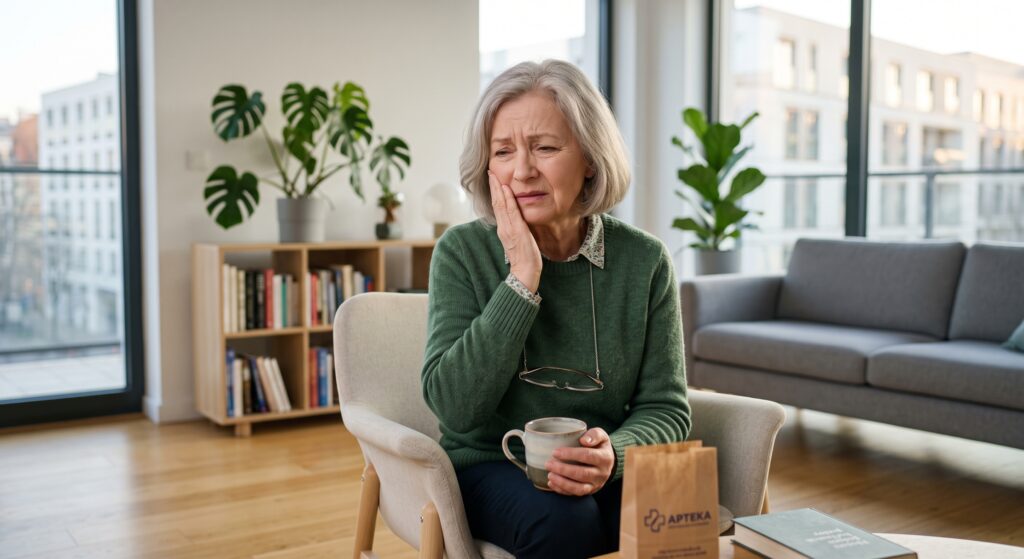
Why do cavities move to the gumline?
When saliva becomes scarce, the cavity changes place and moves to the gumline, that is to where the tooth comes out of the gum: the neck of the tooth, the cervical area, and with a receded gum the exposed root. At the gumline there is little enamel or none at all, and the dentine lying there is dissolved by a weaker acid.
This follows from four things saliva does at once. It rinses away debris and dilutes sugars. It neutralises acid after a meal, so the pH, that is how acidic the mouth is, returns to normal within tens of minutes. It carries calcium and phosphate, from which an etched tooth surface is rebuilt. It holds back the multiplication of bacteria and fungi. Moistening is the fifth thing and the only one that can be felt, and when saliva is missing it is above all the neutralising and the rebuilding that disappear.
This is best described in patients after radiotherapy to the head and neck: radiation-related caries affects mainly the gumline, the incisal edges and the cusp tips, occurs in about one in three of those treated, and starts 6 to 12 months after irradiation. That is how a review of the literature describes it, and that review does not compare groups, so read the figure as an order of magnitude.
With drug-induced dryness the course is sometimes slower, and the direction is the same. This does not mean that everyone taking such medicines has already lost enamel at the gums: the lesion passes through a reversible stage, and it pays to see it early. There is, however, no calculation of how much the risk of a cavity rises for each missing millilitre of saliva.
How the severity of dryness changes the interval between check-ups
| What you notice | What it means for your teeth | What we do |
|---|---|---|
| Green flag. The mouth dries from time to time, after the medicine or at night. You swallow dry food without washing it down. | Risk is raised, but the course is the usual one. Cavities form where they have been forming so far. | Check-up rhythm unchanged: usually every six months. Fluoride toothpaste every day, assessment of plaque at the gums at every appointment. |
| Yellow flag. Dry food has to be washed down, you wake up for water, plaque comes back faster than it did a year ago. | Cavities move to the gumline. White and brown lesions appear there. | Check-ups more often than every six months; the rhythm for which there are data is varnish every three months. High-fluoride toothpaste every day. |
| Red flag. Absence of saliva after radiotherapy to the head and neck, or a new cavity at the gumline between two appointments. The tooth is crumbling at the margin. | The pace is such that a tooth can fracture at the gum within a single six-month gap between appointments; the root is left behind. That is how it looks in everyday practice; this pace has not been measured in a study. | No less often than every three months, varnish at every appointment, early restoration of lesions at the gumline. On your side: do not wait for the scheduled date, and report a new cavity at the gum. |
There is no randomised trial comparing a three-month interval with a six-month one in patients with xerostomia. The check-up intervals are therefore a judgement of risk; there is no measured threshold here. The table orders urgency and does not make a diagnosis. Dry mouth is not a disease of the teeth but the condition in which they work. The protocol in the table applies whatever the cause of the dryness; if you are not on long-term medication and there has been no radiotherapy, the cause is established by a doctor.
A red flag is not, at the same time, a reason to stop the medicine or to change the dose. The medicine stays; what changes is the protection of the tooth.
How do you know that it is already dry mouth?
Not from the feeling of dryness alone. Three observations from your own day say more, and you already know the answers to them by this evening. Two yes answers are enough to raise the subject at an appointment:
- Do you have to wash down a dry slice of bread, a biscuit or a piece of meat in order to swallow it?
- Does the mouth go dry at night: do you wake up for water, and does the tongue stick to the palate in the morning?
- Has plaque been building up faster at the gums for several months, and does bleeding appear more often when you floss?
These questions do not measure salivary flow and do not replace an examination, and the decision about protecting the teeth does not wait for that measurement: the clinical picture and the list of medicines are enough.
The same area gives two symptoms. An exposed neck of the tooth reacts to cold and to brushing, that is it causes tooth sensitivity, while a cavity in the very same place develops without pain. Dry mouth from medication therefore does not hurt where it does the damage, and that is the main reason it is recognised late, while early lesions look merely like white spots (tooth decay stages).
The feeling of dryness and a measured lack of saliva are not the same thing. In a large series of patients at a dry mouth clinic, many complained of dryness while having normal secretion. The reverse also happens, and that is the more dangerous variant: saliva is measurably reduced and the patient does not feel dry. So how many mouth-drying medicines you take says more about the risk to the tooth than how dry the mouth feels.
Which medicines reduce saliva?
Four groups of mouth-drying medicines are named most often, and there is no mechanism common to all of them. Most of them block the signalling that tells the glands to secrete saliva, but diuretics bypass that receptor and act through the amount of fluid in the body.
- Psychiatric and neurological medicines: antidepressants, antipsychotics, antiepileptics, and those used in Parkinson's disease.
- Cardiovascular medicines: some medicines for high blood pressure, and diuretics.
- Antihistamines and nasal decongestant preparations, including those sold without a prescription.
- The rest: medicines for urinary incontinence, antispasmodics, opioid painkillers, and inhaled medicines for asthma and chronic obstructive pulmonary disease.
Dry mouth is listed as a possible adverse effect in the leaflets of a substantial proportion of the medicines taken by the group studied. People taking seven to nine medicines have distinctly lower salivary flow than people taking none. This was measured in people who had come forward themselves because of dryness, so it is not a threshold, but rather a signal that what counts is the whole set of medicines, while a single preparation says little. In the same paper, once age and sex had been taken into account, the number of medicines on its own stopped being a deciding factor.
The more medicines a patient takes that block that signalling (they are called anticholinergic), the worse the state of the teeth. This was measured in people aged between 45 and 64 who complained of dryness, and the commonest group was antidepressants and antipsychotics. It was a review of patient records, so it does not answer the question whether the medicines led to the cavities or whether both things have a common background. Nor does it mean that the medicine was a poor choice.
In everyday clinical practice at Modern Dental & Orthodontics (Klinika MDO) we come across the situation in which a patient does not connect a new medicine with the change in the mouth, because six months passed between the two. It is therefore worth bringing the full list of the preparations you take to the appointment, together with supplements.
What really protects teeth in xerostomia?
Two measures have data from clinical studies behind them, and a third thing is often mistaken for protection.
High-fluoride toothpaste. Lesions at the gumline become arrested and stay in that state in about two cases out of three when the everyday toothpaste is a preparation containing 5000 ppm fluoride. That came out of a two-year comparison with random allocation to groups, in which the picture with 1450 ppm toothpaste was unstable: lesions became arrested at one point and came back at another. The participants were older people with lesions on the roots; they did not have diagnosed xerostomia. The result carries over to xerostomia only through the matching direction of the lesions, because the group studied was a different one.
Toothpaste of this kind is not on the ordinary shelf: a dentist selects it and the dentist sets how long it is used. It is used instead of ordinary toothpaste, and after brushing the mouth is not rinsed with water, because that rinses the fluoride out as well. It is not a preparation for children, nor one for permanent use without supervision.
Fluoride varnish in the practice, repeated to a rhythm. With four applications over a year about eight in ten lesions on the roots harden, and this concerns patients with dryness directly; it is an action on a lesion that is already there. The result was not compared with a group that had no varnish.
Where there are no lesions yet, repeated sodium fluoride varnish reduces the number of new cavities by about two thirds. That is what came out of a single study in nursing home residents over sixty, cited in a systematic review. The scope of such management is settled at a consultation within restorative dentistry.
Changing what is in the mouth between meals. Moisturising preparations raise the pH and improve comfort, and in a study after radiotherapy they reduced the number of fungal species. The pH there, however, rose only to a value that was still acidic. A higher pH is not yet fewer cavities, and that was not measured in the study. Artificial saliva is therefore treatment of a symptom, and it is not caries prevention.
A separate trap concerns lozenges for dry mouth. In a laboratory model on extracted teeth, enamel and dentine were lost after the preparations with the lowest pH had been dissolved, while after the least acidic ones the loss of mass was the smallest.
The manufacturer usually does not state the pH, so go by the composition: citric, malic or ascorbic acid high on the list means an acidic preparation, one that should not stay in the mouth all day. If you cannot judge this yourself, show the packaging at your appointment.
In a patient after radiotherapy this rule is at its strictest, for a separate reason: removing a tooth in irradiated bone risks bone damage that does not heal. Risk of the same type, although from a different cause, applies to people taking bone-strengthening medicines: bisphosphonates and denosumab. In both situations early restoration serves to avoid extraction, and what has to be done before irradiation even begins is described in a separate article on dental clearance before surgery.
Is drinking water enough?
No, and it is worth knowing why. Water moistens and helps you swallow, but it does not carry calcium, phosphate or the bicarbonate that neutralises acid.
At night salivary flow falls physiologically in everyone, and the medicine adds to that fall: this is the longest stretch of the day without rinsing and without neutralisation of acid, so evening protection weighs more than morning protection. The time at which a medicine is taken is decided by the doctor who prescribed it; the dentist does not change that. It can also be worse. If the dryness is quenched with sweetened drinks, juices or water with lemon, a steady supply of sugar and acid is added to the lack of protection, and that speeds the cavity up. Water remains a good choice, but on its own it is not a protocol.
The rest of everyday protection stays unchanged and only gains in weight (caries prevention).
Frequently asked questions
Does dry mouth go away after the medicine is stopped?
Sometimes yes, sometimes partly. Stopping or switching a medicine is decided solely by the doctor who prescribed it. Never the dentist, and never the patient on their own. If the symptom appeared after a change of treatment, report it to the doctor in charge of that treatment. After radiotherapy to the head and neck, secretion usually returns only partly, so the protective protocol stays in place permanently.
Do artificial saliva preparations protect the teeth?
They improve comfort and the pH in the mouth. They have not, however, been shown to reduce the number of cavities. They therefore replace neither fluoride nor check-ups. Acidic lozenges dissolved enamel and dentine under laboratory conditions. So read the composition when choosing a preparation. A promise of moisturising on the packaging is not a criterion of choice.
Can a mouthwash make the dryness worse?
It can, if it contains alcohol. A rinse of that kind dries the mucosa further and stings in an irritated mouth. Choose preparations without alcohol. Do not hold a rinse of acidic composition in the mouth for long. A mouthwash replaces neither the fluoride from toothpaste nor the varnish applied in the practice.
What happens to the gums when saliva is lacking over a long time?
Plaque stays longer where the tooth comes out of the gum, so inflammation persists more easily and bleeding appears more often. In a study of residents of long-term care facilities over the age of 65, signs of dryness occurred together with periodontal disease and with root caries. The direction of that association cannot be established for now, because both things share risk factors.
Does sugar-free gum really help?
Chewing increases the flow of saliva only when the glands still have secretory reserve, that is in drug-induced dryness of mild severity. After radiotherapy, when gland tissue has been damaged, the effect is small. There are no data allowing it to be settled whether gum on its own reduces the number of cavities in this group of patients.
Does dryness increase the risk of oral fungal infection?
Yes, because saliva contains proteins that limit the multiplication of fungi, and its absence weakens that barrier. In a study after radiotherapy, moisturising gels reduced the number of fungal species in the mouth. Diagnosis and treatment belong to a clinician, and preparations from a pharmacy will not replace them. Come in if burning, a white coating or redness at the corners of the mouth appears.
Decay without saliva looks different and is planned differently
Your own sensation of dryness is a poor measure of risk, and that is the most important thing in this article. What can be checked says more: the number of mouth-drying medicines taken and the picture at the gumline. The medicine stays, because the dose is decided by the doctor who prescribed it; what changes is the protection of the tooth.
Dry mouth is a symptom the patient feels, while the dentist sees its consequence only months later. That gap is made up by an earlier appointment, because the sensation alone does not say what is happening at the gum.
Read more:
- Aesthetic and Restorative Dentistry in Warsaw — Modern Dental & Orthodontics
- Dental clearance before surgery — what has to be done, and how far in advance
- Tooth decay stages: when can it be stopped without drilling
- Tooth sensitivity - why cold hurts and what actually helps
- How to protect your teeth from caries effectively? A guide to prevention
Content and liability disclaimer
This article is informational and educational in nature and does not constitute medical advice, a diagnosis or a therapeutic recommendation — it does not replace a consultation with a specialist. If you are experiencing symptoms, have doubts or are facing a decision about treatment, consult a dentist. The methods described and the data cited are general in nature. The results of scientific studies relate to populations, not to an individual patient. The course and outcome of therapy depend on the individual clinical situation and may vary between patients. No information contained in this article constitutes a guarantee of result. The content has been prepared with due care, based on publicly available medical knowledge and the scientific publications indicated in the Sources section. We do not advise taking or refraining from any health-related action solely on the basis of the content of this article, without prior consultation with a doctor.
Sources
Source 1
Links https://doi.org/10.1007/s00784-021-04182-2 │ https://pubmed.ncbi.nlm.nih.gov/34581885/
Description Minagi HO, Yamanaka Y, Nohara K, Ikai K, Sakai T. „Analysis of medication-induced xerostomia in elderly Japanese patients.” Clinical Oral Investigations. 2022;26(2):2021-2029.
Source 2
Links https://doi.org/10.1016/j.jds.2021.12.014 │ https://pubmed.ncbi.nlm.nih.gov/35784170/
Description Kakkar M, Barmak AB, Arany S. „Anticholinergic medication and dental caries status in middle-aged xerostomia patients – a retrospective study.” Journal of Dental Sciences. 2022;17(3):1206-1211.
Source 3
Links https://doi.org/10.1016/j.oooo.2020.04.003 │ https://pubmed.ncbi.nlm.nih.gov/32444333/
Description Palmier NR, Migliorati CA, Prado-Ribeiro AC, de Oliveira MCQ, Vechiato Filho AJ, de Goes MF, Brandão TB, Lopes MA, Santos-Silva AR. „Radiation-related caries: current diagnostic, prognostic, and management paradigms.” Oral Surgery, Oral Medicine, Oral Pathology and Oral Radiology. 2020;130(1):52-62.
Source 4
Links https://doi.org/10.1159/000516176 │ https://pubmed.ncbi.nlm.nih.gov/34352792/
Description Sleibi A, Tappuni AR, Baysan A. „Reversal of Root Caries with Casein Phosphopeptide-Amorphous Calcium Phosphate and Fluoride Varnish in Xerostomia.” Caries Research. 2021;55(5):475-484.
Source 5
Links https://doi.org/10.1016/j.jdent.2025.106018 │ https://pubmed.ncbi.nlm.nih.gov/40754061/
Description León S, Gómez N, Gambetta-Tessini K, Giacaman RA. „Dynamics of root caries in older adults using high-fluoride toothpaste.” Journal of Dentistry. 2025;162:106018.
Source 6
Links https://doi.org/10.1016/j.jdent.2022.104273 │ https://pubmed.ncbi.nlm.nih.gov/36058347/
Description Chan AKY, Tamrakar M, Jiang CM, Tsang YC, Leung KCM, Chu CH. „Clinical evidence for professionally applied fluoride therapy to prevent and arrest dental caries in older adults: A systematic review.” Journal of Dentistry. 2022;125:104273.
Source 7
Links https://doi.org/10.1016/j.jdent.2020.103496 │ https://pubmed.ncbi.nlm.nih.gov/33310065/
Description Delgado A, Dias Ribeiro AP, Aslam M, Olafsson VG, Pereira PN. „Erosive assessment of dry mouth lozenges and tablets on enamel and dentin.” Journal of Dentistry. 2021;105:103496.
Source 8
Links https://doi.org/10.1007/s00784-020-03484-1 │ https://pubmed.ncbi.nlm.nih.gov/32779011/
Description Lam-Ubol A, Matangkasombut O, Trachootham D, Tarapan S, Sattabanasuk V, Talungchit S, Paemuang W, Phonyiam T, Chokchaitam O, Mungkung OO. „Efficacy of gel-based artificial saliva on Candida colonization and saliva properties in xerostomic post-radiotherapy head and neck cancer patients: a randomized controlled trial.” Clinical Oral Investigations. 2021;25(4):1815-1827.
Source 9
Links https://doi.org/10.1111/ger.12776 │ https://pubmed.ncbi.nlm.nih.gov/39016338/
Description Brandt O, Julkunen L, Saarela RKT, Hiltunen K, Mäntylä P. „Clinically estimated signs of hyposalivation in older adult residents of long-term care.” Gerodontology. 2025;42(2):186-193.