
Immediate dentures — the first six weeks after surgery
- On the first day the immediate denture stays in place. The dentist takes it out at the follow-up visit, because swelling can make it impossible to put back in.
- From the follow-up visit onwards, take the denture out for a quarter of an hour, though not within the twenty-four hours before an adjustment. Pain that goes away then is a sore spot; pain that does not go away calls for a phone call.
- Between the third and the sixth week the denture loosens noticeably. That is the result of bone remodelling under the denture, not a fault in how it was made. This is when it gets relined: material is added to its underside.
- Adjustment visits are part of the treatment. Several adjustments in the first month are the expected course, not a sign that the denture was made badly.
- This article deals with a denture fitted on the day of extraction in a patient without implants. All-on-X, the definitive denture and post-operative instructions are covered in separate articles.
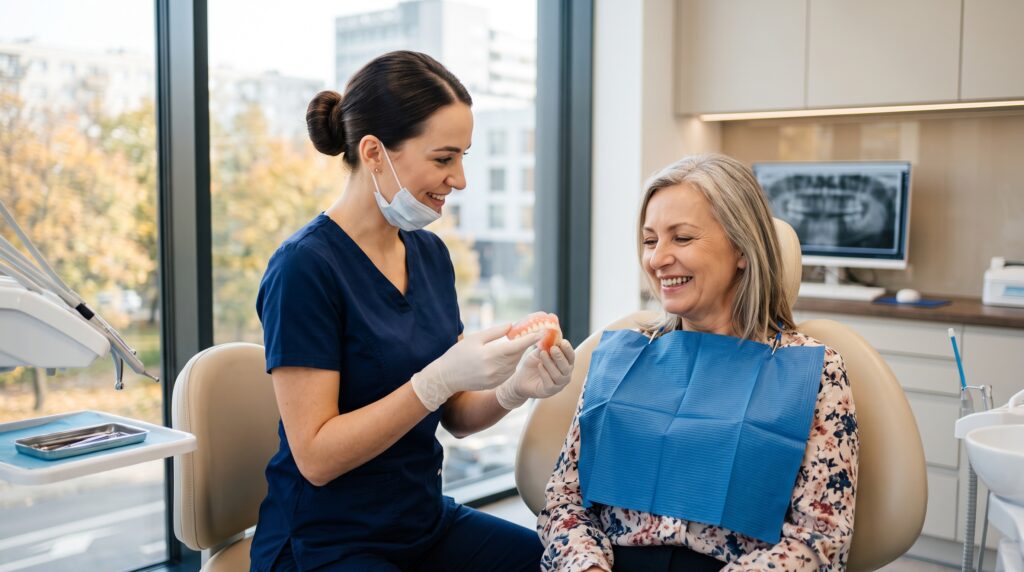
Why is a denture fitted on the day the teeth are taken out?
So that the patient leaves the surgery with a restoration on the same day their teeth were removed. It can be done because the impressions, the shade and the tooth arrangement are prepared over several visits before the procedure, while the teeth are still standing in the arch. An immediate denture then works in three roles at once: it closes the gap, so the patient does not have to avoid people; it covers the fresh sockets and acts on them as a pressure dressing; and in its third role it guides the shape of the healing mucosa.
A patient qualifies for one when the removal of several teeth, or of all the teeth in one arch, is already settled, and the state of the remaining teeth does not allow the procedure to be postponed. The dentist trims the plaster model where the future sockets will be, which means guessing the shape of the denture-bearing tissue that does not yet exist on the day of the impression. Most of the later adjustments come from exactly that guesswork.
In the literature of recent years, no one has compared an immediate denture with a delayed one in a study with random allocation to groups. The advantage of the immediate denture is well established in practice and in case reports. No one, however, has measured it against the alternative, which is several months without teeth. That does not mean the method does not work.
What has been measured is the cost. In a retrospective review of records from a university clinic, after five years 13 in 100 immediate dentures and 5 in 100 dentures made after healing were no longer serving the patient, and the first group needed distinctly more visits and adjustments after delivery. The groups were not allocated at random and the two started from a different state of the mouth, so the conclusion has to be drawn cautiously: an immediate denture requires more work after delivery, and the question of how long it lasts remains open.
This denture is the first stage of prosthetic treatment, and how that treatment goes on is decided over the next six weeks.
The first day and the first week: what to sit out, and when to call
Oozing blood, swelling and pain easing from the third day are all normal. The list below is for checking yourself on the evening of the first day and on every evening after that in the first week.
The expected course:
- Saliva tinged with blood for the first dozen or so hours after the procedure.
- Swelling that builds up to the second day, sometimes the third, and then goes down.
- Dull, diffuse pain that settles with an ordinary painkiller.
- Pinpoint pain in one place that goes away once the denture is taken out. That is a sore spot and it waits for the scheduled adjustment. Do not perform the removal test before the follow-up visit.
The symptoms in the list below concern the healing socket, not the denture; the full tooth extraction aftercare is covered in a separate article.
Contact the practice within twenty-four hours:
- Pain that builds from the second or the third day, radiating to the ear or the temple, not relieved by taking the denture out or by a painkiller, often with an unpleasant smell. This is how a dry socket behaves, and it happens less often than once in every twenty permanent teeth extracted. That figure refers to a single tooth, so with a dozen or more extractions at once the risk that it occurs in any one of the sockets is correspondingly greater. Smoking in the first week increases that risk.
- Swelling that, after the third day, grows instead of going down.
- A suture that has come away in the first two days, leaving the wound exposed.
Immediately, without waiting for opening hours:
- bleeding that does not stop after half an hour of pressure with a gauze swab;
- fever;
- swelling spreading down to the neck;
- difficulty swallowing or breathing;
- numbness of the lip that persists long after the anaesthetic has worn off.
On the first day do not rinse vigorously and do not spit, so as not to disturb the clot; from the second day rinse your mouth with lukewarm water after every meal. Clean the denture outside the mouth from the moment you have learned to take it out: with a soft brush and soap or a denture cleaner, because toothpaste is too abrasive. Keep away from the area of the sutures until they are removed.
This list does not replace the follow-up visit the day after the procedure; it is there to help you not to wait for it passively.
A timeline: the day of surgery, the first week, the third and the sixth week
The table below separates the healing of the sockets from the fit of the immediate denture. Over these six weeks the two change at different rates.t
| When | What happens in the sockets | What happens to the denture | What you do |
|---|---|---|---|
| Day 1 | clotting, swelling building up | it covers the sockets and presses on them | you leave it in the mouth, cold compresses, cool liquid meals |
| Next-day visit | the sockets are assessed for the first time | the dentist takes it out for the first time | you learn to put it in and take it out, you get a plan of adjustments |
| Days 2–5 | the swelling subsides | it starts to press in new places | you come in for adjustments; time off is usually planned for these days |
| Week 1–2 | the mucosa closes over the sockets, the sutures come out | the fit still holds | you go back to solid food; the face stops being swollen, speech settles down |
| Week 3–6 | the ridge remodels quickly | it loosens noticeably, drops when you yawn | you come in for a reline with a soft material |
| After 6 weeks | the change continues, but more slowly | the fit lasts longer between visits | you plan a hard reline or the definitive denture |
A single adjustment visit takes a quarter of an hour or so and sometimes has to be repeated. Come to it wearing the denture you have had in since the morning, because the dentist needs a fresh imprint of where it presses. In people with type 2 diabetes the sockets close more slowly and the symptoms can be stronger; a single study shows the direction of that difference, but not its size. The calendar in the table is a practice convention: no one in the literature of recent years has compared different timings for relining an immediate denture.
The worst week is not the first one.
The first is painful and everyone expects it. The third and the fourth take people by surprise, because the pain has already gone and the denture stops holding.
Why does an immediate denture stop fitting after a few weeks?
Because the tissue it rests on disappears. After a tooth is removed, the alveolar ridge, the bony edge in which the roots sat, first shrinks, and it shrinks more than common sense suggests. When a socket heals with no intervention at all, the crest of the ridge narrows on average by just under 3 mm after teeth other than molars and by more than 3.5 mm after a molar. Those are the figures that came out of pooling studies of socket healing in humans; the observation periods in them differed, so the numbers describe the scale of the phenomenon without being tied to a particular week.
In patients with an upper immediate denture whose sockets were not grafted, this was measured directly. From the tenth day after surgery, the height of the ridge on the cheek side fell on average by 1.2 mm over three months and by 2.1 mm over a year. For the denture this means that a few millimetres less under the plate is enough for it to start slipping when you yawn and speak, even though on the day it was delivered it still held perfectly well.
Alveolar ridge preservation itself does reduce the loss of dimensions, and that is well documented, but calculations from the pooled studies indicate that in four cases out of five it was either not needed or did not spare the patient bone augmentation before the implant anyway.
This is where what is known ends: the literature of recent years does not settle whether the immediate denture itself speeds up this resorption, holds it back, or changes nothing.
Can you eat and speak in it from the first day?
Eat, yes, though not what you ate before; speak, yes as well, with a week’s margin to get the knack.
On the first day food should be cool and liquid or semi-liquid, because warmth increases bleeding from the socket. In the first week it should be soft and divided into small mouthfuls, chewed on the back teeth of the denture, on both sides at once. You do not bite with the front teeth at all: biting at the front levers the plate up and tears the clot in the healing wound. Hard and sticky food comes back after the second week at the earliest, and gradually. An immediate denture will never carry the same load as your own teeth.
Speech deteriorates for a few days and comes back on its own. Exercises and the further mechanics of speaking with a definitive denture are covered in a separate article on what is normal when a new denture hurts.
Almost everyone asks about adhesives during this period. In a multicentre study with random allocation to groups, cream and powder improved masticatory performance in people with complete dentures, but so did the saline used as a control. Patients with a denture relined with a soft material, that is, the patients this article is about, were excluded from the study. So there are no data on adhesives during the healing period.
As long as the denture is still being relined, adhesive is no substitute for an adjustment. If you use it, use it thinly, and wash the denture every day; report a growing need for adhesive as a symptom instead of solving it with a larger amount.
What not to do, regardless of the data: do not adjust the denture yourself and do not use over-the-counter home reline kits. Shortening the border with a file takes away the denture’s seal irreversibly, and material applied at home locks in the wrong position on healing tissue.
An adjustment is a procedure carried out in the dental surgery.
What an immediate denture is not
It is not the definitive restoration: its job is to carry the patient through the healing period, while a complete denture is made later, on denture-bearing tissue that has had time to stabilise, and it is that one that is meant to serve for years. Nor is it a cheaper version of the definitive denture, or a replacement for it; it is a temporary denture after extraction in the strict sense, an earlier stage of the same treatment, planned together with it rather than separately.
Nor is it a copy of the old smile: the shape and shade of the teeth were settled before anyone had seen the denture-bearing tissue, and after a reline the border of the denture can be thicker. Finally, it is not a temporary prosthesis fitted on implants; that one rests on the implants and has a different rhythm of check-ups, and it is covered in a separate article on a temporary prosthesis after All-on-X.
In everyday clinical practice at Modern Dental & Orthodontics (Klinika MDO), the question comes back whether wearing an immediate denture closes off the route to implants. It does not.
A dressing that looks like teeth: the pain that goes away when the denture comes out, and the pain that does not
The main thing worth taking away from these six weeks is the order of importance. Highest stands the removal test: pain that goes away once the denture is out is a technical matter, and pain that does not go away is a matter of healing. Below that comes the loosening between the third and the sixth week, a signal that it is time for a reline, not a failure of the treatment. Lowest comes the appearance, which with an immediate denture is only completed with the definitive restoration. It is worth asking questions at the check-up visits in that same order.
Frequently asked questions
Does an immediate denture hurt in the first few days?
It does, but there are two kinds of pain and they behave differently. Socket pain is dull, diffuse and eases from the third day, while a sore spot under the plate is pinpoint and goes away once the denture is taken out. Hence the test you carry out from the follow-up visit onwards: take it out for a quarter of an hour. On the first day you do not take the denture out. Pain that does not go away after removal concerns healing and calls for a phone call to the practice.
Does the denture have to be taken out at night during healing?
In the first days after the extraction the denture stays in the mouth at night as well. It is working as a dressing then. What decides when to switch to taking it out at night is the state of the sockets, not the number of days. Once the wounds are closed, the rule that applies to long-term denture wearers takes over: wearing a denture around the clock favours inflammation of the mucosa under the plate. The date is set by the dentist at a check-up visit.
How many times is the denture relined before the definitive one is made?
Usually once or twice with a soft material during the healing period, and then once with a hard one if the denture is to serve for longer than six months; the number depends on how quickly the ridge remodels, and that varies a great deal. No study from recent years has established a binding number here.
How long after the extraction is the definitive denture made?
Most often three to six months after the extraction, once the changes in the shape of the ridge have clearly slowed down. This timing is a clinical convention, not the result of a comparison of different timings. Making it earlier risks the new denture ceasing to fit within a few months, which means repeating the same problem.
Does an immediate denture rule out implants later?
It does not. What decides whether implants can be placed is the amount and the quality of bone at the planned site. It is worth talking about implants before the extraction, though, because some of the decisions that protect bone are made on the day the teeth are removed and cannot be put off until later. One of them is filling the socket with bone graft material.
What should you expect after the first reline?
For the first few hours the denture holds distinctly more firmly and presses differently than before, because the material has filled the space that built up over several weeks. For a day or two a new sore spot may appear in a place where there was none before. That is an indication for a short adjustment, not for leaving the denture out.
What should you do when the denture starts dropping in the third week?
Report it at the next visit. And do not try to rescue the situation with adhesive for longer than a few days. Dropping at this stage is expected and means the time has come for a reline, while adhesive only masks the symptom; a denture that no longer seals goes on pressing on the tissue in random places and creates new sore spots.
Read more:
- Prosthetic treatment at Modern Dental & Orthodontics
- New dentures hurt — what's normal in the first few weeks
- Complete dentures — why the upper one sometimes holds better than the lower
- Tooth extraction aftercare: washing your hair, sleeping, work, sick leave and smoking
- Dentures or implants
Content and liability disclaimer
This article is informational and educational in nature and does not constitute medical advice, a diagnosis or a therapeutic recommendation — it does not replace a consultation with a specialist. If you are experiencing symptoms, have doubts or are facing a decision about treatment, consult a dentist. The methods described and the data cited are general in nature. The results of scientific studies relate to populations, not to an individual patient. The course and outcome of therapy depend on the individual clinical situation and may vary between patients. No information contained in this article constitutes a guarantee of result. The content has been prepared with due care, based on publicly available medical knowledge and the scientific publications indicated in the Sources section. We do not advise taking or refraining from any health-related action solely on the basis of the content of this article, without prior consultation with a doctor.
Sources
Source 1
Links https://doi.org/10.1016/j.prosdent.2021.02.013 │ https://pubmed.ncbi.nlm.nih.gov/33840514/
Description Rignon-Bret C, Wulfman C, Valet F, Hadida A, Nguyen TH, Aidan A, Naveau A. „Radiographic evaluation of a bone substitute material in alveolar ridge preservation for maxillary removable immediate dentures: A randomized controlled trial.” J Prosthet Dent. 2022;128(5):928-935.
Source 2
Links https://doi.org/10.1016/j.prosdent.2025.06.025 │ https://pubmed.ncbi.nlm.nih.gov/40628577/
Description D’Souza NL, Vasconcelos A, HajHamid B, Somogyi-Ganss E. „Comparison of postinsertion adjustments between conventional and immediate complete dentures and their association with denture survival.” J Prosthet Dent. 2025;134(4):1207.e1-1207.e8.
Source 3
Links https://doi.org/10.1111/joor.13664 │ https://pubmed.ncbi.nlm.nih.gov/38356185/
Description Findler M, Perzon O, Almoznino G, Zini A, Sharav Y, Czerninski R, Aframian DJ, Haviv Y. „Unveiling denture-induced oral lesions: A comprehensive study on classification and pain assessment.” J Oral Rehabil. 2024;51(6):931-937.
Source 4
Links https://doi.org/10.1111/jcpe.13390 │ https://pubmed.ncbi.nlm.nih.gov/33067890/
Description Couso-Queiruga E, Stuhr S, Tattan M, Chambrone L, Avila-Ortiz G. „Post-extraction dimensional changes: A systematic review and meta-analysis.” J Clin Periodontol. 2021;48(1):126-144.
Source 5
Links https://doi.org/10.1007/s00784-025-06257-w │ https://pubmed.ncbi.nlm.nih.gov/40063196/
Description Bataineh ABA, Alkadi ST. „Incidence and risk factors affecting fibrinolytic alveolitis after permanent tooth extractions.” Clin Oral Investig. 2025;29(3):175.
Source 6
Links https://doi.org/10.1111/jopr.13687 │ https://pubmed.ncbi.nlm.nih.gov/36988151/
Description McReynolds DE, Moorthy A, Moneley JO, Jabra-Rizk MA, Sultan AS. „Denture stomatitis—An interdisciplinary clinical review.” J Prosthodont. 2023;32(7):560-570.
Source 7
Links https://doi.org/10.1186/s40729-022-00453-z │ https://pubmed.ncbi.nlm.nih.gov/36477662/
Description Fischer KR, Solderer A, Arlt K, Heumann C, Liu CC, Schmidlin PR. „Bone envelope for implant placement after alveolar ridge preservation: a systematic review and meta-analysis.” Int J Implant Dent. 2022;8(1):56.
Source 8
Links https://doi.org/10.2186/jpr.JPR_D_22_00105 │ https://pubmed.ncbi.nlm.nih.gov/37316261/
Description Kimoto S, Kawai Y, Suzuki A, i wsp. „Effect of denture adhesives on masticatory performance: Multicenter randomized controlled trial.” J Prosthodont Res. 2024;68(1):132-138.
Source 9
Links https://doi.org/10.1080/00016357.2021.1930149 │ https://pubmed.ncbi.nlm.nih.gov/34033524/
Description Radović K, Brković B, Roganović J, Ilić J, Milić Lemić A, Jovanović B. „Salivary VEGF and post-extraction wound healing in type 2 diabetic immediate denture wearers.” Acta Odontol Scand. 2022;80(1):9-14.