
"Can I have an implant on the same day my tooth is removed?" — this is one of the most frequently asked questions at an implant consultation. The appeal of the procedure is obvious: one operation instead of two, a shorter overall treatment time, less waiting for aesthetic restoration. Immediate implant placement exists, is well described in the literature and, in a properly selected patient, produces excellent results. It is not, however, the default procedure. In this article we explain when it makes sense, what conditions must be met, why rushing can be costly — and when the Modern Dental & Orthodontics team suggests that the patient should wait.
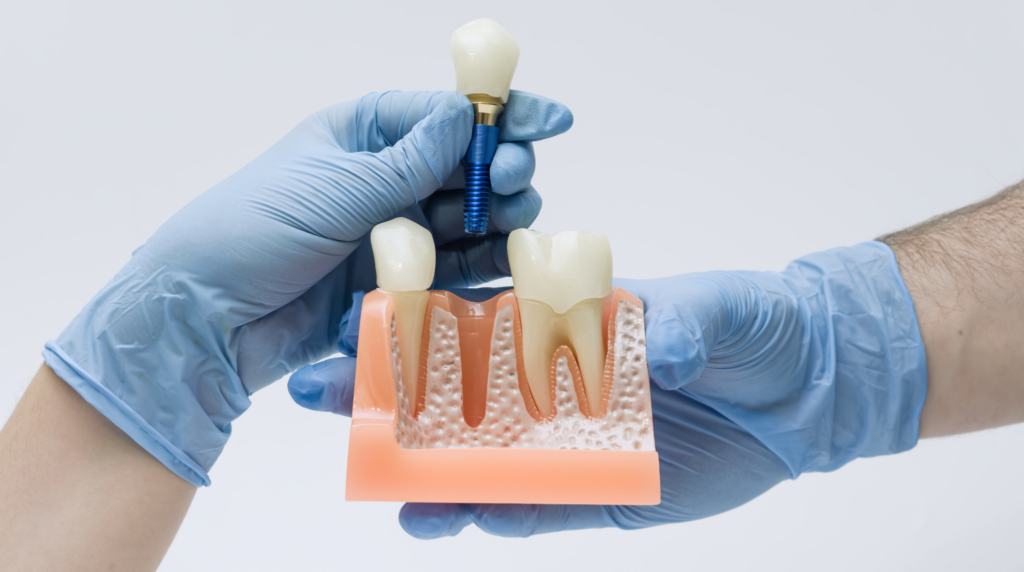
What is an immediate implant?
An immediate implant (immediate implant placement, ITI 2023 classification type 1) is a fixture inserted directly after tooth extraction — during the same appointment. The ITI classification further distinguishes type 1A (immediate placement with immediate loading) and type 1B (immediate placement with deferred loading). The socket (the space left by the root) is used as the implant site without waiting for natural healing. This distinguishes it from early and late implants, which are placed after 4–8 or more than 12 weeks from extraction, respectively.
Temporal classification of implant placement according to the ITI
| Type | Timing of procedure | Tissue condition |
|---|---|---|
| Type 1 — immediate | Immediately after extraction | No tissue healing; fresh socket. |
| Type 2 — early with soft-tissue healing | 4–8 weeks after extraction | Soft-tissue closure; no significant bone regeneration. |
| Type 3 — early with partial bone healing | 12–16 weeks after extraction | Partial bone regeneration within the socket. |
| Type 4 — late | >6 months after extraction | Complete bone regeneration; standard implant placement in healed bone. |
Each type has its own indications. An immediate implant is not "better" — it is simply different. It shortens treatment time where conditions permit, but imposes stricter qualification criteria.
Five conditions that must be met
Before qualifying a patient for immediate implant placement, the Modern Dental & Orthodontics team checks several clinical conditions. The absence of even one does not always disqualify the patient, but each significantly changes the risk assessment.
1. Sufficient bone beyond the socket (bone below the socket floor). The tooth root tapers towards its apex — between the socket floor and anatomical structures (maxillary sinus, inferior alveolar nerve) there must be at least 4 mm of bone to allow adequate primary stability of the implant beyond the socket.
2. No acute purulent infection. Active purulent periapical or periodontal infection is a relative contraindication — it requires thorough debridement of the socket and sometimes an individual decision to defer the procedure. Chronic inflammatory changes require individual assessment — in some cases implant placement after thorough socket debridement is possible.
3. Intact socket walls. The extraction must be atraumatic — if the buccal wall fractures, the risk of gingival recession and aesthetic compromise increases, particularly in the anterior region.
4. Appropriate gingival phenotype. Patients with a thick gingival phenotype (thick, fibrous soft tissue) are better candidates than those with a thin phenotype — in the latter the risk of recession is greater.
5. Ability to achieve primary stability. The implant must be seated with an adequate insertion torque (usually above 25–35 Ncm). If the socket is too wide relative to the implant, primary stability may be insufficient — in that case it is better to defer the procedure.
The aesthetic zone — special requirements
In the anterior region, where smile aesthetics are the priority, criteria are even more stringent. Gingival recession in the area of an incisor is not merely a clinical detail — it can be visible in the everyday smile and very difficult to correct once it has occurred. For this reason, in the aesthetic zone type 2 (early) is increasingly preferred, or immediate implant placement is combined with socket augmentation (e.g. socket grafting) and a temporary crown to guide soft-tissue contour.
The decision whether immediate implant placement is aesthetically safe in a given case is made on the basis of CBCT analysis and smile-line assessment — not solely on the basis of the patient's wish for shorter treatment time.
When is it better to wait? The risks of rushing
- Insufficient primary stability — risk of micro-movement and failure of osseointegration.
- Inadequate bone beyond the socket — inability to place the implant in the optimal prosthetic position.
- Active infection — higher risk of failure.
- Thin gingival phenotype in the aesthetic zone — risk of recession visible in the smile.
- Complex root anatomy (e.g. multi-rooted molar) — difficulty in positioning the implant relative to adjacent roots.
In our practice in Wola, Warsaw, it happens that a patient arrives set on a same-day implant, and after CBCT analysis the recommendation is: "in this case it is better to wait 8–12 weeks — this is not lost time, it is an investment in the long-term outcome". It is sometimes an uncomfortable conversation, but an honest one.
What does the research say about survival and aesthetics?
Current systematic reviews indicate that, with proper patient selection, survival rates for immediate implants are comparable with deferred protocols (usually above 95% over 3–5 years). Differences emerge in aesthetic outcomes — particularly in the anterior zone, where protocols with additional socket grafting and a temporary crown carry a lower risk of recession.
The most common complications described in the literature are: loss of stability during the first weeks (most often in the first month), marginal gingival recession, and partial loss of the buccal plate. All are associated with errors in patient selection or technique — not with the procedure itself.
Key takeaways
- Immediate implant placement is a viable option but not a default procedure — it requires several clinical conditions to be met simultaneously.
- Qualification is determined by CBCT analysis, soft-tissue assessment and the location within the oral cavity, not by the patient's wish alone.
- In the aesthetic zone, hybrid protocols are considered — immediate implant + socket grafting + a temporary crown to guide tissue contour.
- Rushing can be costly: incorrect qualification may lead to gingival recession that is difficult to correct.
- The decision is made on an individual basis — the question is not "whether" but "when and how".
Frequently asked questions
What is the success rate of an immediate implant?
With proper qualification, survival rates are comparable with deferred protocols. Current meta-analyses indicate survival of immediate implants above 95% over 3–5 years, comparable with deferred protocols. In a 5-year randomised trial by Zuiderveld et al. (2024), the survival of immediate implants in the aesthetic zone was 96.7%, regardless of whether a connective tissue graft was used.
Can an immediate implant be placed in a molar?
Yes, in selected cases. A molar has 2–3 roots, so after extraction a wide, irregular socket is created — the implant is usually placed in the interradicular septum (bone between the roots) or in the area of one of the sockets. According to a meta-analysis by Ragucci et al. (2020) comprising over 1,100 implants, the one-year survival of immediate implants in molars is 96.6%, with a mean marginal bone loss of 1.29 mm.
Is an immediate implant in an anterior tooth aesthetically safe?
In the aesthetic zone the qualification criteria are more stringent — a thick gingival phenotype and an intact buccal plate are key. According to a meta-analysis by Seyssens et al. (2021), a simultaneous connective tissue graft (CTG) reduces mean mid-facial recession by 0.41 mm and reduces the risk of gingival asymmetry ≥1 mm 12-fold.
How long does an immediate implant procedure take?
The full procedure, comprising extraction, implant placement and possible socket augmentation or placement of a temporary guiding crown, usually takes 60–120 minutes depending on the location and anatomical complexity. It is performed under local anaesthesia, optionally with inhalation or intravenous sedation. The follow-up appointment is usually 7–10 days later.
Is an immediate implant more painful than a conventional one?
During the procedure the patient does not experience pain — placement is carried out under local anaesthesia, optionally with sedation. After the procedure, discomfort and swelling in some patients may be slightly greater than after conventional placement in healed bone, because the procedure includes simultaneous extraction. In the practice of the Modern Dental & Orthodontics team, symptoms peak during the first 48 hours and in most patients subside noticeably within 3–5 days, responding well to standard analgesics (paracetamol, ibuprofen).
Will I receive a temporary crown on the day of the procedure?
Sometimes — this is known as immediate loading with a temporary guiding crown. It requires, however, high primary stability of the implant. In the aesthetic zone the temporary crown serves to shape the soft tissues; in the posterior region a conventional protocol with a crown placed later is more commonly used.
How long do I need to wait for the final crown after an immediate implant?
Standard osseointegration (the biological fusion of the implant with bone) takes 3–6 months — shorter in the mandible, longer in the maxilla where the bone is less dense. After this period the definitive impression and prosthetic work are completed. In immediate loading protocols the temporary crown serves an aesthetic function throughout the healing period; the definitive crown is made after full integration.
Does smoking rule out an immediate implant?
Active smoking is not an absolute contraindication but significantly increases the risk of failure — nicotine impairs microcirculation and delays healing. In heavy smokers (usually more than 10 cigarettes per day), the Modern Dental & Orthodontics team more often suggests a deferred protocol rather than an immediate one. Optimally, smoking should be stopped at least 2 weeks before the procedure and 8 weeks after.
What should I eat in the first days after an immediate implant?
For the first 7–10 days a soft, cool or room-temperature diet is recommended — cream soups, yoghurts, scrambled eggs, well-cooked vegetables, smoothies without seeds. Avoid chewing on the operated side, hard foods, alcohol, hot liquids and drinking through a straw (the negative pressure destabilises the clot in the socket). After 2 weeks most patients gradually return to a normal diet.
Read more:
- Dental Implants: https://klinikamdo.pl/en/offer/implantology/
- Dental implants and osteoporosis — is placement possible with weakened bones? https://klinikamdo.pl/en/blog/dental-implants-and-osteoporosis/
- What to avoid with dental implants? https://klinikamdo.pl/en/blog/what-to-avoid-with-dental-implants/
- Does getting a dental implant hurt? An honest account of pain, anaesthesia and healing https://klinikamdo.pl/en/blog/does-dental-implant-hurt-pain-anaesthesia/
- Dental implants — a comprehensive guide to treatment stages https://klinikamdo.pl/en/blog/dental-implants-comprehensive-guide/
Sources
Source 1
Links https://doi.org/10.1111/clr.14137 │ https://pubmed.ncbi.nlm.nih.gov/37750529/ │ https://onlinelibrary.wiley.com/doi/10.1111/clr.14137
Description Morton D, Wismeijer D, Chen S, Hamilton A, Wittneben J, Casentini P, Gonzaga L, Lazarin R, Martin W, Molinero-Mourelle P, Obermailer B, Polido WD, Tahmaseb A, Thoma D, Zembic A. „Group 5 ITI Consensus Report: Implant placement and loading protocols.” Clin Oral Implants Res. 2023;34 Suppl 26:349-356.
Source 2
Links https://doi.org/10.1016/j.jebdp.2022.101734 │ https://pubmed.ncbi.nlm.nih.gov/36162892/ │ https://www.sciencedirect.com/science/article/pii/S1532338222000483
Description Yu X, Teng F, Zhao A, Wu Y, Yu D. „Effects of Post-Extraction Alveolar Ridge Preservation versus Immediate Implant Placement: A Systematic Review and Meta-Analysis.” J Evid Based Dent Pract. 2022;22(3):101734.
Source 3
Links https://doi.org/10.1186/s40729-020-00235-5 │ https://pubmed.ncbi.nlm.nih.gov/32770283/ │ https://www.ncbi.nlm.nih.gov/pmc/articles/PMC7413966/
Description Ragucci GM, Elnayef B, Criado-Cámara E, Del Amo FS, Hernández-Alfaro F. „Immediate implant placement in molar extraction sockets: a systematic review and meta-analysis.” Int J Implant Dent. 2020;6(1):40.
Source 4
Links https://doi.org/10.1016/j.prosdent.2021.09.025 │ https://pubmed.ncbi.nlm.nih.gov/34772483/ │ https://www.sciencedirect.com/science/article/pii/S0022391321005254
Description Amid R, Kadkhodazadeh M, Moscowchi A. „Immediate implant placement in compromised sockets: A systematic review and meta-analysis.” J Prosthet Dent. 2023;130(3):307-317.
Source 5
Links https://doi.org/10.1111/jcpe.13397 │ https://pubmed.ncbi.nlm.nih.gov/33125754/ │ https://onlinelibrary.wiley.com/doi/10.1111/jcpe.13397
Description Seyssens L, De Lat L, Cosyn J. „Immediate implant placement with or without connective tissue graft: A systematic review and meta-analysis.” J Clin Periodontol. 2021;48(2):284-301.
Source 6
Links https://doi.org/10.1111/jcpe.13918 │ https://pubmed.ncbi.nlm.nih.gov/38228860/ │ https://onlinelibrary.wiley.com/doi/10.1111/jcpe.13918
Description Zuiderveld EG, Meijer HJA, Gareb B, Vissink A, Raghoebar GM. „Single immediate implant placement in the maxillary aesthetic zone with and without connective tissue grafting: Results of a 5-year randomized controlled trial.” J Clin Periodontol. 2024;51(4):487-498.