
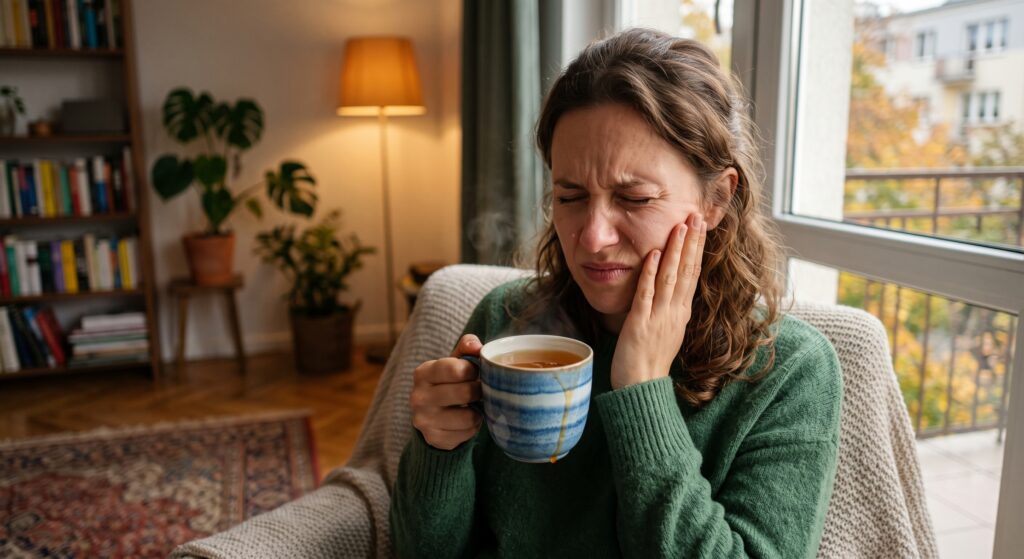
Does it hurt when you drink something hot, or cold?
- Pain from heat that does not end together with the mouthful and drags on for minutes requires a dental visit within a few days.
- When a tooth reacts to heat and cold water calms it, the cold buys hours and changes nothing inside the tooth.
- Pain from heat almost always comes from inside the tooth, not from its surface, and for that reason it means more than the stronger stab from ice cream.
- Pain that has gone away on its own does not close the matter: it is sometimes a sign of a later stage, not a better one.
- Whether the living pulp, that is, the tissue inside the tooth, can still be saved, we describe in the article on reversible and irreversible pulpitis.
Why cold hurts at once and heat only after a moment
Pain from heat is usually weaker than the stab from ice cream, and it means more: the diagnostic value of a symptom is decided by where the signal comes from, and cold and heat reach the nerve endings by two separate routes.
Dentine, that is, the layer situated beneath the enamel, is threaded with thousands of microscopic dentinal tubules filled with fluid. It is assumed that cold contracts this fluid and draws it outwards so quickly that within a fraction of a second it excites the nerve endings; pain from cold is sharp, immediate and short-lived.
Heat works the other way round: the fluid moves towards the pulp, more slowly, and this is usually not enough to excite the nerve endings. Pain appears only once the heat penetrates deeper into the tooth and raises the temperature at the nerve endings above the threshold of excitability. In a healthy tooth that threshold lies high, and the nerve's response to a hot stimulus appears in experimental studies with a delay - a single figure describing that delay is not given in the literature. That is why toothache after hot tea usually does not appear, and when it does appear, it usually means that the threshold has fallen.
It is lowered by inflammation: inflammatory mediators increase the excitability of the nerve endings, and in the pulp of teeth that responded with pain during thermal testing the concentrations of some inflammatory proteins were higher than in the rest. Pain from heat almost always arises from inside the tooth, not from its surface.
What from the studies holds up in the surgery?
| Finding from the literature | How the same thing looks at the chair |
|---|---|
| In a validated questionnaire on pulpal pain, thermal and sweet stimuli occupy five of the eleven questions | The stimulus alone settles nothing. The suspicion is narrowed only by how long the pain lasts after the cup is put down |
| In the validation study, assignment to a category was decided by the duration of the response, spontaneous pain, waking at night and the depth of the cavity | The character of the pain (sharp, dull, throbbing) and its intensity did not differentiate the forms. The patient describes one thing, the clinician needs another |
| A delayed and at the same time lingering response to a thermal stimulus is sometimes a sign of a partially necrotic pulp | After the tooth is opened, the state of the pulp is sometimes different from what the history suggested; that discrepancy follows from the limits of assessment before the procedure, not from an error |
The direction of the response shifts the suspicion; it does not make the diagnosis. The shift itself has value, because it changes how urgent the management is: someone who keeps a bottle of cold water by the bed is not a patient who qualifies for review in three months.
One of these findings usually surprises patients: in the new classification of pulp states, being tested in studies today, pain from heat already appears in the description of mild changes, and in severe ones it is the rule. A patient whose tooth reacts to heat therefore falls into a very wide band: from a change that can still be closed with a filling, to a partially necrotic pulp.
The state of the pulp is recognised from the history, two uncomplicated tests and a radiograph; none of these elements is a direct measurement of inflammation. A single figure describing the accuracy of such recognition is not given even by the review prepared for the European guideline. In clinical conditions there is no reliable reference standard, so there was nothing to compare against. The standard would be microscopic examination of the tissue taken. Such a sample cannot be taken without sacrificing the very pulp being assessed.
What to check yourself before you telephone the surgery?
What counts most here is the history, and within the history, what you have noticed yourself. The answers to the two questions below count for more than the intensity of the pain alone, and no diagnostic device replaces them.
- Does the pain end together with the stimulus? Put the cup down and count the seconds, because pain that fades within a few seconds means something different from pain that drags on for minutes.
- Does the pain come on by itself? Without anything hot, anything cold, without biting: spontaneous pain and pain that wakes you at night are among the strongest diagnostic signals in the whole set of symptoms.
You do not have to be able to point to the tooth that hurts: with this pain it is sometimes diffuse and radiates to other teeth, usually on the same side, and being unable to point to a particular tooth is not a reassuring argument. It is sometimes an argument to the contrary.
Write down before the visit as well how long this has been going on and what has changed in the past week. A painkiller taken as the leaflet directs is not contraindicated with this symptom. Do say at the visit, however, whether and at what hour you took it, because it modifies the picture the clinician assesses during the examination.
What not to do: do not deliberately heat a drink to check whether it will hurt. A provoked stimulus will contribute nothing to the diagnosis, and it can intensify the symptoms for several hours. Nor should you apply a warm compress to the cheek, or a painkiller tablet directly to the gum.
Is this still sensitivity?
Rarely. Tooth sensitivity arises from exposed dentine and uses the same dentinal tubules described above. Heat triggers it rarely, and relief from cold is practically never met with in it.
Four differences you can see without a surgery:
- The stimulus. Sensitivity responds mainly to cold and sweet, whereas here the diagnostic signal is heat.
- The time. Sensitivity passes within a few seconds, whereas pain from heat drags on, and sometimes builds up after the cup is put down.
- Behaviour at night. Sensitivity does not wake you; this pain can.
- The response to cold. With sensitivity cold is the enemy, whereas here it is sometimes the only thing that helps.
A tooth that reacts to heat is sometimes a tooth already treated, filled or covered with a crown. The absence of a visible carious cavity rules nothing out here.
There is one more possibility: not every pain in the region of a tooth comes from the tooth. Pain in the facial muscles can produce symptoms resembling disease of the pulp, including heightened sensitivity of the gum to touch and to cold. In a study of 50 such people the response to the cold test lasted longer than in healthy participants - on average 5.9 versus 3.7 seconds - while its intensity did not differ significantly. The authors of that study warn explicitly against undertaking treatment of a healthy tooth. What speaks for that trail is soreness of several teeth at once, morning stiffness of the jaw and tenderness of the muscle when the cheek is pressed.
How much time is left when a tooth reacts to heat?
The next few days.
Pain from heat that does not end together with the mouthful requires a visit within the next few days, and an appointment next month is, with a symptom like this, decidedly too far off. Nobody has set a stricter threshold, because the pace of change sometimes differs between individuals.
That time concerns something other than it seems: the question is not whether the tooth can be saved, but how much of the living pulp can be left in it.
The pulp is a tissue enclosed in rigid walls and has nowhere to swell, and the accepted explanation holds that rising pressure takes away from one fragment of it after another the chance of being saved. This remains an explanatory model, and nobody has measured it so far.
European guidelines today allow management that preserves the pulp.
Some such teeth can be treated with the living tissue in the root retained, instead of being sent straight for root canal treatment. Whether a given tooth is suited to this is settled neither by the history alone nor by the radiograph alone - what decides is the appearance of the pulp once the tooth is opened, and whether the bleeding can be brought under control. It is assumed that the longer the inflammation lasts, the less of that tissue is left to preserve.
In everyday clinical practice at Modern Dental & Orthodontics (Klinika MDO) we meet patients who waited for the symptom to withdraw on its own and came back after a few weeks with a different situation in the tooth.
A visit is not put off when any of these symptoms appears:
- pain provoked by heat that does not pass together with the stimulus;
- pain that comes on with no cause at all;
- pain that wakes you at night or builds up after lying down;
- cold water as the only thing that brings relief.
Swelling of the face, fever or pain that cannot be borne change the situation: this is no longer something to be planned for the next few days, but a reason to seek help the same day or at night. The situation with swelling is described separately, in the article on tooth abscess.
Why the pain going away is not good news
Pain going away has two possible explanations and only one of them is good.
The first: the inflammation has quietened down. The second: the pulp has died and there is nothing left to hurt. The cessation of symptoms on its own does not tell the two apart, because the pain disappears in both. Only examination tells them apart: a living pulp usually responds to the cold test, a dead one usually does not. In the second case the bacteria travel on, towards the bone surrounding the end of the root, and the pain may come back after weeks or months, although the changes can also run without any symptoms.
A tooth that has stopped reacting to heat after a week of such symptoms requires examination just as much as when it hurt.
Cold water looks like improvement, and buys hours
The sentence "the tooth reacts to heat, and after cold water it lets go" carries more content for a clinician than rating the intensity of the pain on a scale to ten. Say it plainly at the visit - that piece of information the clinician will read neither from the radiograph nor from a standard cold test. And one more thing, less obvious. Relief from cold water counts in hours; it does not buy weeks. Cold changes nothing in what is going on inside the tooth.
Frequently asked questions
Does pain from heat always mean root canal treatment?
No. The description of mild changes also lists the situation in which a tooth reacts to heat, not only the description of severe ones, so the stimulus alone settles nothing. What decides is whether the pain ends together with the stimulus or drags on for minutes, whether it comes on spontaneously and whether it wakes you at night. Some such teeth are treated today with the living tissue in the root retained.
Why does cold water bring relief?
The traditional explanation speaks of a fall in pressure inside the tooth under the influence of cold, and of constriction of the vessels in the pulp. This is, however, a hypothesis carried over from older literature, one that newer work has not tested directly, and that has to be said openly. Pain that eases after cold water is well known to clinicians, but it does not enter any of the classifications used in the surgery, and the mechanism remains unsettled.
Will a toothpaste for sensitivity help with pain like this?
No. Toothpastes intended for sensitivity act on the surface of the tooth, closing the tubules in exposed dentine or numbing the nerve endings in their vicinity. Pain provoked by heat almost always comes from inside the tooth, so there is nothing there for them to act on. A few weeks of trying a toothpaste here means mainly delay, and with this symptom delay changes the extent of the treatment.
How long can a visit be put off with this symptom?
Pain provoked by heat that does not pass together with the stimulus means a visit within the next few days, not observation for another month. Swelling of the face, fever or pain that cannot be borne are already a different situation: they call for help the same day or at night. Pain that has gone away on its own does not cancel the visit.
Does treating a tooth like this hurt?
The procedure itself is carried out under anaesthesia. With a pulp altered by inflammation the effectiveness of anaesthesia is sometimes lower than usual, so supplementary anaesthesia is occasionally needed. Tell the clinician the moment you feel anything at all. That is the simplest way for the procedure to pass calmly, and a real reason why a visit is not worth putting off.
What will I feel in the first days after treatment begins?
For the first twenty-four hours the tooth is sometimes tender on biting, and the symptoms usually ease within two or three days. We describe separately how long root canal treatment takes and how many visits it consists of. Pain building up after the third day, swelling or fever call for contact with the surgery; waiting for the next scheduled visit is the wrong course then.
Read more:
- Root canal treatment in Warsaw
- Pulpitis - reversible or irreversible. Why this distinction decides the fate of the tooth
- Tooth sensitivity - why cold hurts and what actually helps
- Step-by-step root canal treatment
- Tooth abscess — does a tooth with an abscess always have to be removed?
Content and liability disclaimer
This article is informational and educational in nature and does not constitute medical advice, a diagnosis or a therapeutic recommendation — it does not replace a consultation with a specialist. If you are experiencing symptoms, have doubts or are facing a decision about treatment, consult a dentist. The methods described and the data cited are general in nature. The results of scientific studies relate to populations, not to an individual patient. The course and outcome of therapy depend on the individual clinical situation and may vary between patients. No information contained in this article constitutes a guarantee of result. The content has been prepared with due care, based on publicly available medical knowledge and the scientific publications indicated in the Sources section. We do not advise taking or refraining from any health-related action solely on the basis of the content of this article, without prior consultation with a doctor.
Sources
Source 1
Links https://doi.org/10.1111/iej.14254 │ https://pubmed.ncbi.nlm.nih.gov/40423642/
Description Karrar RN, Craig SG, Duncan HF, i wsp. „Clinical validation of a proposed diagnostic classification for pulpitis.” International Endodontic Journal. 2025;58(8):1158-1171.
Source 2
Links https://doi.org/10.1111/iej.14195 │ https://pubmed.ncbi.nlm.nih.gov/39813004/
Description Kumar V, Sharma S, Kumar V, i wsp. „Novel pain assessment tool specific for pulp symptoms to aid diagnosis.” International Endodontic Journal. 2025;58(4):566-578.
Source 3
Links https://doi.org/10.1016/j.joen.2023.11.016 │ https://pubmed.ncbi.nlm.nih.gov/38147909/
Description Sabeti MA, Nikghalb KD, Pakzad R, Fouad AF. „Expression of Selected Inflammatory Mediators with Different Clinical Characteristics of Pulpal Inflammation.” Journal of Endodontics. 2024;50(3):336-343.
Source 4
Links https://doi.org/10.1111/iej.13762 │ https://pubmed.ncbi.nlm.nih.gov/35536159/
Description Donnermeyer D, Dammaschke T, Lipski M, Schäfer E. „Effectiveness of diagnosing pulpitis: A systematic review.” International Endodontic Journal. 2023;56(Suppl 3):296-325.
Source 5
Links https://doi.org/10.1111/iej.13974 │ https://pubmed.ncbi.nlm.nih.gov/37772327/
Description Duncan HF, Kirkevang LL, Peters OA, i wsp. „Treatment of pulpal and apical disease: The European Society of Endodontology (ESE) S3-level clinical practice guideline.” International Endodontic Journal. 2023;56(Suppl 3):238-295.
Source 6
Links https://doi.org/10.1016/j.jdent.2025.105745 │ https://pubmed.ncbi.nlm.nih.gov/40216070/
Description Sun Y, Sanders AM, Pashley DH, i wsp. „Beyond hydrodynamics: The role of ion channels in dentine hypersensitivity.” Journal of Dentistry. 2025;157:105745.
Source 7
Links https://doi.org/10.1016/j.joen.2025.09.013 │ https://pubmed.ncbi.nlm.nih.gov/41033394/
Description Inamoto K, Minusculi Sander BM, Exposto FG, i wsp. „Intraoral Sensory Alterations in Myofascial Orofacial Pain Patients: Implications for Clinical Management.” Journal of Endodontics. 2025;51(12):1766-1774.
Source 8
Links https://doi.org/10.1111/joor.13725 │ https://pubmed.ncbi.nlm.nih.gov/38797958/
Description de Souza PRJ, Ardestani SS, Costa VASM, i wsp. „Referred pain is associated with greater odontogenic spontaneous pain and a heightened pain sensitivity in patients with symptomatic irreversible pulpitis.” Journal of Oral Rehabilitation. 2024;51(8):1589-1598.
Source 9
Links https://doi.org/10.1111/iej.70192 │ https://pubmed.ncbi.nlm.nih.gov/42246072/
Description Caviedes-Bucheli J, Ulate E, Munoz HR, Ríos-Osorio N. „The Role of Neuropeptide Y in Dental Pulp: Balancing Neurogenic Inflammation and Pain Modulation.” International Endodontic Journal. 2026;59(10):2028-2045.