
Usually it comes down to how well the tooth is supported, assessed once the inflammation has settled
- A mobile tooth with facial swelling, fever or discharge of pus is a matter for today. Contact the practice the same day.
- Loose teeth are rarely a final verdict. Once periodontal inflammation is brought under control, most slightly mobile teeth return to full stability, and some of the severely mobile ones do as well.
- You cannot measure the bone yourself. You can measure the direction: how long the loose tooth has been moving, whether it gets in the way when you bite, whether the gum bleeds.
- The treatment plan for periodontitis and the description of splinting with glass fibre sit in the article on periodontitis. Here: mobility itself, and whether the tooth can be kept.
What does it mean that a tooth moves?
Usually less than it sounds. The threshold is simple: movement you can feel with your finger or see in the mirror is already abnormal, and it means that something has changed — either the ligament holding the root, or the bone around it.
Tooth mobility degrees are recorded by the dentist on a three-point scale:
- Degree I: the tooth moves horizontally by up to roughly one millimetre.
- Degree II: it moves horizontally clearly more than one millimetre.
- Degree III: it moves horizontally and, in addition, can be pressed down into the socket or rotated around its own axis.
The same degree, however, describes two phenomena at once, and this is where most of the misunderstanding sits. Part of the movement comes from permanent bone loss, which nothing rebuilds on its own, and the rest from swelling of the periodontal ligament, the layer that fixes the root in the socket, which loosens during active inflammation and whose swelling subsides within a few weeks after treatment.
A tooth measured next to an inflamed gum therefore receives a higher degree than it will deserve a few months later, and that is why loose teeth are assessed twice: once at the start, to know the starting point, and a second time once the inflammation has settled, because only the second measurement shows what part of the mobility persists after the inflammation has been brought under control; the amount of bone left is assessed clinically and on a radiograph. Ask for the date of the measurement to be recorded in your chart next to the degree: loose teeth are compared with themselves over time, not with a standard.
Front teeth behave differently from posterior teeth when bone is lost: besides becoming mobile they begin to drift forward and tilt, a gap appears between the central incisors where there was none before, and the tooth looks longer. Report a mobile front tooth with a changed position even when the movement itself seems slight.
How to check mobility yourself?
You can gather four observations about a loose tooth on your own, and each of them changes the conversation in the surgery.
- The date. Write down the day you first felt the movement, because a week ago and two years ago are two different diagnoses.
- One push instead of ten. Check the tooth with the pad of your finger, once. Repeated wiggling with the tongue and the fingernail itself increases mobility and makes assessment harder.
- Biting. Check whether the tooth gets in the way when you clench, whether it hits first, and whether it hurts when you bite on something hard.
- The gum. Look at whether it bleeds when you brush, whether it is swollen and whether pus is discharging from it.
Until your appointment, chew on the other side, but do not give up brushing the mobile tooth: the gum bleeds because it is inflamed, and the brush is not what causes it. If you drop your oral hygiene, you will worsen exactly the thing mobility depends on.
Do not reposition a tooth that is still sitting in its socket yourself, do not push it back into place and do not stabilise it with a home-made fix. A tooth knocked out completely is the exception, described below. A tooth that is mobile after an injury needs to be immobilised in the surgery, and every attempt made on your own adds damage to the damage already there.
Loose teeth: how much time do you have at each degree?
The degree is half the answer, and the other half is what accompanies the loose teeth and how quickly the movement appeared.
| Flag | Degree | What you see | When to go to the surgery |
|---|---|---|---|
| Red | any, including I | The tooth became mobile after a blow or a fall, or changed its position in the arch | The same day, within hours |
| Red | any, including I | Mobility with facial swelling, fever, feeling unwell or discharge of pus | The same day |
| Amber | usually II–III | Mobility increased over a few weeks, the tooth gets in the way when biting or has drifted out | This week |
| Yellow | I–II | Degree I or II mobility, the gum bleeds on brushing, there is no pain | Within two to three weeks |
| Green | I, stable for years | Mobility unchanged for years, no bleeding, no pain, no change of position | At the next check-up, but do report it and ask for it to be recorded in your chart |
Both red flags look similar, and they call for different things. After an injury, what counts is the time to repositioning the tooth and fitting a splint, because the fibres holding the root reunite only when the tooth is in the correct position, and delay reduces that chance. With an infection, what counts is reaching the cause. In neither of these two cases should you wait to see whether the mobility will subside on its own.
A tooth knocked out completely is yet another situation, and in it the first dozen or so minutes count. Hold it by the crown, not by the root. If it is dirty, rinse it with milk, saline or your own saliva and try to slip it straight back into the socket. If that does not work, transport it in milk or keep it in your mouth, in saliva. Water is suitable only if you have nothing else, because the worst thing is for the tooth to dry out. Go to the surgery immediately.
Five causes that are not periodontitis
Loose teeth in an adult most often start from periodontal disease, and that is where the examination begins, while the remaining causes are rarer and do not exhaust the list, although each has its own set of signs and each ends with different treatment.
Injury. A blow makes a tooth mobile within a second, even when the crown looks intact. International guidelines on the management of dental trauma separate splinting times according to the type of injury: shortest for subluxation and extrusive luxation, longer for lateral luxation and for root fracture. How long the tooth stays immobilised is decided by the diagnosis made in the surgery, not by the degree of mobility.
Occlusal overload and bruxism. A tooth that takes more force than its neighbours when you clench loosens within the periodontal ligament, and on its own it does not take away attachment — it adds to other damage instead. A premature contact, the one that hits first, is corrected in the surgery. Bruxism was among the factors associated with the loss of periodontally treated molars — that is how it came out in a review of studies on the survival of these teeth.
In patients with advanced periodontitis, a removable occlusal splint on the upper arch, worn during the first weeks of gum treatment, reduced the mobility of the upper posterior teeth and improved chewing efficiency within six to eight weeks. That is a different appliance from the splint that joins teeth into a block, discussed below.
An abscess coming from the pulp. Mobility appears together with pain, swelling and the feeling that the tooth stands proud of the others, and usually it does not mean that supporting bone has been lost: the movement comes from pressure within the tissues, and once the infection is brought under control it most often resolves.
A lesion linking the pulp with the periodontium. A dead pulp and a diseased periodontium meet at the same root, the pocket then reaches its apex, and the tooth here can be markedly mobile while the rest of the dentition is relatively healthy — and that very disproportion is the diagnostic clue.
A fractured root. A tooth after root canal treatment, with suddenly increasing mobility, a narrow deep pocket and a sinus tract on the gum, points towards a cracked tooth.
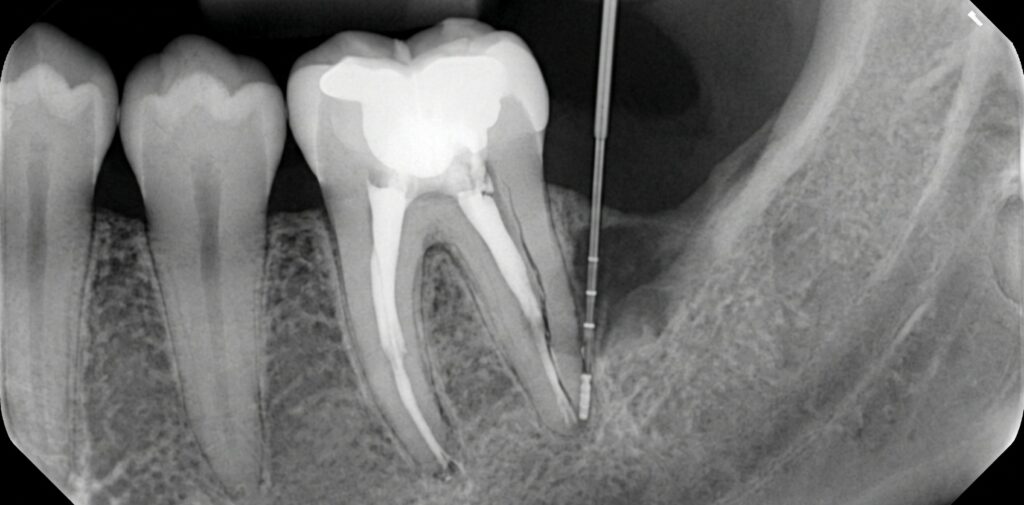
What decides whether a tooth can be kept?
It depends, among other things, on how much of the mobility disappears after treatment. Mobility that persists is one of the prognostic factors; the amount of bone left is assessed separately.
Once the pockets have been cleaned by closed or open curettage, that is after basic periodontal treatment, mobility measured a year later drops markedly. Seven out of ten teeth mobile in degree I return to full stability, and among teeth in degree II more than four out of ten do. This was counted retrospectively, from the records of patients at eight American university clinics. The result therefore comes from treatment records, not from the conditions of a clinical trial.
The more mobile the tooth, the greater the risk of losing it, and this shows in the mobility itself as well: among teeth in degree III, roughly one in five regained full stability after a year, and more than nine out of ten improved by at least one degree.
About five teeth per hundred present at the start of supportive care were lost, and that is what came out in one private practice which followed its patients for thirty years, with a rigorous recall programme every three to six months. In that cohort, mobility was associated with tooth loss only from degree II upwards, although another paper records an increase in risk already from degree I. In our dental practice at Modern Dental & Orthodontics (Klinika MDO) we observe that the first measurement is sometimes misleadingly poor, and the second one, taken once the inflammation has settled, changes the decision about the tooth.
With the inflammation settled, vertical mobility that persists or a pocket reaching the area of the root apex requires an individual periodontal assessment; in selected cases advanced treatment makes it possible to keep the tooth long term. A fractured root needs a separate assessment, one that depends on the type and location of the fracture.
What reduces a tooth's chances: mobility that has not decreased after periodontal treatment; a pocket that has stayed deep after it; furcation involvement between the roots of a multi-rooted tooth; smoking; diabetes. From that list, the patient changes the most with smoking.
Loose teeth: when a splint only postpones the decision
A splint does not treat the cause of the teeth being loose: it glues several teeth into one block in order to distribute chewing forces and restore comfort when biting, and that is less than the word "stabilisation" suggests.
Attachment and pocket depth changed similarly in splinted teeth and in teeth without a splint, and fewer than one third of the splints survived a decade without fracture, debonding or repair. Loose posterior teeth were observed in this way for ten years, alongside unsplinted teeth in the same patients.
That study, however, covered only 24 people. The splinted teeth in it were in worse condition at the start than those they were compared with. The second paper covered only teeth with mobility of zero or degree I. In procedures that regenerate bone, it showed no advantage of splinting either after one year or after three years. Neither of these papers assesses separately what joining a degree III tooth into a block achieves — that is, the very situation in which a splint is most often proposed.
Tooth splinting therefore makes sense when mobility interferes with eating or when a tooth has to be held still while it heals. Not when it is meant to replace treating the cause: a splint placed over uncontrolled inflammation hides the sign by which the progress of the disease is recognised, and makes cleaning between the teeth harder, so it is worth asking before the procedure what daily hygiene underneath it will look like.
Mobility is a symptom, not a diagnosis
Loose teeth have no treatment of their own, because what is treated is whatever caused the mobility, and that is something different every time. What stays the same is the order: mobility has to be assessed again once the inflammation has settled, and the decision about the tooth has to rest on the periodontal examination and the radiographic picture as well. If we reverse that order, we lose teeth that could have been kept for years yet.
Frequently asked questions
Can a loose tooth tighten up on its own?
Sometimes it does, but rarely without treatment. Mobility caused by swelling of the periodontal ligament subsides within weeks, but only after the inflammation has been brought under control or the overload has been removed. Mobility resulting from bone loss does not resolve on its own, because bone does not grow back spontaneously. Delay improves nothing here, and usually worsens the starting point.
Does a moving tooth always mean periodontitis?
No. Periodontal disease is the most common cause in an adult, but not the only one. Loose teeth are also caused by injury, occlusal overload, an abscess coming from the pulp, a lesion linking a diseased periodontium with a dead pulp, and root fracture. The cause is decided by examination: pocket measurement, a pulp vitality test and a radiograph.
How long can you put off an appointment for a mobile tooth?
It depends on what accompanies the mobility. Mobility after an injury, or together with swelling, fever or pus, requires contact with the practice the same day. Mobility that has been increasing over weeks requires an appointment within the week. Mobility that has been stable for years, with no bleeding and no pain, can wait until the next check-up.
Can a loose tooth still be used to support a bridge?
Sometimes, though rarely as the only abutment. A mobile tooth transfers to its neighbours forces it does not carry itself, so a bridge resting on such an abutment loads the whole structure, and the decision is made after periodontal treatment and after mobility has been measured again, never on the basis of the state before treatment.
Can an injury make a tooth mobile without a visible fracture?
Yes, and this is a typical situation. A blow tears some of the fibres holding the root without damaging the crown. The tooth then needs immobilisation and follow-up over the coming months. The colour of the crown, the response to a vitality test and the radiographic picture are checked. Darkening of the tooth after some weeks is a reason for an urgent check.
What happens in the first weeks after a tooth is stabilised?
For the first few days the tooth may be tender on biting. The splint then feels rough to the tongue. The gum around the joined teeth needs flossing with a floss threader — ordinary floss does not pass between the teeth. A check-up after two weeks verifies the seal and the occlusion. Mobility decreases gradually over several weeks.
Read more:
- Periodontist in Warsaw Wola — periodontal treatment at Modern Dental & Orthodontics
- Periodontitis: symptoms, causes and modern treatment methods
- Advanced periodontitis and implants - when to save teeth and when to replace them
- Closed vs open curettage — a comparison of methods for treating advanced periodontitis
- Bone regeneration around teeth
Content and liability disclaimer
This article is informational and educational in nature and does not constitute medical advice, a diagnosis or a therapeutic recommendation — it does not replace a consultation with a specialist. If you are experiencing symptoms, have doubts or are facing a decision about treatment, consult a dentist. The methods described and the data cited are general in nature. The results of scientific studies relate to populations, not to an individual patient. The course and outcome of therapy depend on the individual clinical situation and may vary between patients. No information contained in this article constitutes a guarantee of result. The content has been prepared with due care, based on publicly available medical knowledge and the scientific publications indicated in the Sources section. We do not advise taking or refraining from any health-related action solely on the basis of the content of this article, without prior consultation with a doctor.
Sources
Source 1
Links https://doi.org/10.1002/jper.70046 │ https://pubmed.ncbi.nlm.nih.gov/41553866/
Description Chatzopoulos GS, Wolff LF. „Change in tooth mobility following non-surgical periodontal therapy: A retrospective cohort study of clinical outcomes.” Journal of Periodontology. 2026;97(7):1388-1394.
Source 2
Links https://doi.org/10.1111/jcpe.14027 │ https://pubmed.ncbi.nlm.nih.gov/38986602/
Description Shi S, Meng Y, Jiao J, Shi D, Feng X, Meng H. „A nomogram-based predictive model for tooth survival in Chinese patients with periodontitis: An 11-year retrospective cohort study.” Journal of Clinical Periodontology. 2024;51(10):1384-1394.
Source 3
Links https://doi.org/10.1111/jcpe.13951 │ https://pubmed.ncbi.nlm.nih.gov/38317331/
Description Chen X, Xu C, Wu Y, Zhao L. „The survival of periodontally treated molars in long-term maintenance: A systematic review and meta-analysis.” Journal of Clinical Periodontology. 2024;51(5):631-651.
Source 4
Links https://doi.org/10.1111/jcpe.13770 │ https://pubmed.ncbi.nlm.nih.gov/36631984/
Description Agudio G, Buti J, Bonaccini D, Pini Prato G, Cortellini P. „Longevity of teeth in patients susceptible to periodontitis: Clinical outcomes and risk factors associated with tooth loss after active therapy and 30 years of supportive periodontal care.” Journal of Clinical Periodontology. 2023;50(4):520-532.
Source 5
Links https://doi.org/10.1007/s00784-024-05679-2 │ https://pubmed.ncbi.nlm.nih.gov/38683397/
Description Sonnenschein SK, Kilian S, Ruetters M, Ciardo A, Kim TS. „Changes in periodontal parameters of splinted versus non-splinted posterior teeth during ten years of supportive periodontal therapy – A retrospective evaluation.” Clinical Oral Investigations. 2024;28(5):283.
Source 6
Links https://doi.org/10.1111/jcpe.14190 │ https://pubmed.ncbi.nlm.nih.gov/40474381/
Description Mikami R, Ishimaru M, Mizutani K, Shioyama H, Matsuura T, Aoyama N, Suda T, Kusunoki Y, Takeda K, Anzai T, Takahashi K, Matsuo K, Aida J, Izumi Y, Aoki A, Iwata T. „Effect of Tooth Splinting on Clinical Outcomes following Periodontal Regenerative Therapy in Teeth with Mobility Degree 1 or 0: A Propensity Score-Matched Analysis.” Journal of Clinical Periodontology. 2025;52(9):1254-1262.
Source 7
Links https://doi.org/10.1007/s00784-025-06506-y │ https://pubmed.ncbi.nlm.nih.gov/40875065/
Description Hui S, Hong Y, Chen S, Bao Y, Song J, Zhao Y, Tang X. „Efficacy of maxillary occlusal splints on mobile posterior teeth in patients with stage III or IV periodontitis during steps 1 and 2 of periodontal therapy: a randomized parallel-controlled clinical trial.” Clinical Oral Investigations. 2025;29(9):425.