
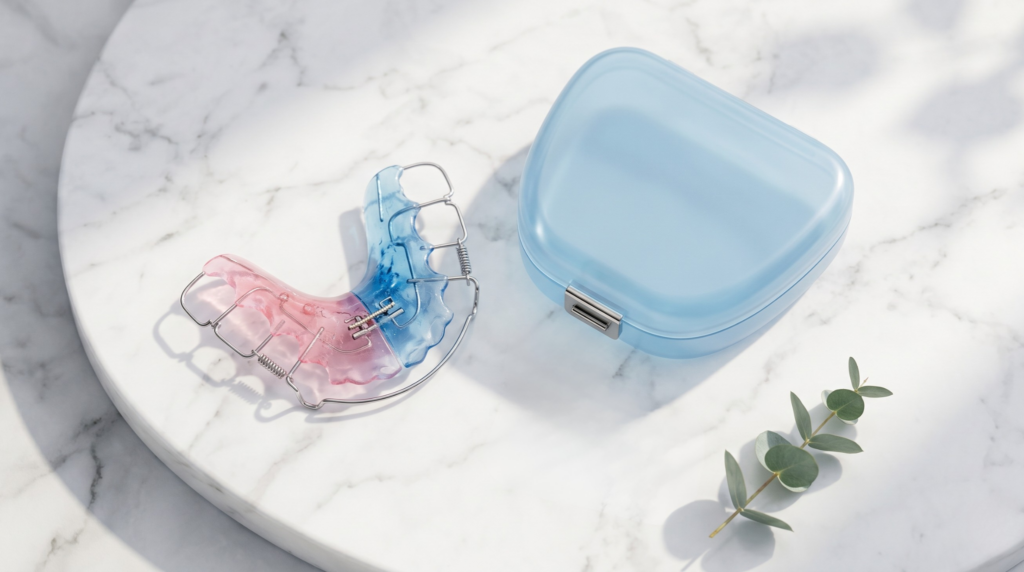
A functional appliance (i.e. a removable orthodontic device that harnesses the child's own muscular forces) and fixed braces are not two competing products from which one chooses the cheaper option. They are two different types of treatment, addressing different stages of a child's development and resolving different problems. In this article we explain how a functional appliance works, when it is used, why the age window of 7–11 years is so important, and — most crucially — what the success of treatment truly depends on.
What is a functional appliance — a clinical definition
A functional appliance is a removable orthodontic device that uses the internal forces of the child's muscular system — the muscles of mastication, the tongue and the cheeks — to guide jaw growth and tooth positioning during the period of active craniofacial growth. Unlike fixed braces, which mechanically move individual teeth, a functional appliance acts systemically: it influences how the mandible and maxilla grow. It is used primarily in children aged 7–14.
The most commonly used types of functional appliance
In Polish and European orthodontic practices the following designs are most frequently encountered:
- Twin-block — a two-piece appliance with acrylic blocks, most commonly used in Class II malocclusion (a retruded mandible); children generally tolerate it well because the design is stable and does not significantly impede speech after the initial wearing period.
- The activator (classic monoblock) — serves a similar function to the twin-block, is a single-piece design, and is sometimes more challenging to maintain during speech.
- Klammt appliance — with open acrylic surfaces, giving the child greater freedom of speech; often chosen for children who are particularly sensitive to loss of clear articulation.
- Schwarz appliance — with an expansion screw to widen the palate; used when the maxilla is narrow, often combined with other treatment elements.
- Herbst appliance — structurally similar to a fixed functional appliance (with bilateral telescopic pistons), with documented efficacy in Class II malocclusion in adolescents after the pubertal growth spurt; data from a meta-analysis (Xu et al., BMC Oral Health 2024) indicate efficacy comparable to the twin-block with better compliance control.
The decision regarding which appliance to use for a given child is made by the orthodontist after a full diagnostic work-up: a lateral cephalometric radiograph, a panoramic radiograph, dental models (analogue or digital from an intraoral scan), assessment of biological development, and — equally importantly — an honest conversation about the realities of the child's daily life.
How does it work biologically?
The key is that a child aged 7–14 is still growing. The bones of the maxilla and mandible are not yet fully formed, and their rate of growth can be actively modulated. A functional appliance does not "pull" an individual tooth — it changes the muscular environment in which the bone grows. If the appliance holds the mandible in a protruded position for many hours a day, the biological signal sent to the growth cartilages stimulates them to proliferate further in that direction. This is a mechanism that cannot be reproduced in an adult, in whom bone growth has already been completed.
Hence the philosophical difference: fixed braces in a teenager or adult move teeth within existing, mature bone. A functional appliance in a child modifies how that bone develops. Two entirely different biologies and two different tools — neither of which is "better", but each of which is appropriate in its own time window.
The growth window of 7–11 years — why it is so important
In orthodontics we speak of a "growth window" — the period during which the child is growing fast enough for a functional intervention to be worthwhile, yet the structures are already sufficiently mature to retain the appliance effectively. For most children the window opens at around age 7 (when the first permanent molars and incisors erupt) and closes gradually between age 11 and 13, around the time of the pubertal growth spurt.
What does this mean in practice? A malocclusion that can be resolved with a functional appliance in 10–14 months at the age of 9 would typically require 18–24 months of fixed braces at the age of 16 — sometimes with additional support from orthodontic mini-screws (TADs). The same malocclusion identified at the age of 25 may require combined surgical-orthodontic treatment (orthognathic surgery), which we discuss in a separate article. The earlier a parent brings the child to the orthodontist, the more tools the treating team has at its disposal.
Table: age → treatment goal → appliance type → required compliance
The table below sets out what is used at which age. It is not a ready-made plan for a specific child — every treatment is designed individually after a full diagnostic assessment — but it gives the parent a general picture of what to expect.
| Child's age | Typical treatment goal | Most commonly used appliance | Required compliance |
|---|---|---|---|
| 4–6 years (early) | Correction of oral habits (thumb sucking, mouth breathing), preliminary palatal expansion in selected cases | Myofunctional appliances, small removable devices | Low — mainly night-time wear |
| 7–9 years (mixed dentition I) | Correction of crossbite, palatal expansion, elimination of parafunctions | Activator, Klammt, Schwarz appliance, twin-block | Moderate — 14+ hours/day |
| 10–12 years (mixed dentition II / pre-pubertal) | Correction of skeletal Class II/III, correction of vertical bite | Twin-block, activator, hybrid appliances (functional + fixed components) | High — 14–16 hours/day |
| 12–14 years (pubertal) | Utilising the final months of growth; often combining functional with fixed appliances | Functional appliance → transition to fixed braces; in some patients functional clear aligners are an alternative | High — success depends most on the child |
| 14+ (post-pubertal growth spurt) | Functional appliance usually ineffective — treatment with fixed braces | Fixed braces (conventional or Invisalign Teen) | Fixed braces work continuously — compliance less critical |
What does the current evidence say — efficacy assessment
The highest-quality evidence in this field comes from a Cochrane review (Batista et al., 2018), which summarised randomised controlled trials on the treatment of Class II malocclusion (protruding upper incisors, the most common malocclusion requiring intervention in children). The conclusions from this review are more nuanced than marketing messages tend to be.
- Early treatment at age 7–11 (Phase I, i.e. intervention before the pubertal growth spurt) leads in the longer term to a similar occlusal outcome as treatment deferred to the teenage years. In other words: for the final tooth alignment itself, early treatment does not confer a significant advantage over later treatment with fixed braces — most studies show that the end result after both approaches is comparable.
- Early treatment significantly reduces the risk of trauma to the upper incisors — children with protruding incisors are more vulnerable to impact, fracture or avulsion during falls, sport or play. Reducing the overjet (the horizontal distance between the upper and lower incisors) early therefore serves a protective function.
- Early treatment in some children improves self-esteem and social comfort during the school years — a factor that does not always appear in randomised trials but is important in clinical practice.
The decision to proceed with early treatment should therefore not rest solely on the promise of a "better final result". It should take into account: the degree of incisor protrusion (and therefore the risk of trauma), the child's psychosocial comfort, family readiness for compliance, and the individual growth pattern.
Compliance — the factor behind success (and failure)
Here we arrive at the most important and most difficult aspect of the entire topic. A functional appliance works only when it is actually worn. That sounds trivial, but it is the central issue of the entire treatment — and the most common cause of its failure.
Recommendations for most types of functional appliance specify a minimum of 14 hours of wear per day — that is, the entire period of sleep plus a few additional hours at home. Some appliances require 16–18 hours; some (for example the twin-block during the active mandibular advancement phase) — virtually the entire day with the exception of meals, tooth brushing and vigorous physical activity. The more hours, the faster the effect. An appliance worn for 6 hours a day produces no effect — on the contrary, the patient loses months of treatment and returns to the starting point.
From our orthodontic practice at Modern Dental & Orthodontics we observe a very clear correlation: children who wear the appliance as instructed from day one achieve the planned treatment result in 10–14 months. Children who wear it irregularly (8–10 hours instead of 14+) often do not achieve the effect even after 18 months — and sometimes the decision has to be made to switch to fixed braces or surgical-orthodontic treatment.
What helps children maintain compliance?
- A conversation with the child at the first appointment — not with the parent over the child's head, but with the child. The orthodontist explains in their own words what the appliance is for and what it does. Children who understand the purpose cooperate significantly better than those who simply "have to".
- A well-designed appliance — comfortable, non-traumatic, well-fitted. An appliance that hurts every time it is put in will be hidden in a drawer by the child.
- The first weeks with a wearing diary — a shared notebook for parent and child in which the daily hours are recorded. This builds a routine and helps the parent monitor without interrogation.
- A realistic approach from the parent — without pressure of "you have to wear it", without punishment for forgetting. An atmosphere of tension around the appliance almost always worsens compliance.
- Regular check-ups every 6–8 weeks — the child sees progress, the orthodontist activates the appliance, the parent receives external confirmation that the plan is on track.
What parents need to know before starting treatment
A functional appliance is an investment of time and commitment from the entire family — not just the child. Before deciding, it is worth considering a few practical aspects.
- The first two weeks after fitting the appliance are the hardest — the child complains, speaks less clearly, may have increased salivation. This is natural and passes. Giving up during these two weeks is the most common point of treatment failure.
- A functional appliance is not "invisible". The child may be asked at school why they speak differently. It is worth talking to the child about this beforehand, and possibly involving the class teacher.
- Appliance hygiene is simple — daily brushing with a toothbrush; periodically we recommend soaking in a cleaning-tablet solution. The appliance is not expensive to maintain.
- After functional treatment some children transition to fixed braces (usually for fine-tuning individual teeth during adolescence). This does not mean the first phase "failed" — it means the functional appliance achieved its goal (jaw alignment), and the fixed appliance completes the details (individual tooth alignment).
- After functional treatment, just as after fixed braces, retention is necessary — we discuss the details in our article on retainers after orthodontics.
FAQ — the most frequently asked questions from parents about functional appliances
How many hours a day does the child need to wear the functional appliance?
For most types of functional appliance the recommendation is a minimum of 14 hours per day, i.e. the entire period of sleep plus a few hours at home. The twin-block during the active advancement phase may require up to 18–20 hours. In the practice of the Modern Dental & Orthodontics team we observe that consistency of wear is more important than the exact number of hours — a child who wears the appliance every night without exception achieves better results than one who occasionally wears it "all day" and then takes two days off.
Does wearing the functional appliance hurt?
A properly designed appliance does not cause pain — it may, however, cause discomfort during the first days of wear: tension in the muscles of mastication, a sensation of pressure on the teeth and mild speech difficulties. These symptoms usually resolve within 5–7 days. If pain persists, the appliance may need adjustment — the child should be brought for a check-up, not forced to keep wearing a poorly fitting device.
Will a functional appliance replace fixed braces?
In some children — yes, if the malocclusion was identified early and compliance was good. In a proportion of patients the functional appliance constitutes the first phase of treatment (jaw correction), after which a second phase with fixed braces follows (individual tooth alignment). This is not "double treatment" — it is a logical two-stage plan. The orthodontist discusses the likely scenario at the start.
Does the functional appliance affect the child's speech?
Yes — in the first days of wear, speech is less clear; the child may have difficulty with sibilant consonants (s, sh) and with articulation at the front of the mouth. This is a temporary effect — the tongue and the muscles adapt within 5–10 days. If speech difficulties persist beyond 2 weeks, the fit of the appliance should be reassessed.
What should I do if the child does not want to wear the appliance?
This is a real problem that is worth discussing openly with the orthodontist — rather than concealing. The first step is to establish the cause (does the appliance hurt, is the child embarrassed, or is it simply an inconvenience). Then a realistic plan is needed: a modified wearing schedule, an adjustment of the appliance, a change of design, or — in some cases — a decision to switch to fixed braces. Forcing the child against their will is rarely effective.
Will the functional appliance eliminate the need for fixed braces?
Sometimes yes, sometimes no — and this is a question that can honestly be answered only after the functional phase has been completed. In children in whom the functional appliance achieved both skeletal correction and adequate tooth alignment, fixed braces may not be necessary. In others, a short phase of fixed braces for final detailing is the optimal approach. The orthodontist discusses the prognosis at the outset, but the definitive decision is made during treatment.
At what age is it best to start treatment with a functional appliance?
The optimum usually lies between the ages of 8 and 11, i.e. during the mixed-dentition period, when craniofacial growth is active and the structures are already sufficiently mature for the appliance to work. Starting too early (age 5–6) means the child has to wear the appliance for a very long time with a high risk of loss of motivation. Starting too late (after the pubertal growth spurt) means the biological window for skeletal modification has closed.
Does the functional appliance affect the temporomandibular joints?
Current meta-analyses (Minervini et al., BMC Oral Health 2024) do not confirm an increased risk of long-term temporomandibular disorders in children treated with functional appliances. The opposite is sometimes true — correction of a Class II malocclusion may reduce abnormal loading of the joints and improve their long-term function.
Can the child eat normally during treatment?
Yes, because the functional appliance is removable — the child takes it out at mealtimes and eats normally. This is an important advantage over fixed braces, where dietary restrictions apply (no nuts, no hard sweets, no chewing gum). After the meal the child brushes their teeth and puts the appliance back in.
Is the functional appliance covered by the NFZ (Polish national health fund)?
NFZ reimbursement covers selected removable appliances for children up to the age of 12 within a limited range of indications. The exact scope and conditions of reimbursement should be verified directly with the orthodontist or the local NFZ branch, as the regulations change. In the practice of the Modern Dental & Orthodontics team we always inform parents about the available reimbursement options.
Key takeaways
- A functional appliance is not a "cheaper version" of fixed braces — it is a different tool for a different task, operating within the growth window of 7–14 years.
- The first screening visit to the orthodontist is recommended at around age 7, regardless of whether the teeth "look fine" or not.
- Treatment success depends 70% on the child's compliance — a minimum of 14 hours of wear per day, every day.
- Current Cochrane data indicate that early treatment does not confer a significant advantage in the final occlusal result itself, but clearly reduces the risk of trauma to protruding incisors and may improve the child's psychosocial comfort.
- After the functional phase, some children proceed to a shorter fixed-braces stage for final detailing — this is not failure but a logical continuation of the treatment plan.
Read more:
- Orthodontist Warsaw Wola 🡪 klinikamdo.pl/en/offer/orthodontist/
- Child grinds teeth at night — when is it an orthodontic problem? 🡪 https://klinikamdo.pl/en/blog/child-teeth-grinding-bruxism-orthodontics/
- Child breathes through the mouth — when is it a matter for the orthodontist? 🡪 https://klinikamdo.pl/en/blog/child-mouth-breathing-orthodontics/
- What does getting braces look like? A step-by-step guide 🡪 https://klinikamdo.pl/en/blog/getting-braces-step-by-step-guide/
- Braces for children — when to start orthodontic treatment? 🡪 https://klinikamdo.pl/en/blog/braces-for-children-when-to-start/
Sources
Source 1
Links https://doi.org/10.1002/14651858.CD003452.pub4 │ https://pubmed.ncbi.nlm.nih.gov/29534303/ │ https://www.ncbi.nlm.nih.gov/pmc/articles/PMC6494411/
Description Batista KB, Thiruvenkatachari B, Harrison JE, O’Brien KD. „Orthodontic treatment for prominent upper front teeth (Class II malocclusion) in children and adolescents.” Cochrane Database Syst Rev. 2018;3(3):CD003452.
Source 2
Links https://doi.org/10.1371/journal.pone.0141198 │ https://pubmed.ncbi.nlm.nih.gov/26510187/ │ https://www.ncbi.nlm.nih.gov/pmc/articles/PMC4624952/
Description Perinetti G, Primožič J, Franchi L, Contardo L. „Treatment Effects of Removable Functional Appliances in Pre-Pubertal and Pubertal Class II Patients: A Systematic Review and Meta-Analysis of Controlled Studies.” PLoS One. 2015;10(10):e0141198.
Source 3
Links https://doi.org/10.1186/s12903-024-04027-w │ https://pubmed.ncbi.nlm.nih.gov/38409017/ │ https://www.ncbi.nlm.nih.gov/pmc/articles/PMC10895725/
Description Xu F, Fang Y, Sui X, Yao Y. „Comparison of Twin Block appliance and Herbst appliance in the treatment of Class II malocclusion among children: a meta-analysis.” BMC Oral Health. 2024;24(1):278.
Source 4
Links https://doi.org/10.1111/ocr.12908 │ https://pubmed.ncbi.nlm.nih.gov/40008555/ │ https://onlinelibrary.wiley.com/doi/10.1111/ocr.12908
Description Ghorbani M, Mousavi SA, Bardideh E, Saeedi P, Shahnaseri S, Shafaee H, Akyalcin S. „The Effectiveness of Functional Clear Aligners for Class II Correction in Growing Patients: A Systematic Review and Meta-Analysis.” Orthod Craniofac Res. 2025;28(4):577-592.
Source 5
Links https://doi.org/10.1016/j.ejwf.2020.04.003 │ https://pubmed.ncbi.nlm.nih.gov/32672656/ │ https://www.sciencedirect.com/science/article/pii/S2212443820300205
Description Moro A, Mattos CFP, Borges SW, Flores-Mir C, Topolski F. „Stability of Class II corrections with removable and fixed functional appliances: A literature review.” J World Fed Orthod. 2020;9(2):56-67.
Source 6
Links https://doi.org/10.1186/s12903-023-03738-w │ https://pubmed.ncbi.nlm.nih.gov/38281907/ │ https://www.ncbi.nlm.nih.gov/pmc/articles/PMC10822183/
Description Minervini G, Di Blasio M, Franco R, Marrapodi MM, Vaienti B, Cicciù M, Ronsivalle V. „Prevalence of temporomandibular disorders diagnosis in patients treated with Herbst appliance: a systematic review and meta-analysis.” BMC Oral Health. 2024;24(1):137.